Article 164 and Minister Qualification Norms in Supreme Court
Source:livelaw ↗
Why It Matters
The article exemplifies the practical application of Article 164(4) and the Supreme Court's guardrails against the backdoor entry of non-legislators into the executive. Understanding constitutional remedies like the writ of quo warranto and state legislative procedures is highly relevant for BPSC Prelims Polity questions.
Summary
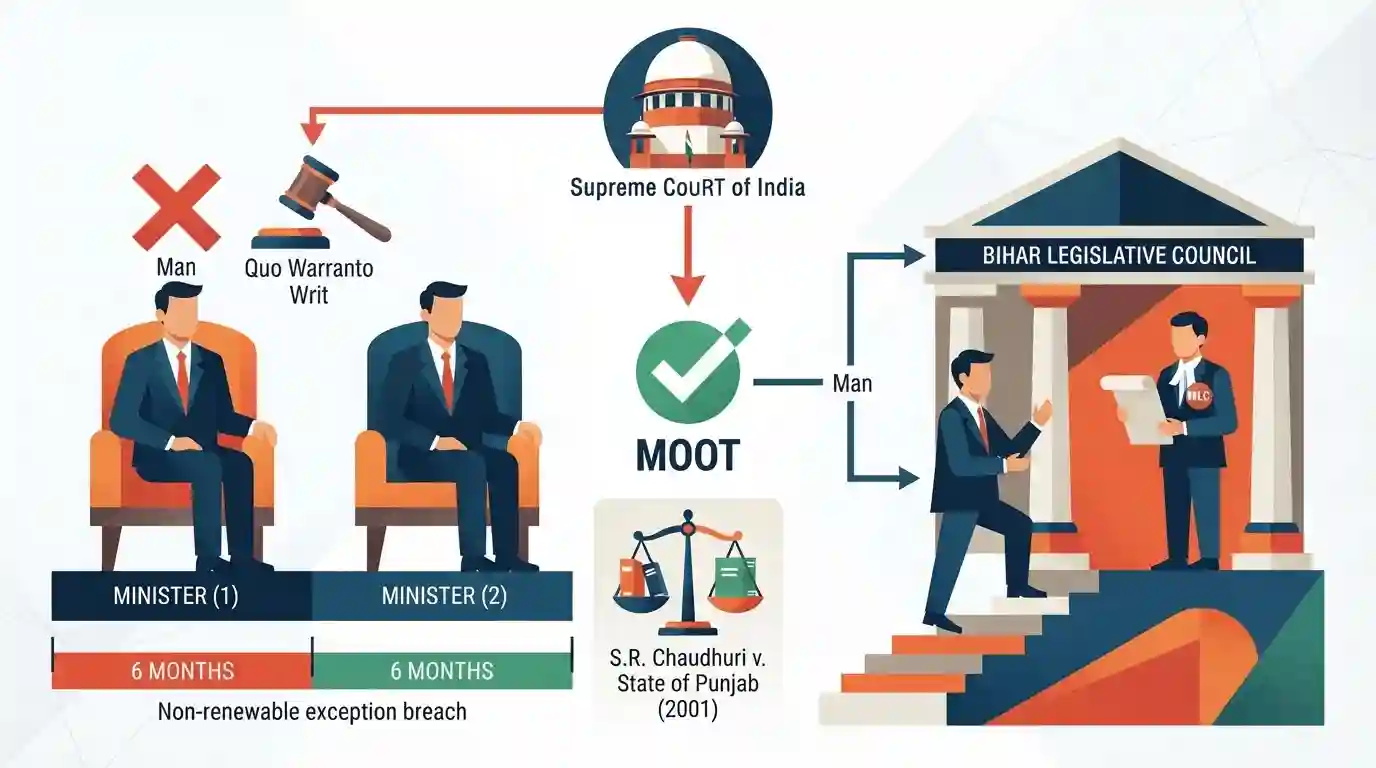
A writ of quo warranto challenged the continuation of Bihar Minister Deepak Prakash, who was appointed as a minister in consecutive cabinets without securing a legislative seat within the six-month window prescribed by Article 164(4). Relying on the precedent set by S.R. Chaudhuri v. State of Punjab (2001), petitioners argued that the six-month exception is non-renewable and cannot be circumvented via cabinet reshuffles. The Supreme Court was informed that the defect was cured after Prakash was nominated as a Member of the Legislative Council (MLC) and took a fresh oath, rendering the disqualification moot.
Key Points
- Article 164(4) of the Constitution permits a non-legislator to serve as a Minister for a maximum of six consecutive months without being elected to the state legislature.
- In S.R. Chaudhuri v. State of Punjab (2001), the Supreme Court ruled that the six-month grace period cannot be bypassed by repeatedly re-appointing a non-legislator following a resignation or cabinet dissolution.
- A quo warranto writ petition challenged Bihar Minister Deepak Prakash's continuation in office after he exceeded the six-month limit following consecutive appointments under Chief Ministers Nitish Kumar and Samrat Choudhary.
- The constitutional defect was ultimately cured by nominating Deepak Prakash as a Member of the Legislative Council (MLC) and administering a fresh oath of office.
Important Terms
Article 164(4) of the Constitution of India

A constitutional provision allowing an unelected person to be appointed as a state minister for up to six consecutive months, during which they must secure membership of the state legislature to remain in office.
UPSC context
Relevant for GS Paper 2 (State Executive). Tests understanding of parliamentary democracy and constraints on unelected individuals holding ministerial positions.
Writ of Quo Warranto
A prerogative writ meaning 'by what authority,' issued by courts to challenge a person's claim to a substantive public office and prevent them from unlawfully usurping or holding it without proper legal authorization.
UPSC context
Essential for GS Paper 2 (Constitutional Remedies/Writs). Tests knowledge of Articles 32 and 226 regarding judicial checks on unlawful public office occupation.
Legislative Council
The upper house in states with a bicameral legislature, created or abolished under Article 169. It is a permanent body comprising indirectly elected and nominated members representing graduates, teachers, local bodies, and MLAs.
UPSC context
Crucial for GS Paper 2 (State Legislature). Tests knowledge of state bicameralism, Article 169 provisions, and the composition of the upper house.
Prelims Trap
"A non-legislator minister must be elected to the State Legislature within six consecutive months."
The constitutional requirement is to become a *member* of the legislature. This includes being nominated to the Legislative Council by the Governor, not strictly being elected.
Static Concepts Connected
What rules govern the appointment of non-legislators as Ministers?
- Article 164(4): A Minister who is not a member of the State Legislature for six consecutive months ceases to be a Minister at the expiration of that period.
- Non-renewable Grace: S.R. Chaudhuri v. State of Punjab (2001) ruled that the six-month grace period is non-renewable and cannot be bypassed by re-appointment following resignation or cabinet dissolution.
- Nomination is Valid: Acquiring membership can be achieved through direct election, indirect election, or nomination by the Governor to the State Legislative Council.
What are the essential conditions for issuing a writ of Quo Warranto?
- Public Office: The office in question must be substantive, public in nature, and created by a statute or the Constitution itself.
- Locus Standi: Unlike Mandamus or Certiorari, it can be sought by any public-minded person, not exclusively the aggrieved party whose rights have been infringed.
- No Private Office: It cannot be issued against a purely private office or an office of a private association/corporation.
Cross-Topic Patterns
Nomination Powers vs Executive Accountability
UPSC often links Article 164(4) constraints to the Governor's power to nominate MLCs under Article 171(5), questioning whether nominations are misused to bypass electoral mandates or constitutional limits.
Quo Warranto vs Judicial Review
While Quo Warranto strictly challenges the statutory/constitutional eligibility to hold office, courts generally avoid reviewing the 'merits' of the Governor's subjective satisfaction in nominating a member to the Council.

A 2026 Prelims question will likely fuse Article 164(4) exceptions, S.R. Chaudhuri precedent, and the Governor's nomination power into one multi-statement item.
Linked PYQs · 4
Linked PYQs · 4
- 2024-IBPSC_PRELIMSGS1
Which of the following Constitutional Amendment in India has decided the maximum strength of the Council of Minister with Chief Minister in a State?
- 2025BPSC_PRELIMSGS1
Which one of the following subjects fall within the jurisdiction of both High Court and Supreme Court?
- 2019BPSC_PRELIMSGS1
Which one of the following constitutional remedies is also known as 'postmortem'?
- 2023BPSC_PRELIMSGS1
The Council of Ministers in a State is collectively responsible to
