Banking Sector Reforms and FDI Limit Revision Proposals
Source:Indian Express ↗
Why It Matters
Understanding the constraints faced by the banking sector, such as FDI caps and rigid Priority Sector Lending norms, provides crucial context for answering GS3 questions on banking reforms, investment models, and structural changes needed in the Indian economy.
Summary
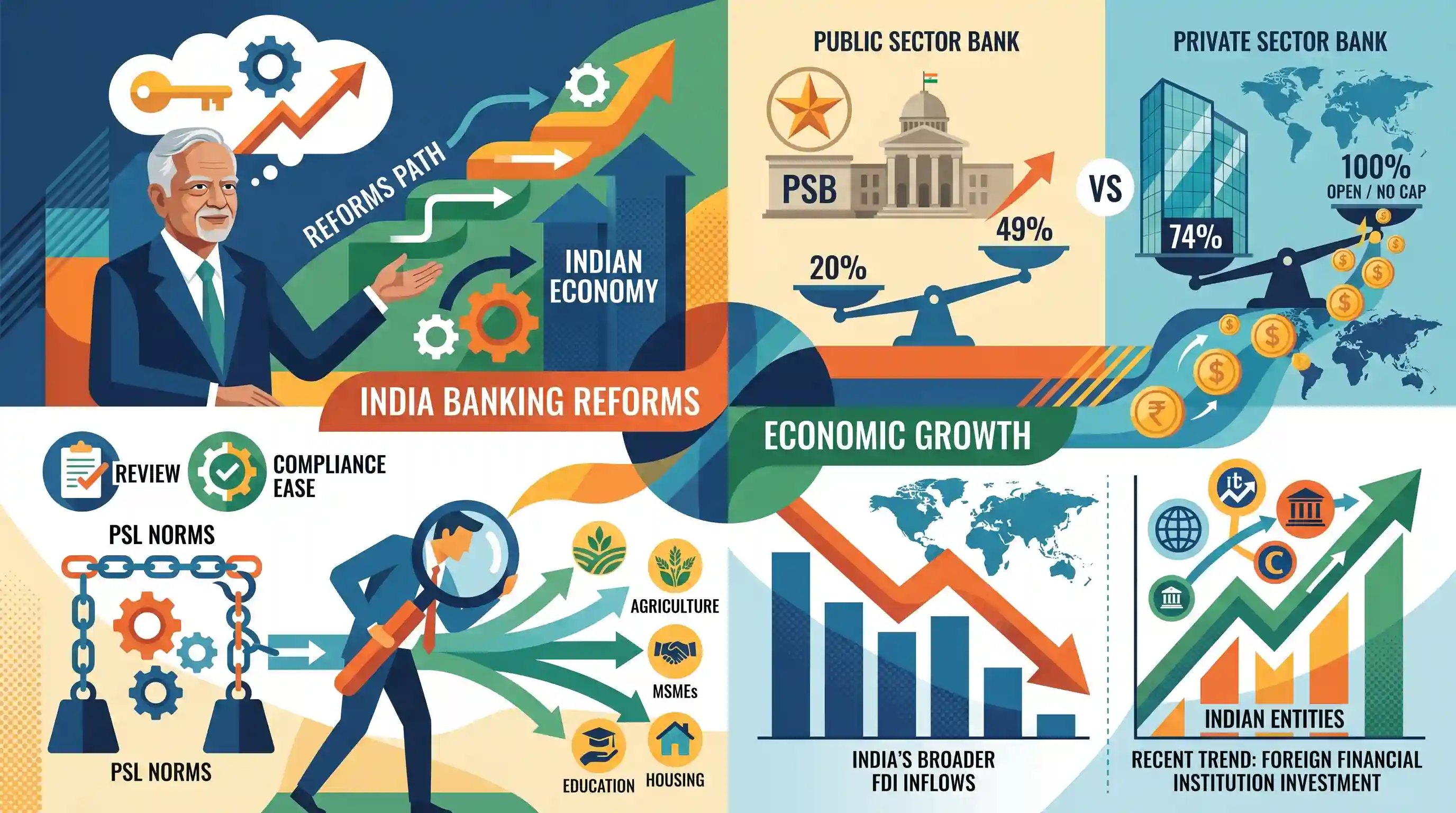
Former HDFC Chairman Deepak Parekh has called for significant banking sector reforms in India, emphasizing the need to grant banks greater operational freedom. He proposed raising the Foreign Direct Investment (FDI) limit in public sector banks to 49% and completely removing the 74% cap on private sector banks to attract global capital. Additionally, he suggested a comprehensive review of Priority Sector Lending (PSL) norms to reduce the compliance burden on banks. These recommendations align with recent trends of foreign financial institutions investing in Indian entities despite an overall recent slowdown in India's broader FDI inflows.
Key Points
- Deepak Parekh advocated for increasing the FDI limit in public sector banks from 20% to 49%, and removing the 74% cap on private banks to attract more foreign capital.
- He suggested a review of Priority Sector Lending (PSL) norms, pointing out that strict sub-limits and reporting requirements are overly burdensome for banks.
- The comments come against the backdrop of recent foreign investments in the Indian financial sector, such as MUFG investing in Shriram Finance and SMBC in Yes Bank.
- Overall FDI inflows to India have slowed due to geopolitical uncertainties, with net FDI outflows recorded for a sixth month in January, highlighting the need for regulatory easing.
Important Terms
Priority Sector Lending (PSL)

An RBI framework requiring banks to allocate a specified percentage of credit to development-critical sectors like agriculture, MSMEs, education, and housing to ensure inclusive financial growth.
UPSC context
GS Paper III (Indian Economy); tests knowledge of credit-flow mechanisms to underserved sectors and inclusive growth strategies.
Reserve Bank of India (RBI)
India's central bank and primary regulator of the financial system, responsible for formulating monetary policy, managing foreign exchange, and supervising the banking sector.
UPSC context
GS Paper III (Indian Economy); essential for understanding monetary stability, regulatory frameworks, and banking oversight.
HDFC
India's premier housing finance institution (merged with HDFC Bank in 2023). Its former chairman, Deepak Parekh, is a prominent advocate for banking sector liberalization.
UPSC context
GS Paper III (Economy); relevant for studying the evolution of Indian banking and the role of specialized financial institutions.
Shriram Finance
A major Indian Non-Banking Financial Company (NBFC) that recently received the largest cross-border investment in India's financial sector from Japan's MUFG Group.
UPSC context
GS Paper III (Economy); illustrates the growing role of NBFCs and foreign capital in the Indian credit market.
Yes Bank
A private sector Indian bank that recently attracted a 20% foreign investment stake from Japan’s Sumitomo Mitsui Banking Corporation (SMBC) as part of its capital growth strategy.
UPSC context
GS Paper III (Economy); tests understanding of bank reconstruction, foreign investment caps, and private sector banking resilience.
RBL Bank
A private sector Indian bank in which UAE's Emirates NBD recently acquired a 60% majority stake, marking a significant milestone in India's banking FDI.
UPSC context
GS Paper III (Economy); relevant for FDI limits and the internationalization of India's private banking sector.
MUFG
A major Japanese financial services group that recently invested ₹40,000 crore in Shriram Finance, highlighting the trend of global capital entering Indian credit markets.
UPSC context
GS Paper III (Economy); serves as a case study for Foreign Portfolio and Direct Investment in the finance sector.
Emirates NBD
A leading UAE-based bank that acquired a controlling interest in RBL Bank, reflecting deepening economic ties and remittance corridors between India and the Middle East.
UPSC context
GS Paper III (Economy); relevant for studying bilateral economic relations and cross-border financial acquisitions.
Prelims Trap
"Foreign Direct Investment in Public Sector Banks is permitted up to 74% under the automatic route."
Aspirants often mix Private and Public bank limits. Current FDI in Public Sector Banks is capped at 20% strictly through the government approval route.
Static Concepts Connected
What are the current Priority Sector Lending (PSL) targets?
- SCBs & Foreign Banks: 40% of Adjusted Net Bank Credit (ANBC) for Domestic SCBs and Foreign banks with 20 or more branches.
- Sub-targets: Mandates include Agriculture (18%), Weaker Sections (12% phased), and Micro Enterprises (7.5%).
- Small Finance Banks: RBI recently reduced the overall PSL target for SFBs from 75% to 60% of ANBC to ease compliance.
- PSLCs: Banks falling short of targets can buy Priority Sector Lending Certificates (PSLCs) from over-achieving banks.
What were the P.J. Nayak Committee's core recommendations for PSBs?
- Bank Investment Company: Transfer government stakes in PSBs to an autonomous BIC to ensure professional, arm's-length governance.
- Repeal Acts: Recommended repealing the Bank Nationalisation Acts to incorporate PSBs under the Companies Act.
- Government Holding: Suggested reducing government holding in PSBs to below 50% to improve competitiveness and capitalization.
Cross-Topic Patterns
FDI caps vs FPI volatility
Debates on easing FDI caps in banking directly link to India's strategy of shifting from volatile FPIs (hot money) to stable, long-term FDI capital amid geopolitical risks.
PSL burden vs Bank competitiveness
The tension between mandated financial inclusion (PSL targets) and operational profitability frequently appears in Mains GS-3 when analyzing PSB underperformance and banking sector reforms.

Expect a 2026 prelims statement mixing up the FDI approval routes (automatic vs government) and exact caps for Private vs Public banks.
Linked PYQs · 4
Linked PYQs · 4
- 2013PrelimsGS1
Priority Sector Lending by banks in India constitutes the lending to
- 2012PrelimsGS1
Which of the following would include Foreign Direct Investment in India? 1. Subsidiaries of foreign companies in India 2. Majority foreign equity holding in Indian companies 3. Companies exclusively financed by foreign companies 4. Portfolio investment Select the correct answer using the codes given below:
- 2021PrelimsGS1
Consider the following : 1. Foreign currency convertible bonds 2. Foreign institutional investment with certain conditions 3. Global depository receipts 4. Non-resident external deposits Which of the above can be included in Foreign Direct Investments?
- 2016MainsGS3
Justify the need for FDI for the development of the Indian economy. Why there is gap between MOUs signed and actual FDIs? Suggest remedial steps to be taken for increasing actual FDIs in India.
