Kavach 4.0: Indigenous Technology for Indian Railways Safety
Source:The Hindu ↗
Why It Matters
Enhancing railway safety is a critical infrastructure priority. The development of an indigenous system like Kavach 4.0 highlights India's push towards self-reliance (Aatmanirbhar Bharat), 'Make in India' in high-tech manufacturing, and addressing cybersecurity in critical infrastructure systems.
Summary
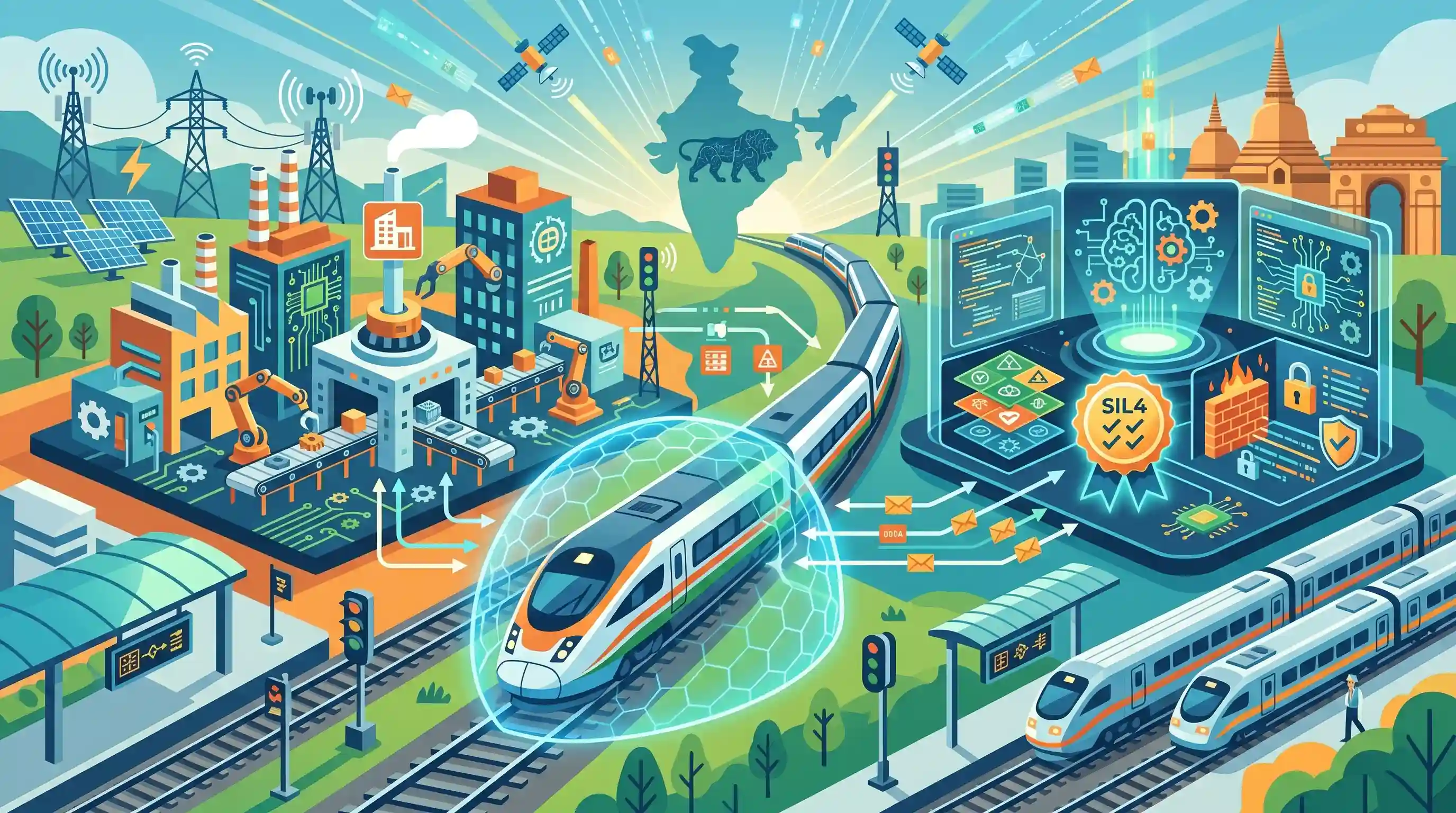
NOVA Control Tecnologix, a subsidiary of e2E Transportation Infrastructure, has partnered with Tata Elxsi to develop 'Kavach 4.0', India's next-generation indigenous Automatic Train Protection (ATP) system. NOVA will act as the primary Original Equipment Manufacturer (OEM) for manufacturing and integration, while Tata Elxsi will focus on hardware/software design, SIL4 safety certification, and cybersecurity engineering. The collaboration supports the 'Make in India' initiative and aims to enhance the safety, self-reliance, and modernization of Indian Railways.
Key Points
- NOVA Control Tecnologix and Tata Elxsi have collaborated to build Kavach 4.0, India's next-generation indigenous Automatic Train Protection (ATP) system.
- NOVA will function as the primary Original Equipment Manufacturer (OEM), responsible for manufacturing, testing, and system integration.
- Tata Elxsi will manage the hardware and software design, SIL4 global safety certification, and cybersecurity engineering.
- The partnership aligns with the Ministry of Railways' 'Make in India' vision to modernize and strengthen India's RailTech ecosystem.
Important Terms
Kavach 4.0

India's indigenous Automatic Train Protection system (Version 4.0 approved July 2024), featuring 5G-readiness and enhanced location accuracy to prevent collisions and overspeeding.
UPSC context
GS Paper 3 (Infrastructure/S&T); crucial for questions on railway safety, indigenous technology, and modernization of public transport.
Automatic Train Protection (ATP)
A rail safety mechanism that continuously monitors train speed and signal compliance, automatically applying brakes if the pilot fails to respond to danger signals.
UPSC context
GS Paper 3 (Critical Infrastructure); a foundational concept for understanding disaster management and technology in transport.
SIL-4 (Safety Integrity Level 4)
The highest international functional safety standard (IEC 61508), certifying that a system's probability of dangerous failure is less than 10^-8 per hour.
UPSC context
GS Paper 3 (Science & Tech); tests awareness of international benchmarks for reliability in high-stakes infrastructure.
Make in India
A flagship government initiative launched in 2014 to promote indigenization, foster innovation, and transform India into a global manufacturing hub.
UPSC context
GS Paper 3 (Economy/Industry); central to 'Atmanirbhar Bharat' and questions on industrial policy and domestic value addition.
Ministry of Railways
The nodal union ministry responsible for India's rail transport and safety, overseeing the Research Designs and Standards Organisation (RDSO) for technical development.
UPSC context
GS Paper 2 (Governance); involves departmental roles in executing large-scale public safety and infrastructure projects.
Prelims Trap
Kavach 4.0 relies exclusively on India's NavIC satellite constellation for real-time train tracking and collision avoidance.
Kavach relies primarily on physical track-mounted RFID tags and UHF radio communication for precise, fail-safe tracking, as satellite signals can drop in tunnels or bad weather.
Static Concepts Connected
What is Critical Information Infrastructure (CII) and who protects it?
- Definition: Computer resources whose incapacitation would have a debilitating impact on national security, economy, or public health.
- Nodal Agency: The National Critical Information Infrastructure Protection Centre (NCIIPC), created under the IT Act 2000, is the nodal agency for protecting CII.
- OT Networks: Railway signaling systems, power grids, and nuclear plants operate on Operational Technology (OT) networks, which are prime examples of CII requiring isolation.
How does an Automatic Train Protection (ATP) system like Kavach function?
- Auto-braking: It automatically applies brakes if the locomotive pilot jumps a red signal (Signal Passed at Danger) or exceeds speed limits.
- Collision Avoidance: It prevents head-on and rear-end collisions by using RFID tags on tracks to establish precise train locations and communicate via UHF radio.
- SIL-4 Certification: Kavach is designed to Safety Integrity Level 4 (SIL-4), the highest global safety standard for electronic systems, meaning an extremely low probability of failure.
Cross-Topic Patterns
OT Cybersecurity in Critical Infrastructure
Kavach relies on Operational Technology (OT) networks. UPSC tests the distinction between standard IT networks and OT security, linking it to the NCIIPC and critical infrastructure protection.
Indigenous tech for public transport safety
Similar to GAGAN in civil aviation, Kavach represents an indigenous push substituting expensive foreign systems (like the European ETCS) with domestic intellectual property, aligning with Make in India.

A 2026 prelims question will likely blend Kavach's RFID/radio communication mechanism with Critical Information Infrastructure protections.
Linked PYQs · 4
Linked PYQs · 4
- 2021MainsGS3
“Investment in infrastructure is essential for more rapid and inclusive economic growth.” Discuss in the light of India's experience.
- 2017MainsGS3
Discuss the potential threats of Cyber attack and the security framework to prevent it.
- 2020MainsGS3
Discuss different types of cyber crimes and measures required to be taken to fight the menace.
- 2021MainsGS3
Keeping in view India's internal security, analyse the impact of cross-border cyber attacks. Also discuss defensive measures against these sophisticated attacks.
