Decolonising Science requires Shifting from Western Metrics
Source:The Hindu ↗
Why It Matters
This topic is crucial for UPSC aspirants as it reframes the narrative around India's science and technology policy. It highlights the necessity of focusing on domestic societal challenges rather than Western validation metrics, which is directly relevant to GS Paper 3 (S&T ecosystem) and GS Paper 1 (traditional knowledge).
Summary
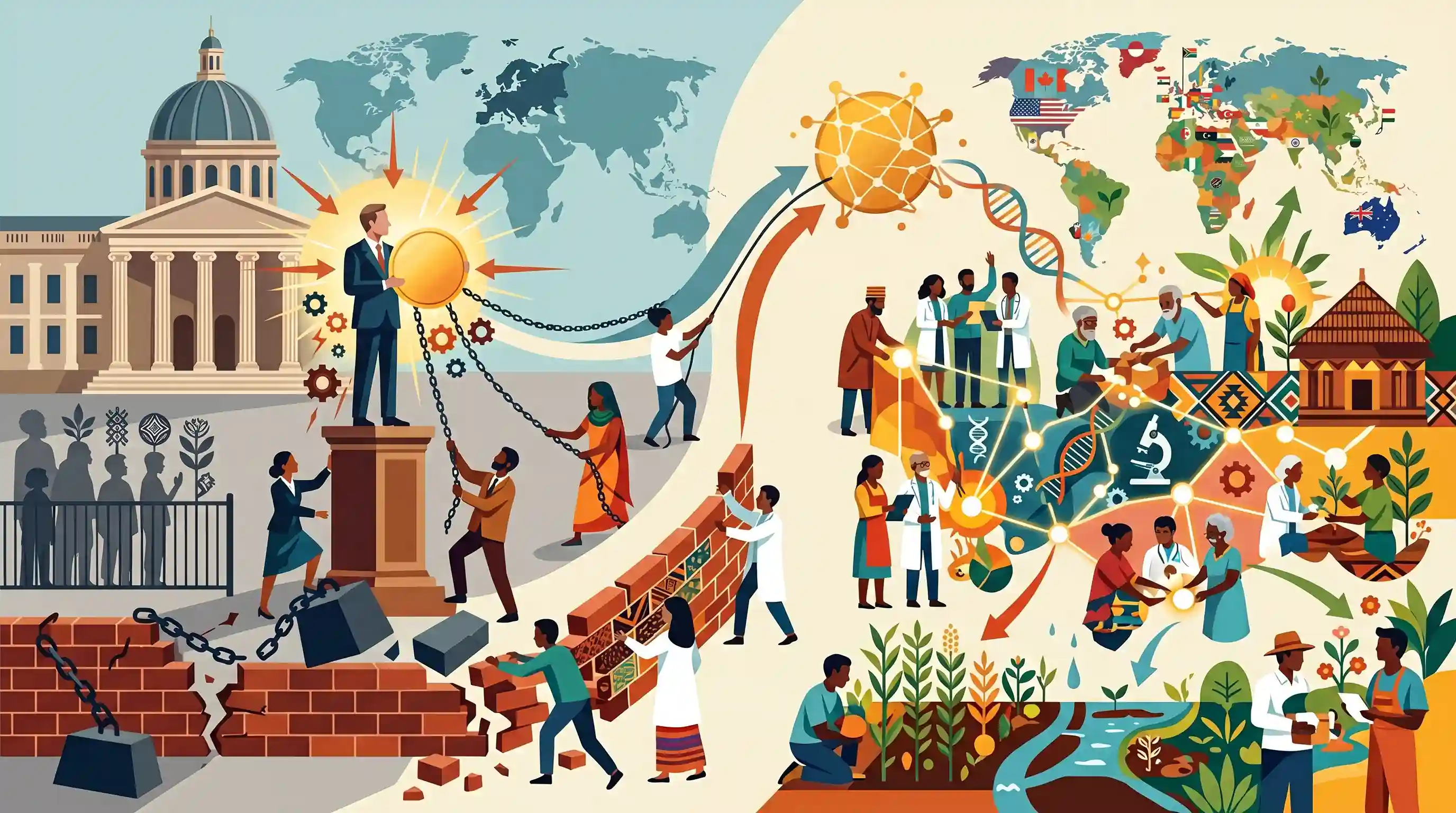
The article advocates for the dual processes of 'decolonising' and 'de-Nobelising' science to create a more equitable and relevant global research ecosystem. It critiques the Nobel Prize for its inherent Eurocentric biases and its perpetuation of the 'lone genius' myth, which fails to reflect the highly collaborative reality of modern scientific inquiry. By prioritizing Western research paradigms and metrics, such global accolades marginalize the Global South and devalue indigenous knowledge systems. The piece argues that countries like India should pivot away from chasing individualistic international prestige. Instead, they must restructure their scientific ecosystems to focus on locally relevant challenges, promote community-driven research, and recognize collaborative efforts, ultimately liberating science from its colonial legacies.
Key Points
- Global scientific evaluation systems, particularly the Nobel Prize, suffer from a profound Eurocentric bias, historically marginalising the contributions and priorities of the Global South.
- The Nobel Prize perpetuates the outdated myth of the 'lone genius' by limiting the award to a maximum of three individuals, ignoring the collaborative and interdisciplinary nature of modern 'Big Science'.
- Decolonising science necessitates acknowledging and integrating indigenous and traditional knowledge systems alongside mainstream scientific paradigms.
- Developing nations like India must localise their scientific research priorities to address domestic socio-economic challenges, rather than aligning with research trends dictated by Western institutions for international prestige.
- There is an urgent need to restructure the academic reward and recognition ecosystem to incentivise teamwork, open science, and societal impact over individual accolades and high-impact-factor publications.
Important Terms
Nobel Foundation

A private institution established in 1900 that manages the finances and administration of the Nobel Prizes, ensuring the legacy of Alfred Nobel's will is upheld globally.
UPSC context
GS Paper 1 & Prelims: Knowledge of major international institutions and awards that shape global cultural and scientific standards.
Royal Swedish Academy of Sciences
An independent scientific organization responsible for selecting Nobel laureates in Physics and Chemistry; it promotes science and strengthens its influence in society.
UPSC context
Prelims & GS Paper 3: Recognizing international bodies that validate scientific breakthroughs and influence global research priorities.
Decolonisation of Science
The process of dismantling the hegemony of Western research paradigms to integrate diverse, local, and indigenous knowledge systems into the global scientific discourse.
UPSC context
GS Paper 3: Science & Technology (Indigenisation of Technology) and Ethics (Epistemic Justice).
Indigenous Knowledge Systems (IKS)
Holistic knowledge and practices developed by local communities over generations, often pertaining to ecology, medicine, and agriculture; recognized in India's National Education Policy 2020.
UPSC context
GS Paper 3: Environment and Technology; GS Paper 1: Culture and traditional wisdom.
Global South
A geopolitical term for developing and less-developed nations in Asia, Africa, and Latin America, characterized by shared histories of colonialism and ongoing economic marginalization.
UPSC context
GS Paper 2: International Relations and groupings involving India’s interests (e.g., Voice of Global South Summit).
Eurocentrism
A worldview that centers European culture, history, and scientific methods as the universal standard, often marginalizing non-Western perspectives and achievements.
UPSC context
GS Paper 1: World History/Post-colonialism; GS Paper 4: Ethics and bias in intellectual frameworks.
Scientific Ecosystem
The interconnected network of researchers, institutions, funding bodies, and policies that facilitate scientific progress and innovation within a country or globally.
UPSC context
GS Paper 3: Development of S&T in India; focus on Anusandhan National Research Foundation (ANRF).
Prelims Trap
"STIP 2020 mandates that all Traditional Knowledge Digital Library (TKDL) data be made freely accessible to the public under Open Science."
TKDL access is restricted to international patent offices under non-disclosure agreements to prevent bio-piracy. It is not an open database for the public.
Static Concepts Connected
What is the Traditional Knowledge Digital Library (TKDL) and its role in IPR?
- Joint initiative: Established in 2001, it is a collaborative project between the Council of Scientific and Industrial Research (CSIR) and the Ministry of AYUSH.
- Defensive protection: It translates Indian traditional medical knowledge (Ayurveda, Unani, Siddha) into multiple international languages to establish 'prior art', preventing false patent claims.
- Restricted access: Database access is exclusively granted to major international patent offices (like USPTO, EPO) via strict non-disclosure agreements, preventing unauthorized commercial use.
Which major international 'Big Science' projects feature significant Indian participation?
- LIGO-India: A planned advanced gravitational-wave observatory in Maharashtra, functioning as a node in the global network alongside US-based facilities.
- ITER (Fusion): India is one of the seven core members contributing critical components to the International Thermonuclear Experimental Reactor (nuclear fusion) in France.
- CERN: As an Associate Member State, India contributes hardware, software, and highly skilled researchers to the Large Hadron Collider experiments in Switzerland.
Cross-Topic Patterns
Indigenous knowledge vs Global Patents
The push to decolonise science directly connects to the Convention on Biological Diversity (CBD) and the Nagoya Protocol, which mandate equitable benefit-sharing to protect traditional knowledge against Western bio-piracy.
Open Science vs Commercial Publishing
India’s STIP 2020 champions 'One Nation, One Subscription' and FAIR data principles, actively shifting the research ecosystem away from costly, Eurocentric paywalled journals toward democratized knowledge access.

Mains GS-3 2026: Expect a critical question evaluating how STIP 2020 balances integration into global Big Science with local, indigenous R&D.
Linked PYQs · 3
Linked PYQs · 3
- 2014MainsGS3
Scientific rescarch in Indian universities is declining, because a career in science is not as attractive as are business professions, engineering or administration, and the universities are becoming consumer-oriented. Critically comment.
- 2021MainsGS1
Examine the uniqueness of tribal knowledge system when compared with mainstream knowledge and cultural systems.
- 2021MainsEssay
What is research, but a blind date with knowledge!
