Decolonising Science and Global Knowledge Systems
Source:The Hindu ↗
Why It Matters
Understanding the colonial legacy in knowledge production is crucial for policymakers to foster indigenous R&D, protect traditional knowledge from biopiracy, and build a scientific ecosystem that relies on context-specific, socially responsible metrics rather than merely seeking Western validation.
Summary
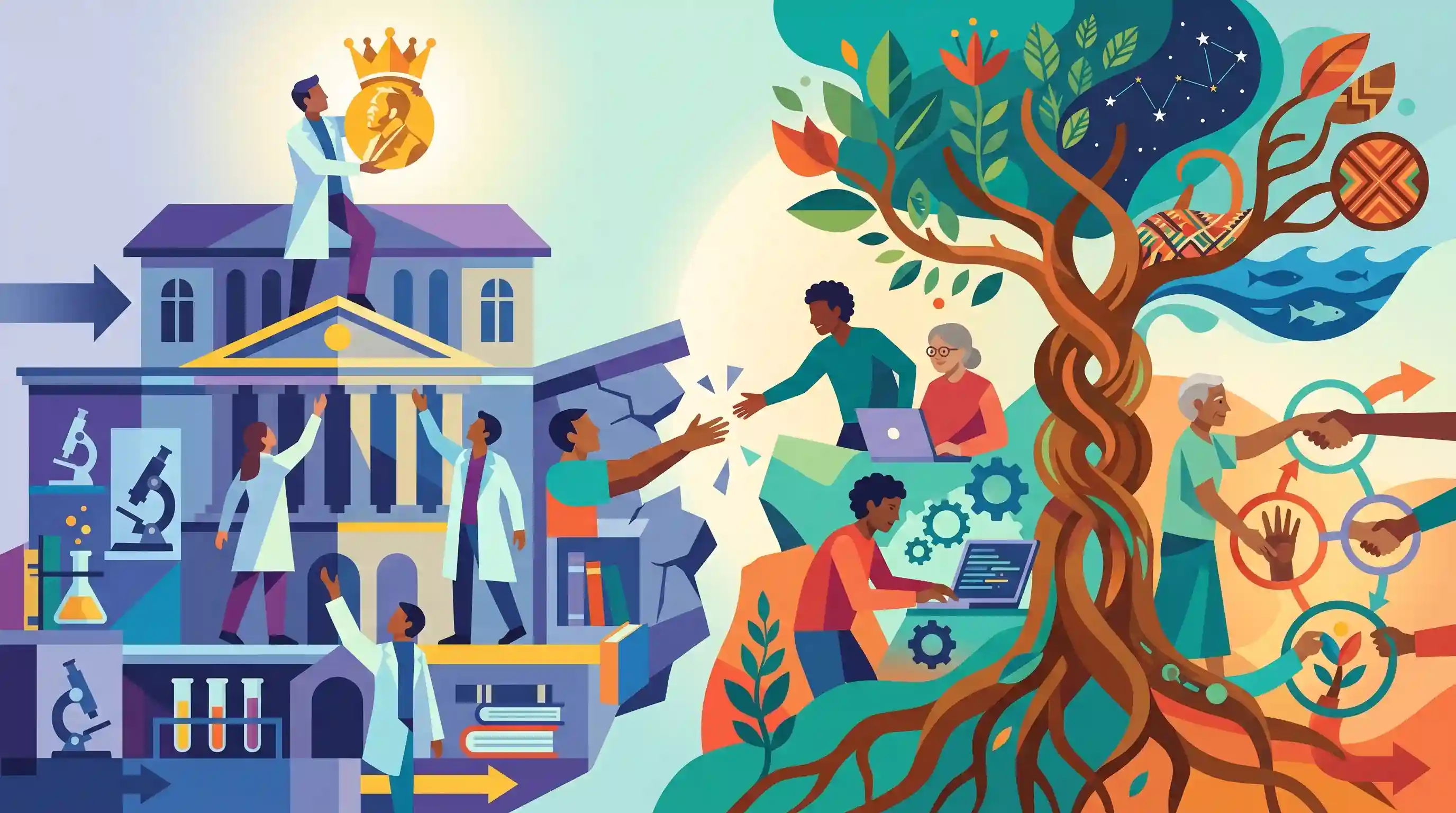
The article examines the ongoing discourse around 'decolonising' science, arguing against the entrenched Eurocentric biases that dominate global scientific narratives and metrics of success. It highlights how prestigious recognitions like the Nobel Prize perpetuate a Western-centric, individualistic view of scientific achievement, often sidelining the collaborative efforts and contributions of researchers from the Global South. By advocating for the 'de-Nobelising' of science, the piece calls for a more inclusive approach that values indigenous knowledge systems, fosters equitable global partnerships, and redefines scientific excellence beyond Western validation.
Key Points
- The article critiques Eurocentric biases in global scientific research, arguing that Western epistemologies are often treated as universal while indigenous knowledge systems are marginalized.
- The concept of 'de-Nobelising' science challenges the hyper-individualistic and competitive nature of awards like the Nobel Prize, which disproportionately favor researchers from the Global North and ignore the deeply collaborative nature of modern science.
- Decolonising science requires creating equitable research partnerships, acknowledging historical non-Western scientific contributions, and integrating traditional knowledge systems into mainstream research.
- There is a need to re-evaluate metrics of scientific success, shifting focus from Western validation towards inclusive, context-relevant, and socially responsible scientific progress.
Important Terms
Decolonisation of Science

The process of dismantling Western-centric biases and colonial power structures in scientific research to promote equitable, diverse, and locally relevant knowledge systems.
UPSC context
GS Paper III/S&T; tests awareness of "Indigenisation of Technology" and developing independent, home-grown scientific paradigms.
Global South
A geopolitical concept representing developing nations in Africa, Asia, and Latin America that share histories of colonialism and seek equitable global representation.
UPSC context
GS Paper II/International Relations; central to India’s leadership role and efforts to reform global governance structures.
Eurocentrism
A worldview that prioritizes European history and culture as the universal standard for excellence, often marginalizing non-Western scientific achievements and traditional knowledge.
UPSC context
GS Paper I/Indian Society; relevant for analyzing post-colonial identity and the influence of Western standards on Indian education.
Indigenous Knowledge Systems (IKS)
Generational bodies of knowledge and practices developed by local communities through interaction with their environment, essential for sustainable agriculture and medicine.
UPSC context
GS Paper III/Environment & S&T; tests understanding of biodiversity conservation and the integration of traditional wisdom with modern science.
Nobel Foundation
A private body managing the Nobel Prizes; it is critiqued for perpetuating an individualistic, Western-centric view of excellence that overlooks collaborative Southern research.
UPSC context
GS Paper III/S&T; relevant for discussing global scientific metrics and the ethics of individual versus collaborative research recognition.
Prelims Trap
"TKDL facilitates the granting of patents to indigenous communities for their traditional knowledge."
TKDL does not grant patents; it serves as a defensive "prior art" database to prevent Western patent offices from granting patents on pre-existing traditional Indian knowledge.
Static Concepts Connected
What is the structural conflict between WTO's TRIPS and the CBD?
- TRIPS framework: Focuses on private intellectual property rights and does not mandate disclosing the geographical source of biological materials.
- CBD principles: Emphasizes state sovereignty over biological resources and mandates Access and Benefit Sharing (ABS) with local indigenous communities.
- The Clash: TRIPS essentially enables 'biopiracy' of traditional knowledge without fair compensation, actively contradicting the equitable sharing goals of the CBD.
How does the Traditional Knowledge Digital Library (TKDL) prevent biopiracy?
- Establishing Prior Art: Converts ancient texts (Ayurveda, Unani, Siddha) into structured classifications to officially prove prior public knowledge.
- Global Access: Available to international patent offices (e.g., USPTO, EPO) in multiple languages to help examiners reject fraudulent patent claims.
- Historical Victories: Crucial in successfully revoking foreign patents on the medicinal properties of Neem, Turmeric, and Basmati by demonstrating pre-existing indigenous use.
Cross-Topic Patterns
"Parachute Science" in GS4 Ethics
The Global North extracting data from the Global South without equitable credit ("helicopter science") is a rising GS4 case study theme on research ethics and scientific equity.
IPR vs. Access and Benefit Sharing (ABS)
Decolonising science connects directly to the Nagoya Protocol. Expect questions linking WTO-TRIPS patent regimes with the Nagoya Protocol's Access and Benefit Sharing (ABS) mechanisms.

Biopiracy, TKDL, and the TRIPS-CBD conflict are highly likely to feature in a 2026 GS3 Mains question on intellectual property.
Linked PYQs · 4
Linked PYQs · 4
- 2019MainsGS3
How is the Government of India protecting traditional knowledge of medicine from patenting by pharmaceutical companies?
- 2020MainsGS3
How is science interwoven deeply with our lives? What are the striking changes in agriculture triggered off by the science-based technologies?
- 2024MainsEssay
The doubter is a true man of science.
- 2021MainsEssay
What is research, but a blind date with knowledge!
