Personality Rights and Legal Challenges in the Era of AI
Source:The Hindu ↗
Why It Matters
The intersection of disruptive AI technologies and constitutional rights represents a critical frontier in modern governance. For UPSC aspirants, understanding how existing frameworks (like Article 21 and IPR laws) apply to new challenges like deepfakes is essential for answering questions on Fundamental Rights in GS2 and Science & Technology/Security issues in GS3.
Summary
The article explores the emerging legal, ethical, and constitutional challenges surrounding "personality rights" in the era of Artificial Intelligence. With the proliferation of deepfakes and AI voice cloning, individuals—particularly public figures—face significant risks of unauthorized commercial exploitation of their likeness and identity. India currently lacks a dedicated statutory framework for personality rights, relying instead on a patchwork of laws, including the Right to Privacy under Article 21, the Copyright Act, and common law remedies. Highlighting the foundational importance of the K.S. Puttaswamy privacy judgment and recent Delhi High Court rulings protecting celebrities, the article argues for comprehensive legislation to govern AI-generated content, mandate explicit consent, and protect individual autonomy against technological misuse.
Key Points
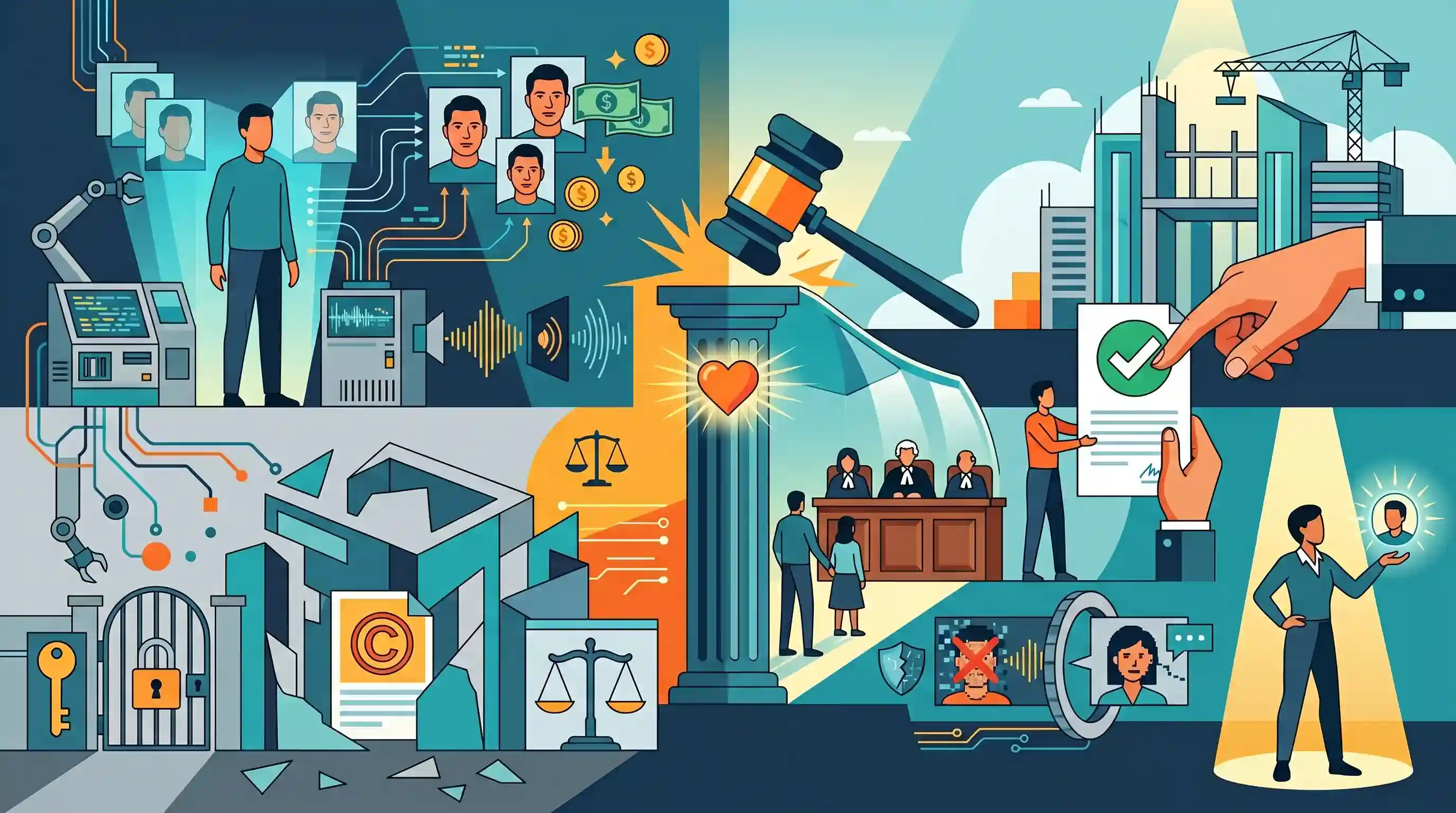
- AI technologies such as deepfakes, generative AI, and voice cloning have made it unprecedentedly easy to appropriate an individual's voice, likeness, and identity without consent.
- In India, personality rights are not explicitly codified in a single statute but are protected through a combination of the Right to Privacy (Article 21), intellectual property frameworks (Copyright Act), and common law torts like passing off and defamation.
- The Supreme Court's landmark K.S. Puttaswamy judgment solidified the Right to Privacy as a fundamental right, providing constitutional backing to protect individuals from unauthorized commercial exploitation of their persona.
- Recent proactive judicial interventions by the Delhi High Court (e.g., granting injunctions to protect the personality rights of actors like Anil Kapoor and Amitabh Bachchan) underscore the courts' role in bridging the legislative gap.
- There is an urgent need for a dedicated statutory framework to regulate AI-generated digital replicas, ensuring explicit consent and balancing technological innovation with individual autonomy and commercial interests.
Important Terms
Personality Rights

A bundle of rights protecting an individual's name, voice, image, and likeness from unauthorized commercial exploitation. It includes the 'right to privacy' and the 'right of publicity'.
UPSC context
Relates to GS Paper II (Judiciary, Rights Issues) and GS Paper III (Intellectual Property Rights and AI).
Article 21 of the Constitution
The fundamental right to life and personal liberty, which the Supreme Court has interpreted to include the right to privacy as an intrinsic component.
UPSC context
Core topic for GS Paper II (Fundamental Rights); tests understanding of judicial activism and constitutional evolution.
K.S. Puttaswamy Judgment
A landmark 2017 Supreme Court ruling that declared the Right to Privacy a fundamental right, establishing the constitutional basis for protecting individual autonomy and identity.
UPSC context
Essential for GS Paper II; frequently cited in questions regarding digital rights, Aadhaar, and data protection.
Performer's Rights
Statutory rights granted to actors, singers, and musicians under Sections 38A and 38B of the Copyright Act (1957) to control the reproduction and prevent distortion of their performances.
UPSC context
Relevant for GS Paper III (IPR) and GS Paper II (Statutory bodies/laws); explores legal gaps in the digital era.
Deepfakes
AI-generated synthetic media (video, audio, or images) that convincingly mimic a person's appearance or voice, often used for misinformation or unauthorized commercial exploitation.
UPSC context
Key topic in GS Paper III (Science & Technology, Internal Security) regarding the ethical and security challenges of AI.
John Doe Order
A legal remedy granted by courts against unidentified defendants ('John Doe'), allowing individuals to prevent the unauthorized use of their persona by anonymous online entities.
UPSC context
Relevant for GS Paper II (Judiciary) as an example of judicial innovation in addressing anonymous digital infringements.
Prelims Trap
Personality rights are explicitly defined and protected under the Copyright Act of 1957 in India.
India lacks a dedicated statutory framework for personality rights. They are derived from a mosaic of Article 21, the Copyright Act, and common law torts.
Static Concepts Connected
How does the Puttaswamy Judgment (2017) protect personality rights?
- Article 21: Recognized the Right to Privacy as an intrinsic part of the Right to Life and Personal Liberty.
- Informational Privacy: Guards an individual's autonomy over personal data, digital footprint, and identity.
- Commercial Exploitation: Provides constitutional backing against the unauthorized use of an individual's persona or likeness for commercial gain.
What is the tort of "passing off" in Intellectual Property?
- Common Law Remedy: A common-law tort used to enforce unregistered trademark rights and protect business goodwill.
- Misrepresentation: Prevents an entity from misrepresenting their goods, services, or identity as belonging to someone else.
- Personality Rights Link: Often invoked by public figures to stop unauthorized commercial use of their name, voice, or likeness.
Cross-Topic Patterns
AI Deepfakes vs. Article 21 Privacy
The surge in generative AI explicitly ties GS3 tech regulations (like IT Rules amendments targeting deepfakes) to GS2 constitutional debates on Article 21, privacy, and the Puttaswamy judgment.
Intersecting domains of Intellectual Property
The distinction between traditional copyright (protecting creators) and performer's rights (protecting actors/singers under Sections 38A/38B) is increasingly tested in AI voice-cloning cases, expanding the GS3 IPR syllabus.

A 2026 Mains question will likely bridge GS2 (privacy/personality rights vacuum) with GS3 (generative AI & deepfake regulation).
Linked PYQs · 5
Linked PYQs · 5
- 2017MainsGS2
Examine the scope of Fundamental Rights in the light of the latest judgement of the Supreme Court on Right to Privacy.
- 2024MainsGS2
Right to privacy is intrinsic to life and personal liberty and is inherently protected under Article 21 of the constitution. Explain. In this reference discuss the law relating to D.N.A. testing of child in the womb to establish its paternity.
- 2014MainsGS3
In a globalized world, Intellectual Property Rights assume significance and are a source of litigation. Broadly distinguish between the terms-Copyrights, Patents and Trade Secrets.
- 2023MainsGS3
Introduce the concept of Artificial Intelligence (AI). How does Al help clinical diagnosis? Do you perceive any threat to privacy of the individual in the use of Al in healthcare?
- 2024PrelimsGS1
Under which of the following Articles of the Constitution of India, has the Supreme Court of India placed the Right to Privacy ?
