Kerala High Court stays local fund usage for political outreach
Source:Indian Express ↗
Why It Matters
This incident is highly relevant for GS2 questions on the financial autonomy of local self-governments. It provides a real-world case study of the friction between State governments and LSGs, and illustrates the application of judicial review to curb the misuse of public funds by the executive for political outreach.
Summary
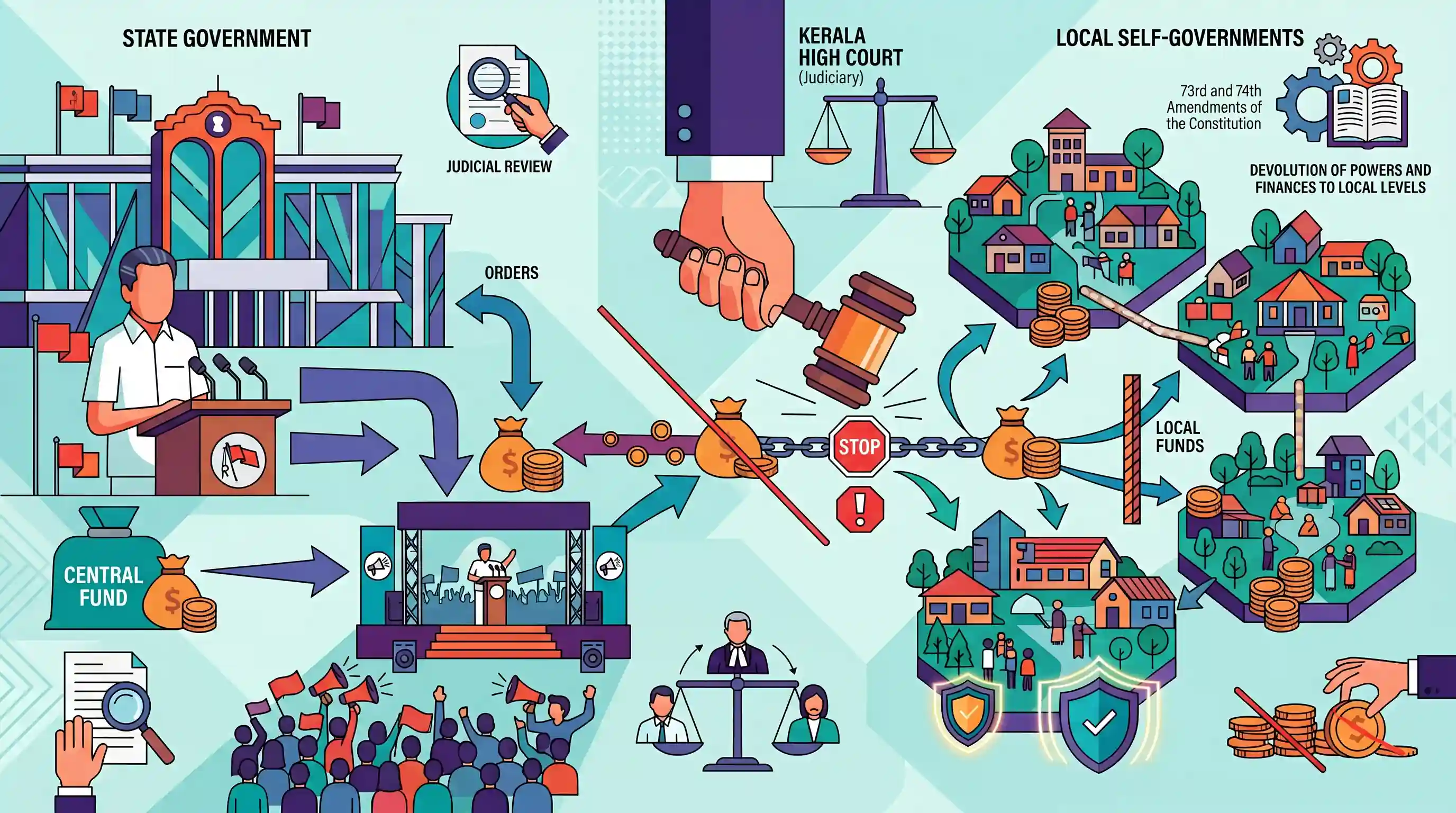
The Kerala High Court recently stayed a state government order permitting Local Self-Governments (LSGs) to utilize their funds for the 'Nava Kerala Sadas', a massive public outreach programme led by Chief Minister Pinarayi Vijayan. Opponents challenged the directive, alleging the event was a thinly veiled political campaign for the upcoming Lok Sabha elections, making the utilization of local body funds illegal and an overreach. The judicial intervention underscores the critical importance of protecting the financial autonomy of local bodies under the 73rd and 74th Amendments, preventing state governments from co-opting local resources for partisan administrative exercises. It also demonstrates the role of judicial review in scrutinizing executive orders that potentially misuse public funds.
Key Points
- The Kerala High Court intervened to halt a state government order that allowed local bodies to spend their own funds on the 'Nava Kerala Sadas' outreach programme.
- Nava Kerala Sadas is an initiative by the Pinarayi Vijayan-led government, criticized by the opposition as a politically motivated campaign rather than a genuine administrative outreach.
- The controversy highlights the tension between state executive directives and the financial and functional autonomy of Panchayati Raj Institutions (PRIs) and Urban Local Bodies (ULBs).
- The High Court's stay serves as an example of judicial review checking the potential misuse of public exchequer for political events disguised as government programs.
Important Terms
Nava Kerala Sadas

A state-wide public outreach programme by the Kerala Government to highlight achievements, gather public feedback, and address grievances through ministerial tours across all 140 Assembly constituencies.
UPSC context
Relevant for GS Paper II (Governance); tests the line between administrative outreach and partisan political campaigning using public funds.
73rd Constitutional Amendment
The 1992 Act that institutionalized rural local self-government (Panchayats) in India, adding Part IX and the 11th Schedule to the Constitution to ensure decentralization.
UPSC context
Core GS Paper II topic (Polity); essential for understanding democratic decentralization and the devolution of powers and finances.
74th Constitutional Amendment
The 1992 Act that granted constitutional status to urban local bodies (Municipalities), adding Part IXA and the 12th Schedule to ensure urban governance and financial autonomy.
UPSC context
Key for GS Paper II (Local Self-Government); focuses on urban administrative structures and their protection from state executive overreach.
Local Self-Governments (LSGs)
The third tier of Indian governance comprising Panchayats and Municipalities, empowered to manage local affairs and execute developmental projects independently within their jurisdictions.
UPSC context
Vital for GS Paper II (Decentralization); focuses on the financial and administrative autonomy of the lowest level of government.
Judicial Review
The constitutional power of higher courts to examine and potentially invalidate executive orders or legislative acts that violate the Constitution or exceed delegated authority.
UPSC context
Crucial GS Paper II concept; tests the judiciary's role in maintaining the checks and balances and the rule of law.
Left Democratic Front (LDF)
A CPM-led coalition of left-wing political parties in Kerala; the current ruling alliance responsible for initiating the Nava Kerala Sadas outreach programme.
UPSC context
Relevant for understanding regional political dynamics and coalition governance in the context of state-level administrative decisions.
Prelims Trap
"The State Government holds absolute executive authority to redirect Panchayat and Municipal funds."
Devolution of powers and funds to local bodies is the constitutional prerogative of the State Legislature (by law), not arbitrary State Executive orders.
Static Concepts Connected
How is the financial autonomy of local bodies constitutionally structured and protected?
- Legislative Devolution: Articles 243H and 243X empower the State Legislature to authorize local bodies to levy taxes, duties, and tolls, establishing a legal framework for revenue generation.
- State Finance Commission: Articles 243I and 243Y mandate the Governor to constitute a State Finance Commission every five years to review local financial positions and recommend devolution principles.
- Grants-in-Aid: The State Legislature may provide for grants-in-aid to Panchayats and Municipalities directly from the Consolidated Fund of the State.
What is the scope of Judicial Review over executive financial directives?
- Ultra Vires Check: Constitutional Courts can strike down executive actions that are ultra vires, meaning they exceed the legal authority granted to the executive by the legislature.
- Checking Mala Fides: Courts can intervene if executive orders demonstrate mala fides (bad faith) or attempt to misappropriate public funds for partisan, non-public purposes.
Cross-Topic Patterns
Fiscal Federalism vs. Subsidiarity
This tension mirrors Centre-State fiscal disputes, highlighting the paradox of state governments demanding federal autonomy while simultaneously centralizing power and funds away from local bodies.
Public Funds for Political Campaigns
Intersects with Supreme Court guidelines (e.g., Common Cause vs UoI) that restrict the use of the public exchequer for partisan political campaigns disguised as administrative outreach.

Expect a 2026 Prelims statement testing the precise constitutional boundary between State Legislature and State Executive regarding PRI finances.
Linked PYQs · 3
Linked PYQs · 3
- 2017PrelimsGS1
In India, Judicial Review implies
- 2023MainsGS2
“The states in India seem reluctant to empower urban local bodies both functionally as well as financially.” Comment.
- 2023MainsGS2
“Development and welfare schemes for the vulnerable, by its nature, are discriminatory in approach.” Do you agree? Give reasons for your answer.
