Tamil Nadu State Education Policy Versus NEP Centre Tussle
Source:Indian Express ↗
Why It Matters
The issue exemplifies the practical challenges of cooperative federalism in India, particularly regarding Concurrent List subjects. It is a prime case study for GS2 questions on Centre-State friction, the pushback from regional parties against centralization, and the implementation hurdles of the NEP 2020.
Summary
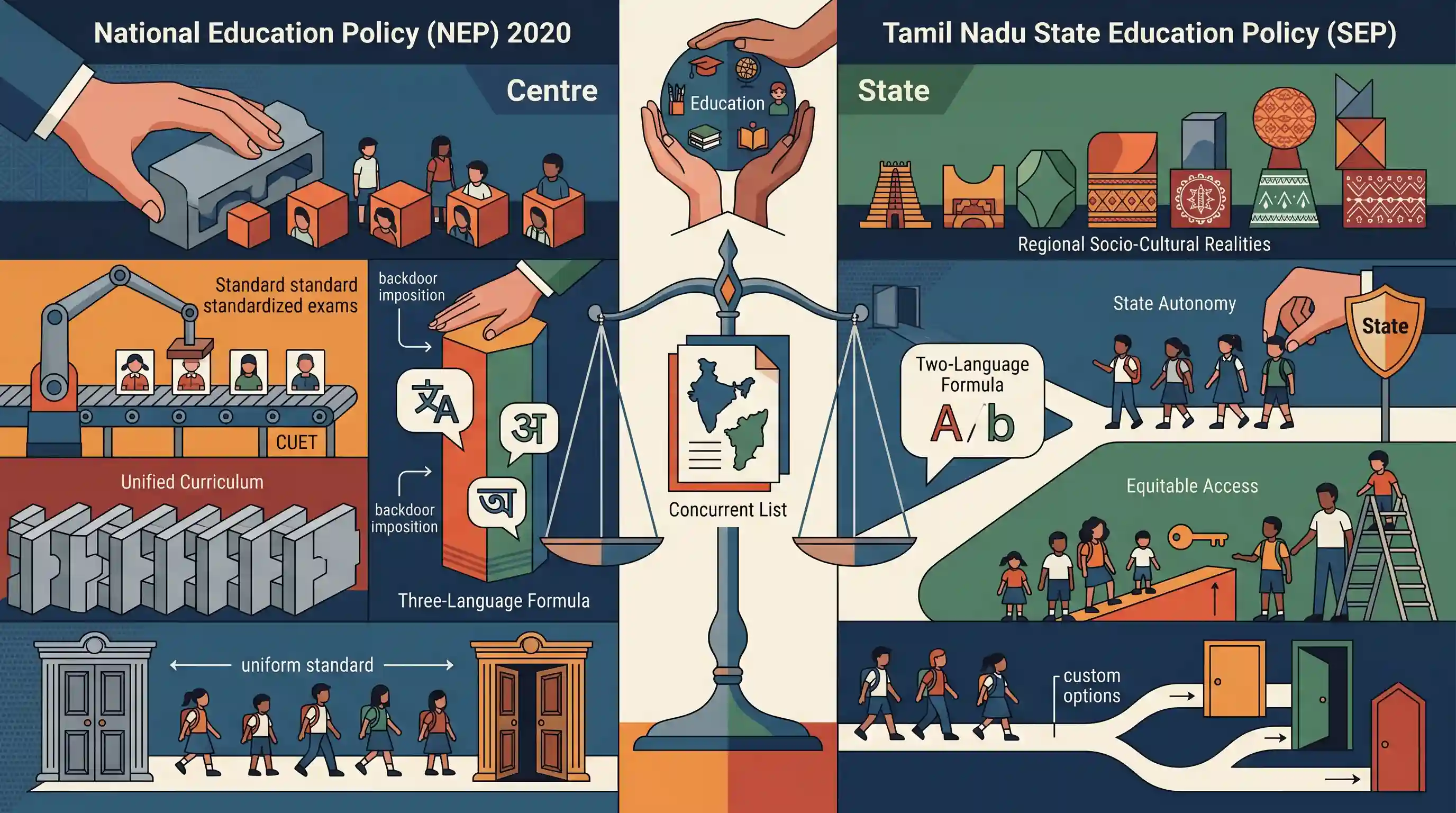
The Tamil Nadu government recently unveiled its own State Education Policy (SEP), positioning it as an alternative to the Centre's National Education Policy (NEP) 2020. The primary trigger for this move is an ideological and administrative clash over the NEP's provisions, particularly the three-language formula, which Tamil Nadu perceives as a backdoor imposition of Hindi. The state remains steadfast on its historic two-language formula. Furthermore, Tamil Nadu objects to NEP's centralising tendencies, such as standardized entrance exams (like CUET) and unified curriculum frameworks. The state argues that education—a Concurrent List subject—must reflect regional socio-cultural realities, protect state autonomy, and ensure equitable access without disadvantaging marginalized students.
Key Points
- Tamil Nadu has introduced its own State Education Policy (SEP) as an alternative to the Centre's National Education Policy (NEP) 2020.
- The state fundamentally opposes the NEP's three-language formula, maintaining its historic adherence to a two-language policy (Tamil and English) to prevent perceived Hindi imposition.
- The friction underscores challenges in cooperative federalism, as Tamil Nadu views the NEP's centralized frameworks (like CUET and national standardized testing) as an infringement on state autonomy.
- Education being a Concurrent List subject, the formulation of a distinct state policy highlights the ongoing tussle between the Centre and states over administrative control and regional socio-cultural identity.
Important Terms
National Education Policy (NEP) 2020

India's first 21st-century education framework replacing the 1986 policy. It introduces a 5+3+3+4 structure, multidisciplinary learning, and foundational literacy while promoting mother-tongue education and global standards.
UPSC context
GS Paper 2: Governance and Education. Tests understanding of major policy shifts, administrative reforms, and federal challenges in social sector development.
State Education Policy (SEP)
A state-led alternative to the National Education Policy, such as Tamil Nadu's 2025 framework. It prioritizes regional autonomy, social justice, and specific local needs like the two-language policy over central mandates.
UPSC context
GS Paper 2: Federalism. Analyzes the 'quasi-federal' nature of India and state-level resistance to centralized policies.
Three-Language Formula
A policy proposed by the Kothari Commission (1964-66) mandating three languages in school: regional language, English, and a third (often Hindi in non-Hindi states). NEP 2020 retains this with flexibility.
UPSC context
GS Paper 2: Governance/Welfare. Relevant for debates on linguistic diversity, national integration, and perceived "Hindi imposition" in education.
Two-Language Formula
Tamil Nadu’s long-standing language policy (since 1968) teaching only Tamil and English. It rejects the mandatory inclusion of a third language (Hindi) to protect regional linguistic identity.
UPSC context
GS Paper 2: Federalism. Highlights regional political history and the use of language as a tool for asserting state autonomy.
Concurrent List (Education)
Part of the Seventh Schedule (List III) where both Centre and States can legislate. Education was moved here from the State List by the 42nd Amendment Act (1976).
UPSC context
GS Paper 2: Constitution/Federalism. Essential for understanding legislative jurisdiction and the dominance of Union law (Article 254) in conflicts.
Prelims Trap
Education is a State subject, granting states exclusive jurisdiction to formulate binding education policies.
Education was moved to the Concurrent List via the 42nd Amendment (1976). While states can frame policies, central laws ultimately prevail in conflicts.
Static Concepts Connected
How is 'Education' distributed under the Constitution's Seventh Schedule?
- Original Status: Education was originally placed in the State List, granting state legislatures exclusive law-making authority over it.
- 42nd Amendment: The 42nd Constitutional Amendment Act (1976) transferred Education to the Concurrent List, allowing both the Union and States to legislate.
- Article 254: Under the Doctrine of Repugnancy, Central laws prevail in conflicts on Concurrent subjects unless the State legislation secures Presidential assent.
What is the evolution of the Three-Language Formula in India?
- Origin: It was comprehensively recommended by the Kothari Commission (1964-66) to foster national integration, and adopted in the 1968 National Policy on Education.
- Two-Language Pushback: Tamil Nadu formally rejected the formula in 1968 under C.N. Annadurai, legally committing to a two-language policy (Tamil and English).
- NEP 2020 Stance: The policy retains the three-language framework but introduces flexibility, mandating that at least two chosen languages must be native to India.
Cross-Topic Patterns
Federalism vs. Central Standardisation
The SEP pushback mirrors state opposition to central frameworks in other Concurrent areas, such as the Farm Laws or the Electricity Amendment Bill, highlighting a rising trend of federal friction.
Post-Independence Linguistic Reorganization
Tamil Nadu’s staunch defense of the Two-Language Formula directly links to the 1960s anti-Hindi agitations, a critical GS1 theme regarding language as an organizing principle in independent India.

Mains GS2 is highly likely to test the friction between central standardisation (NEP, NEET, CUET) and state autonomy on Concurrent subjects.
Linked PYQs · 4
Linked PYQs · 4
- 2020MainsGS2
National Education Policy 2020 is in conformity with the Sustainable Development Goal-4 (2030). It intends to restructure and reorient education system in India. Critically examine the statement.
- 2022MainsGS2
“While the national political parties in India favour centralisation, the regional parties are in favour of State autonomy.” Comment.
- 2016MainsGS1
Has the formation of linguistic States strengthened the cause of Indian Unity?
- 2018PrelimsGS1
Consider the following statements: 1. As per the Right to Education (RTE) Act, to be eligible for appointment as a teacher in a State, a person would be required to possess the minimum qualification laid down by the concerned State Council of Teacher Education. 2. As per the RTE Act, for teaching primary classes, a candidate is required to pass a Teacher Eligibility Test conducted in accordance with the National Council of Teacher Education guidelines. 3. In India, more than 90% of teacher education institutions are directly under the State Governments. Which of the statements given above is/are correct?
