Right to Information Act faces dilution debates and ministerial veto
Source:Indian Express ↗
Why It Matters
The RTI Act is a core topic in GS2 (Governance section). The Economic Survey's critique provides direct fodder for analytical questions on the challenges facing the RTI Act, balancing state efficiency with transparency, and evaluating recent attempts to amend or restrict the information regime.
Summary
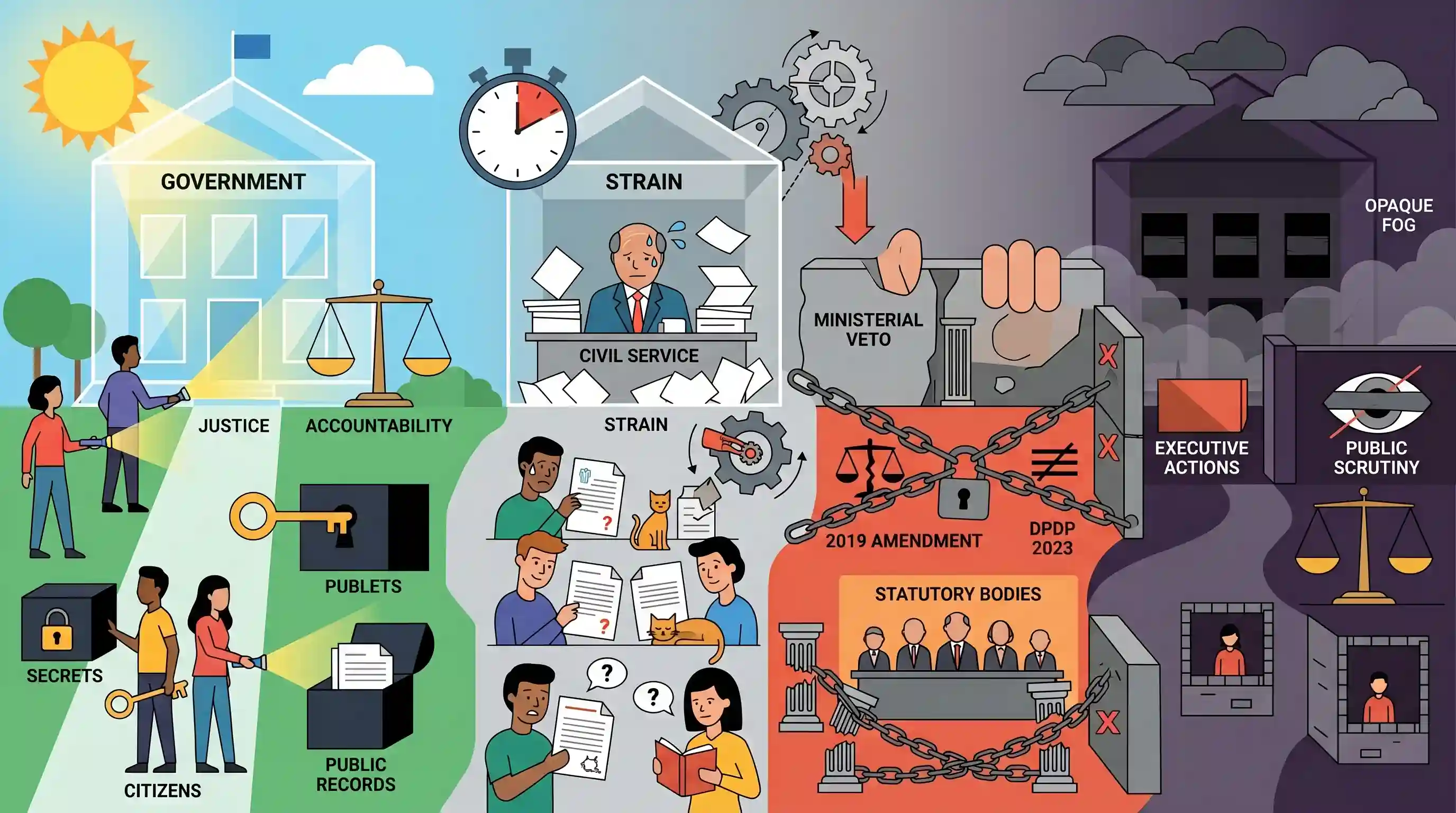
The Right to Information (RTI) Act, originally hailed as the dawn of a new era for transparency and democratic accountability in India, is facing renewed scrutiny. The latest Economic Survey controversially suggests that the RTI is being misused as a 'tool for idle curiosity', placing a significant strain on the administrative capacity of the state. To curb this, the Survey moots the idea of a 'ministerial veto' to block certain information disclosures. Transparency activists warn that this move, viewed alongside the RTI Amendment Act of 2019 and the Digital Personal Data Protection Act of 2023, threatens to systematically dilute citizen rights, shield executive actions from public scrutiny, and revert governance towards a culture of opacity.
Key Points
- The RTI Act, 2005 revolutionized Indian governance by transitioning from a culture of official secrecy to one of transparency and citizen empowerment.
- The recent Economic Survey has raised concerns that the RTI Act is increasingly being used as a 'tool for idle curiosity', resulting in an excessive administrative burden on government departments.
- The Survey controversially suggests introducing a 'ministerial veto' over the disclosure of certain types of information under the RTI Act, sparking fears of state overreach.
- Critics argue this proposal is part of a broader trend of diluting the RTI framework, citing the 2019 amendments (which altered the tenure and salary conditions of Information Commissioners) and the 2023 DPDP Act (which expanded exemptions for personal information under Section 8).
- The debate highlights the delicate balance between maintaining administrative efficiency/state capacity and ensuring democratic accountability through an informed citizenry.
Important Terms
Right to Information (RTI) Act, 2005

A landmark 2005 law empowering citizens to request information from public authorities, mandating timely responses to promote transparency and accountability in government functioning.
UPSC context
GS II: Governance/Transparency. Key for questions on citizen empowerment, accountability, and the "master key" to good governance.
RTI Amendment Act, 2019
Legislation that empowered the Central Government to determine the tenure, salary, and service conditions of Information Commissioners, which were previously fixed by law to ensure institutional independence.
UPSC context
GS II: Statutory Bodies. Tests understanding of executive control over quasi-judicial bodies and impacts on institutional autonomy.
Digital Personal Data Protection (DPDP) Act, 2023
A data privacy law that amended the RTI Act to remove the "public interest" override for disclosing personal information, leading to concerns about reduced accountability for public officials.
UPSC context
GS II: Governance/Fundamental Rights. Examines the tension between the Right to Privacy and the Right to Information.
Central Information Commission (CIC)
The apex statutory body responsible for adjudicating second appeals and complaints under the RTI Act, ensuring that central public authorities adhere to transparency mandates.
UPSC context
GS II: Statutory Bodies. Critical for evaluating institutional mechanisms that enforce governmental accountability and transparency.
Official Secrets Act, 1923
A colonial-era statute used to protect state secrets; while the RTI Act has an overriding effect (Section 22), the OSA is often invoked to withhold information on national security grounds.
UPSC context
GS II & IV: Governance/Ethics. Discusses the shift from colonial secrecy to democratic transparency and bureaucratic ethics.
Economic Survey
The Finance Ministry's annual report reviewing the economy; the latest edition proposed an RTI "ministerial veto" to prevent governance constraints and satisfy "idle curiosity."
UPSC context
GS II & III: Governance/Economy. Tests ability to analyze executive proposals balancing administrative efficiency with democratic transparency.
Prelims Trap
"Under the RTI Act, personal information can still be disclosed if larger public interest justifies it."
The DPDP Act 2023 amended Section 8(1)(j) of the RTI Act, completely removing the 'public interest override' and creating a blanket exemption against disclosing personal information.
Static Concepts Connected
What is the composition and nature of the Central Information Commission (CIC)?
- Statutory nature: The CIC is a statutory body established under the RTI Act, 2005. It is not a constitutional body.
- Composition: It consists of a Chief Information Commissioner and up to 10 Information Commissioners.
- Appointment Committee: Appointed by the President on the recommendation of a committee comprising the PM, Leader of Opposition in LS, and a Union Cabinet Minister.
How does the Right to Information intersect with Fundamental Rights?
- Implicit in Art 19: The Supreme Court ruled that RTI implicitly flows from Article 19(1)(a) (Freedom of Speech and Expression).
- Link to Art 21: Access to information is also viewed as essential for a dignified life, linking it to Article 21.
- Reasonable Restrictions: RTI is not absolute; it is subject to reasonable restrictions under Article 19(2), such as state security and friendly relations with foreign states.
Cross-Topic Patterns
RTI vs. Right to Privacy (Art 21)
The DPDP Act 2023's blanket exemption for personal data creates a direct constitutional friction point between the implicit Right to Information (Art 19) and the Right to Privacy (Puttaswamy, Art 21).
State Capacity vs. Transparency debate
The Economic Survey's warning about 'governance paralysis' due to RTI echoes long-standing bureaucratic concerns (noted in 2nd ARC) that excessive scrutiny deters civil servants from candid note-making.

Expect a Prelims 2026 multi-statement question contrasting the 2019 RTI amendments (tenure changes) with the 2023 DPDP Act exemptions.
Linked PYQs · 3
Linked PYQs · 3
- 2020MainsGS2
Recent amendments to the Right to Information Act will have profound impact on the autonomy and independence of the Information Commission". Discuss.
- 2023MainsGS2
e-governance, as a critical tool of governance, has ushered in effectiveness, transparency and accountability in governments. What inadequacies hamper the enhancement of these features ?
- 2024MainsGS2
e-governance is not just about the routine application of digital technology in service delivery process. It is as much about multifarious interactions for ensuring transparency and accountability. In this context evaluate the role of the 'Interactive Service Model' of e-governance.
