Fiscal Implications of State Pension Scheme Reforms in India
Source:Indian Express ↗
Why It Matters
The debate over government pension schemes (OPS vs. NPS) is a critical UPSC topic. It illustrates the tension between electoral populism and macroeconomic stability, testing aspirants' understanding of state liabilities, the Fiscal Responsibility and Budget Management (FRBM) Act, and the long-term impact on capital expenditure.
Summary
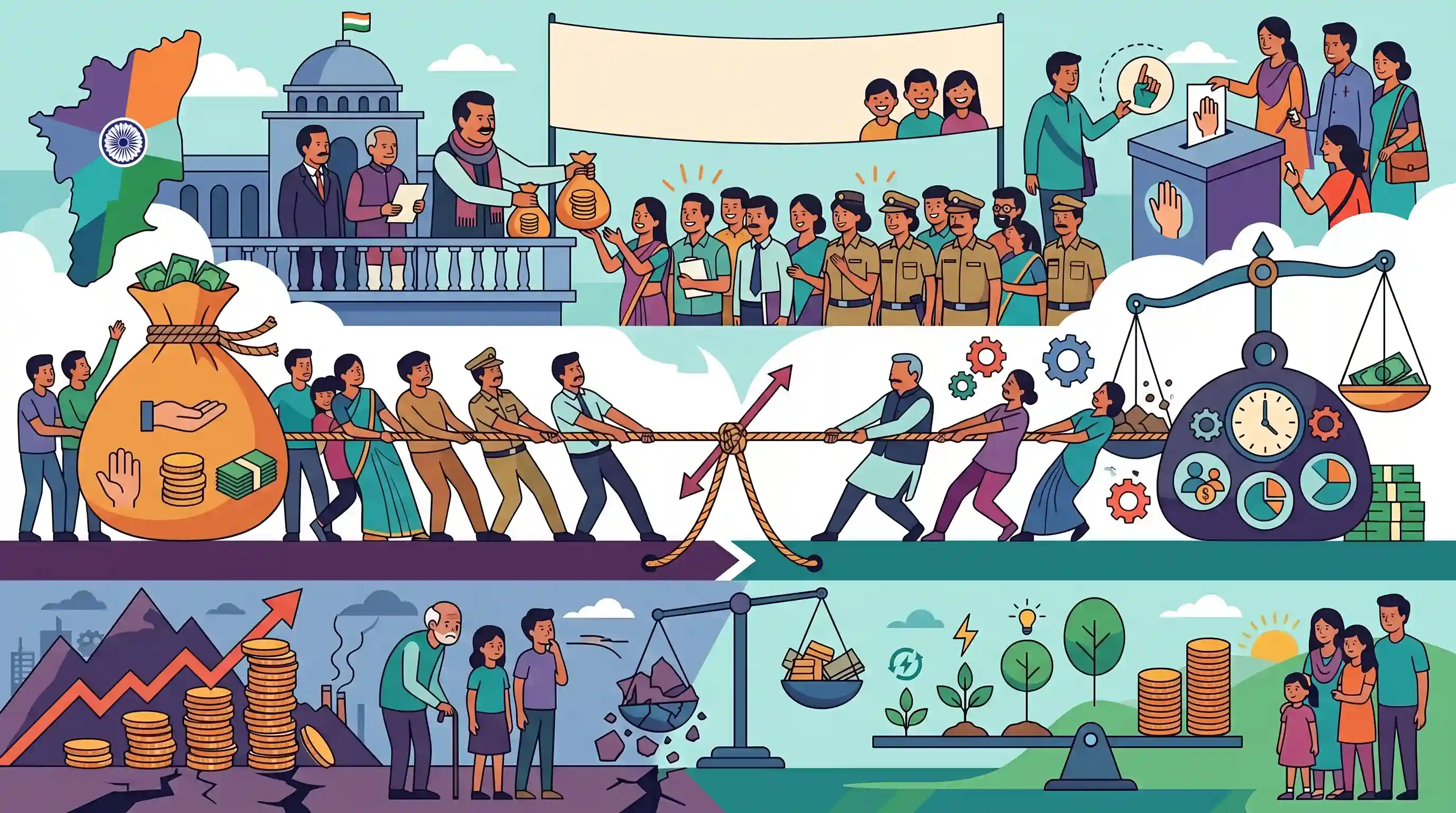
Ahead of upcoming polls, the DMK government in Tamil Nadu has announced a new pension scheme to placate state government employees. This political move highlights the ongoing tug-of-war across Indian states between reverting to guaranteed pension models (like OPS) and maintaining the fiscally sustainable contributory model (NPS). While such policy decisions yield immediate electoral dividends by securing the civil servant vote bank, they pose significant risks to long-term state finances, potentially derailing fiscal prudence and intergenerational equity.
Key Points
- The DMK-led Tamil Nadu government has announced a new pension scheme for state employees, timing the move ahead of upcoming elections to secure the backing of a critical voting bloc.
- The announcement reflects a broader national trend where state governments are seeking alternatives to the market-linked National Pension System (NPS) to offer guaranteed returns similar to the Old Pension Scheme (OPS) or the Centre's Unified Pension Scheme (UPS).
- Populist pension announcements raise severe concerns regarding long-term fiscal prudence, as guaranteed pension liabilities can disproportionately burden state exchequers and reduce fiscal space for capital expenditure.
- These independent state-level pension shifts often create administrative and financial friction with the Centre and the PFRDA over the handling and refund of accumulated employee corpuses.
Important Terms
National Pension System (NPS)

A market-linked, contributory retirement scheme where benefits depend on contributions and investment performance. Launched in 2004, it shifted the pension burden from the government to a funded model.
UPSC context
GS Paper 3 (Economy); tests understanding of social security reforms and fiscal sustainability of defined-contribution models.
Old Pension Scheme (OPS)
An unfunded "pay-as-you-go" system where government employees received 50% of their last-drawn salary as a guaranteed pension, paid entirely from the current tax revenue.
UPSC context
GS Paper 3 (Public Finance); tests knowledge of intergenerational equity and the fiscal risks of defined-benefit systems.
Tamil Nadu Assured Pension Scheme (TAPS)
A hybrid pension model introduced by Tamil Nadu in 2026 guaranteeing a 50% pension while retaining employee contributions, balancing political demands with fiscal constraints.
UPSC context
GS Paper 3 (State Finances); crucial for analyzing state-level policy shifts and "middle-path" solutions in social security.
Pension Fund Regulatory and Development Authority (PFRDA)
A statutory regulatory body established under the PFRDA Act, 2013, to oversee, promote, and regulate the National Pension System and India's broader pension sector.
UPSC context
GS Paper 2 (Governance); tests awareness of statutory bodies and the regulatory architecture of financial social security.
Fiscal Prudence
The management of government spending and debt to ensure long-term economic stability, often contrasted with populist measures that may increase fiscal deficits.
UPSC context
GS Paper 3 (Budgeting); essential for discussing the trade-offs between social welfare and macroeconomic stability.
Dravida Munnetra Kazhagam (DMK)
The ruling regional political party in Tamil Nadu. Its policy moves, like TAPS, illustrate the influence of regional politics on national economic and social security discourse.
UPSC context
GS Paper 2 (Federalism/Regional Parties); relevant for studying the political economy of state-level governance and electoral incentives.
Prelims Trap
States withdrawing from NPS can legally mandate PFRDA to refund the accumulated corpus.
The PFRDA Act, 2013 contains no provision allowing the refund of accumulated NPS corpuses (both employee and government shares) back to the state exchequer.
Static Concepts Connected
What distinguishes Defined Benefit (OPS) from Defined Contribution (NPS)?
- Defined Benefit (OPS): Pension amount is guaranteed (e.g., 50% of last salary) and funded entirely by current tax revenues, with zero employee contribution.
- Defined Contribution (NPS): Both employee and employer contribute a fixed percentage of salary. The final payout is market-linked, depending on the performance of the invested corpus.
How do unfunded pension schemes impact Intergenerational Equity?
- Core Concept: The public finance principle dictating that the current generation should fund its own public consumption via taxes, rather than passing debt to future generations.
- Fiscal Impact: Reverting to unfunded OPS forces future taxpayers to pay for current employees' retirements, structurally crowding out future capital and social expenditure.
Cross-Topic Patterns
Pension burdens & Article 293 limits
Rising committed expenditures squeeze state capex, pushing states to borrow more, which triggers friction with the Centre's borrowing consent rules under Article 293.
PFRDA statute vs State fiscal autonomy
Friction between states creating independent pension models and the Central PFRDA Act highlights the complexities of federal financial governance and statutory overlaps.

UPS vs NPS vs OPS structural differences + PFRDA's statutory refund rules is highly probable as a 2026 Prelims economy question.
Linked PYQs · 3
Linked PYQs · 3
- 2025MainsGS3
Explain how the Fiscal Health Index (FHI) can be used as a tool for assessing the fiscal performance of states in India. In what way would it encourage the states to adopt prudent and sustainable fiscal policies?
- 2017PrelimsGS1
Who among the following can join the National Pension System (NPS)?
- 2024MainsGS2
What changes has the Union Government recently introduced in the domain of Centre-State relations ? Suggest measures to be adopted to build the trust between the Centre and the States and for strengthening federalism.
