Manipur political transition back toward an elected state government
Source:Indian Express ↗
Why It Matters
The political crisis in Manipur serves as a vital contemporary case study for the application of Article 356 (President's Rule), the responsibilities of the Union Government in protecting states against internal disturbance (Article 355), and the broader challenges of maintaining federal democratic structures amidst severe ethnic conflicts.
Summary
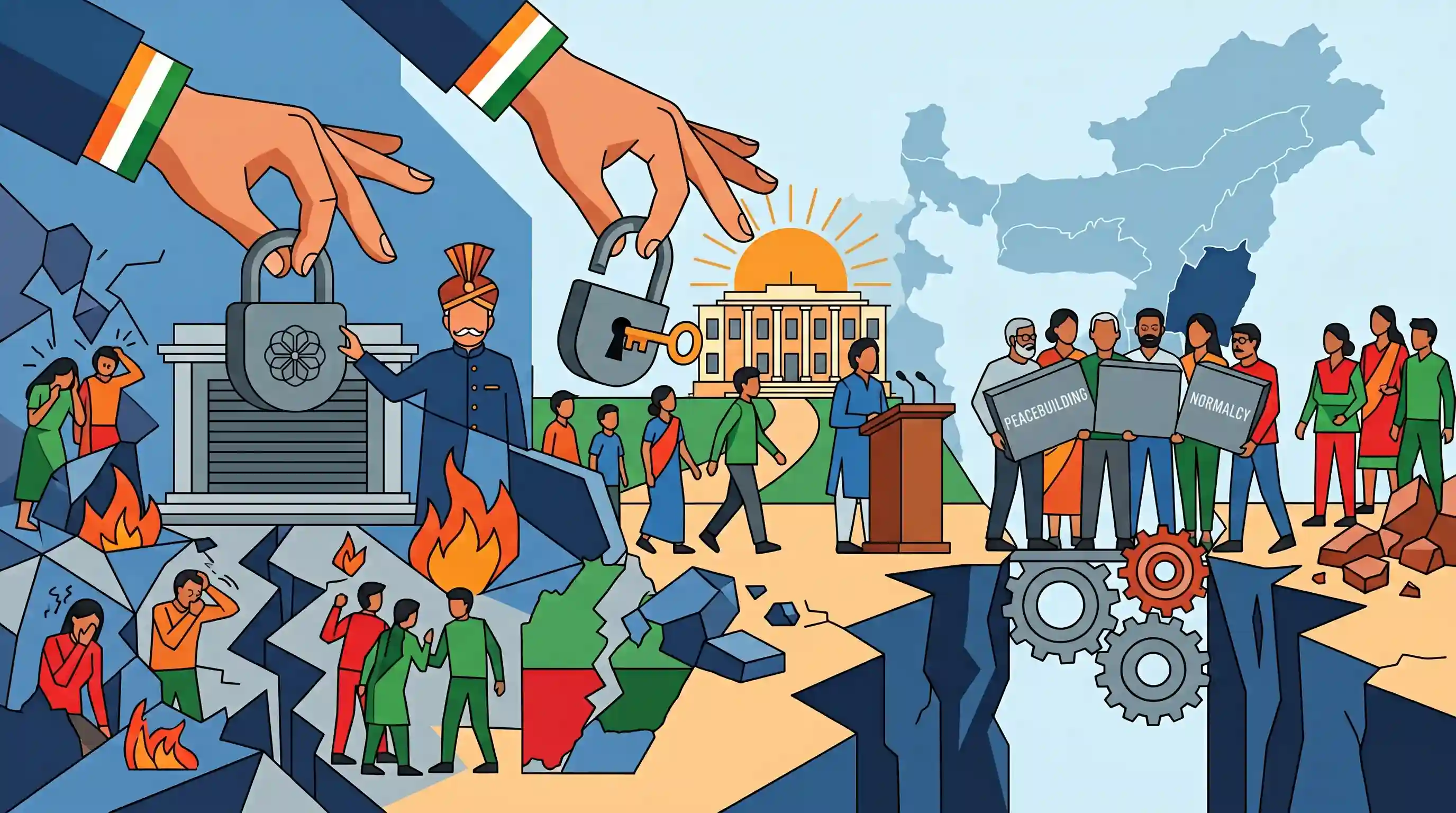
The article analyzes the political dynamics behind Manipur's return to an elected government after a prolonged period of political instability and ethnic conflict. It examines the role of the Centre and the Governor in managing the state's constitutional machinery during the crisis, likely involving the suspension of the assembly or President's Rule. The transition marks a critical step towards restoring democratic normalcy but also places the burden of peacebuilding, law and order, and bridging the severe Meitei-Kuki ethnic divide squarely on the shoulders of the reinstated political leadership.
Key Points
- Manipur has moved back towards an elected government, signaling an end to the period of central administration or suspended assembly that followed severe ethnic violence.
- The restoration highlights the constitutional mechanisms involved in Centre-State relations, specifically concerning the revocation of President's Rule (Article 356).
- The newly reinstated political leadership faces immense challenges in peacebuilding and restoring trust between the Meitei and Kuki-Zo communities.
- The development underscores the complex intersection of democratic processes and internal security management in India's North-East.
Important Terms
Article 356 (President's Rule)

Constitutional provision (Part XVIII) allowing the Union to impose President's Rule if a state government cannot function according to the Constitution. Often used in cases of political instability or law-and-order collapse.
UPSC context
GS Paper II: Emergency provisions. Tests knowledge of Centre-State relations and the 'S.R. Bommai' safeguards against executive misuse.
Article 355
Constitutional mandate obliging the Union government to protect every state from external aggression and internal disturbances, ensuring governance follows constitutional norms. Used frequently as a precursor or alternative to Article 356.
UPSC context
GS Paper II/III: Internal Security and Federalism. Tests the Union's constitutional duty during civil unrest.
Suspended Animation
A status where a state Legislative Assembly's powers are temporarily halted rather than being dissolved. This allows the assembly to be reinstated once a stable government is formed or President’s Rule is revoked.
UPSC context
GS Paper II: Polity. Tests technical understanding of legislative status during Article 356 and the Governor's role.
Armed Forces (Special Powers) Act (AFSPA)
A 1958 legislation granting special powers and legal immunity to Indian Armed Forces in designated "disturbed areas" to maintain public order. It allows for arrest and search without warrants.
UPSC context
GS Paper III: Internal Security. Tests the balance between security imperatives and civil liberties in border states.
Constitutional Machinery
The framework through which a state is governed per the Constitution. Its 'failure' or 'breakdown' is the technical prerequisite for invoking emergency provisions like President’s Rule.
UPSC context
GS Paper II: Indian Constitution. Tests understanding of what constitutes a 'breakdown' of law and order vs. political failure.
Federalism
The constitutional distribution of power between the Centre and States. In the North-East, this often involves 'asymmetric federalism' (e.g., Article 371) and complex Centre-State cooperation during ethnic crises.
UPSC context
GS Paper II: Federal structure. Tests issues of central intervention and regional autonomy in conflict zones.
Prelims Trap
Revocation of President's Rule under Article 356 requires parliamentary approval by a simple majority.
A proclamation of President’s Rule can be revoked by the President at any time via a subsequent proclamation. Unlike its imposition, revocation does not require any parliamentary approval.
Static Concepts Connected
What is the constitutional distinction between Article 355 and Article 356?
- Article 355 (Duty): Imposes a constitutional duty on the Union to protect states from external aggression and internal disturbance, acting as a precursor to direct intervention.
- Article 356 (President's Rule): Invoked when a state's constitutional machinery fails, allowing the Union to assume direct executive control and suspend or dissolve the state assembly.
What are the core principles established by the S.R. Bommai judgment (1994)?
- Judicial Review: Presidential proclamations under Article 356 are not absolute and are subject to judicial review on grounds of mala fide intent.
- Floor Test: A Chief Minister's majority must strictly be tested on the floor of the House, not determined by the Governor's subjective assessment.
- Assembly Dissolution: The state legislative assembly should only be dissolved after both Houses of Parliament have approved the President's Rule proclamation.
Cross-Topic Patterns
Topography of ethnic conflict
Manipur's valley-hill demographic divide (Meitei in 10% valley, Kuki-Zo/Naga in 90% hills) inherently links human geography directly to internal security, border management (Myanmar), and asymmetric federalism.
AFSPA and Article 371C overlap
The unique administrative setup for Manipur's hill areas (Article 371C) alongside "Disturbed Areas" notifications under AFSPA creates overlapping jurisdictions, heavily compounding Centre-State friction and security management.

Expect a multi-statement question on the procedural nuances of Article 356 revocation and the exact constitutional wording of Article 355.
Linked PYQs · 3
Linked PYQs · 3
- 2023MainsGS2
Account for the legal and political factors responsible for the reduced frequency of using Article 356 by the Union Governments since mid 1990s.
- 2025MainsGS3
What are the major challenges to internal security and peace process in the North-Eastern States? Map the various peace accords and agreements initiated by the government in the past decade.
- 2018PrelimsGS1
If the President of India exercises his power as provided under Article 356 of the Constitution in respect of a particular State, then
