Governor Legislative Address Conflicts and Constitutional Provisions
Source:Indian Express ↗
Why It Matters
The recurring conflict between Governors and elected state governments highlights significant federal fault lines. It serves as an essential case study for GS Paper 2 on the constitutional limits of the Governor's office, discretionary powers vs. ministerial advice, and the role of the judiciary in interpreting constitutional morality.
Summary
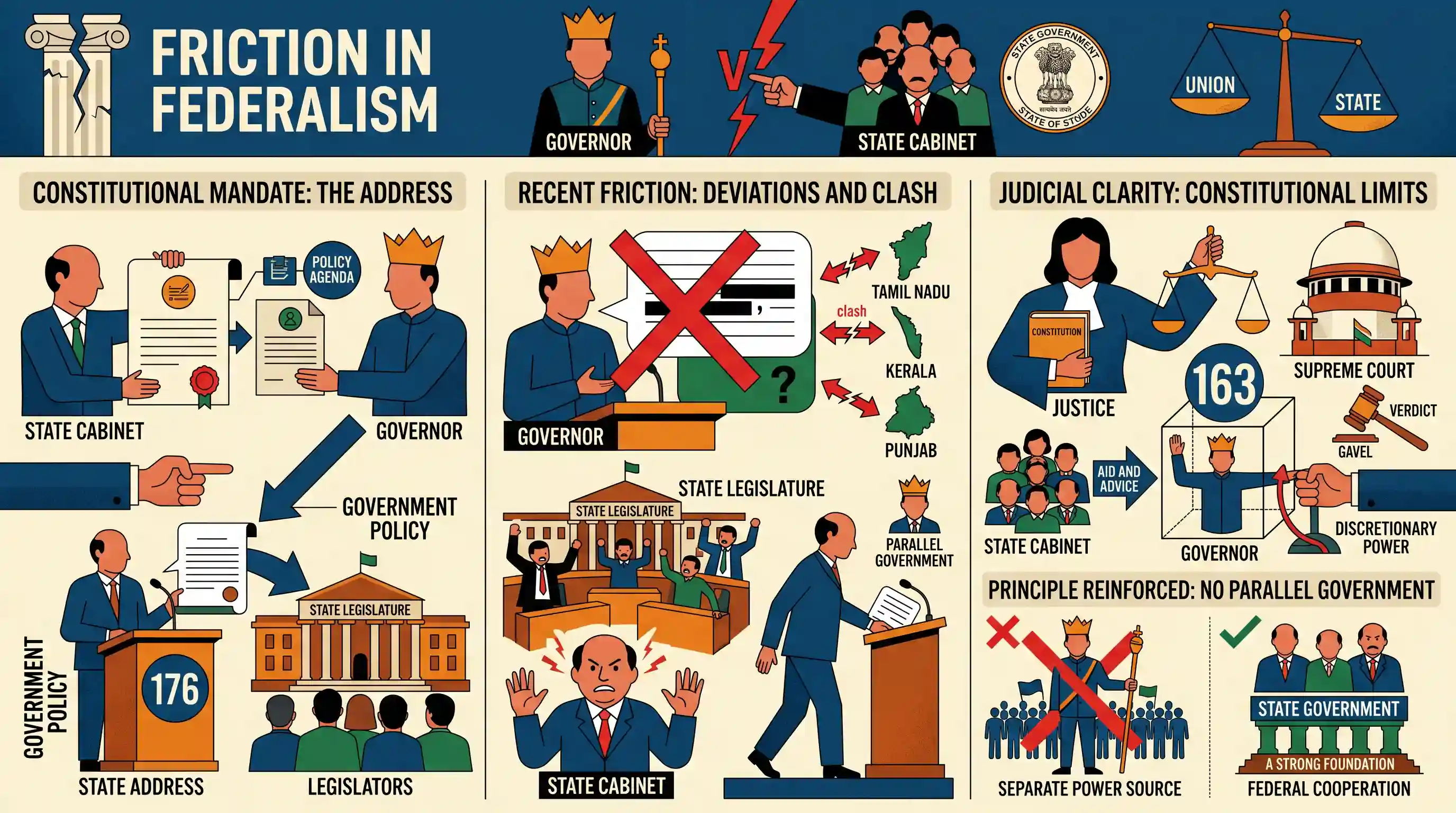
The article examines the ongoing constitutional friction between Governors and Opposition-ruled state governments over the customary Governor's address to the State Legislature. Under Article 176, the Governor is constitutionally mandated to deliver an address prepared by the state cabinet, which outlines the government's policy agenda. However, recent incidents in states like Tamil Nadu, Kerala, and Punjab have seen Governors deviating from the approved text or skipping portions altogether. Constitutional experts and Supreme Court precedents, particularly the Nabam Rebia verdict, clarify that the Governor is bound by the 'aid and advice' of the Council of Ministers (Article 163) and does not possess discretionary powers to alter the state's policy address, reinforcing the principle that a Governor cannot run a parallel government.
Key Points
- Under Article 176, the Governor must address the state legislature at the start of the first session each year, reading a speech prepared by the state cabinet that outlines government policies.
- Tensions have arisen in states like Tamil Nadu, Kerala, and Punjab where Governors have skipped portions of the prepared address or concluded it abruptly, citing disagreements with the state government.
- Article 163 restricts the Governor's discretionary powers, binding them to the 'aid and advice' of the Council of Ministers in matters including the customary legislative address.
- The Supreme Court, notably in the Nabam Rebia judgment (2016) and subsequent observations, has emphasized that the Governor cannot function as a parallel government or act outside the strict confines of constitutional discretion.
Important Terms
Article 176 of the Constitution

Constitutional provision mandating the Governor to address the State Legislature at the start of the first session annually and after general elections.
UPSC context
GS Paper II (Polity); tests understanding of the Governor's ceremonial vs. executive roles.
Article 163 of the Constitution
Mandates that the Governor act on the 'aid and advice' of the Council of Ministers except in matters requiring constitutional discretion.
UPSC context
GS Paper II (Polity); central to debates on the Governor's discretionary powers and federalism.
Nabam Rebia Case Judgment (2016)
A 2016 Supreme Court ruling that limited the Governor's discretionary powers, affirming they must generally act on ministerial advice regarding House summons.
UPSC context
GS Paper II (Judiciary/Federalism); vital precedent for cases involving gubernatorial overreach and floor tests.
State Legislature
The primary legislative body at the state level, composed of the Governor and one or two Houses (Assembly/Council).
UPSC context
GS Paper II; core component of the State Executive and Legislature relationship.
Aid and Advice Principle
The constitutional convention where the Governor/President acts solely on the recommendations of the elected Cabinet in parliamentary systems.
UPSC context
GS Paper II; fundamental to the 'nominal vs. real executive' distinction in India.
Motion of Thanks
A legislative procedure where members debate and vote on the Governor's address, serving as a test of the government's majority.
UPSC context
GS Paper II (Polity); tests knowledge of legislative procedures and executive accountability.
Constitutional Discretion
The specific powers granted to the Governor by the Constitution to act independently of the Council of Ministers' advice.
UPSC context
GS Paper II; critical for analyzing Centre-State friction and the Governor's neutral role.
Prelims Trap
The Governor has constitutional discretion to omit portions of the customary address if they conflict with Union policies.
Under Article 163 and established SC precedents, the Governor is bound by the Cabinet's 'aid and advice' for the Art 176 address. They have no constitutional discretion to edit or skip text.
Static Concepts Connected
What are the rules and implications of the Motion of Thanks?
- Mandatory Debate: It follows the customary address under Art 87 (President) or Art 176 (Governor) to debate the government's policy agenda.
- Voting Consequence: If the Motion of Thanks is defeated in the Lower House, it is treated as a loss of confidence and the government must resign.
- Amendments: MPs/MLAs can move amendments. Passing an amendment embarrasses the government, but only the defeat of the final motion forces resignation.
What was the core ruling of the Nabam Rebia (2016) judgment regarding Governors?
- Discretionary Limits: The Supreme Court ruled that a Governor's discretionary powers under Article 163 are strictly limited to explicit constitutional provisions, not general administration.
- No Parallel Government: Governors cannot act as a 'parallel government' or override the elected Cabinet's binding advice in matters like summoning or addressing the House.
Cross-Topic Patterns
Art 200 & Legislative Vetoes
Conflicts over customary addresses (Art 176) parallel the recent spate of Governors indefinitely withholding assent to state bills (Art 200), collectively testing the boundaries of cooperative federalism.
Motion of Thanks vs No-Confidence
Both test the executive's majority on the floor of the House; defeating the Motion of Thanks effectively serves as a successful No-Confidence Motion, forcing resignation.

Expect a multi-statement Polity question in 2026 contrasting Art 87 and Art 176, specifically testing 'Motion of Thanks' defeat implications.
Linked PYQs · 2
Linked PYQs · 2
- 2022MainsGS2
Discuss the essential conditions for exercise of the legislative powers by the Governor. Discuss the legality of re-promulgation of ordinances by the Governor without placing them before the Legislature.
- 2025PrelimsGS1
Consider the following statements : I. The Constitution of India explicitly mentions that in certain spheres the Governor of a State acts in his/her own discretion. II. The President of India can, of his/her own, reserve a bill passed by a State Legislature for his/her consideration without it being forwarded by the Governor of the State concerned. Which of the statements given above is/are correct?
