Poverty Trends and Empirical Data in India
Source:Indian Express ↗
આ શા માટે મહત્વનું છે
Understanding poverty estimation, data reliability, and inclusive growth trends is crucial for evaluating India's developmental policies and welfare architecture under GS Paper III.
સારાંશ
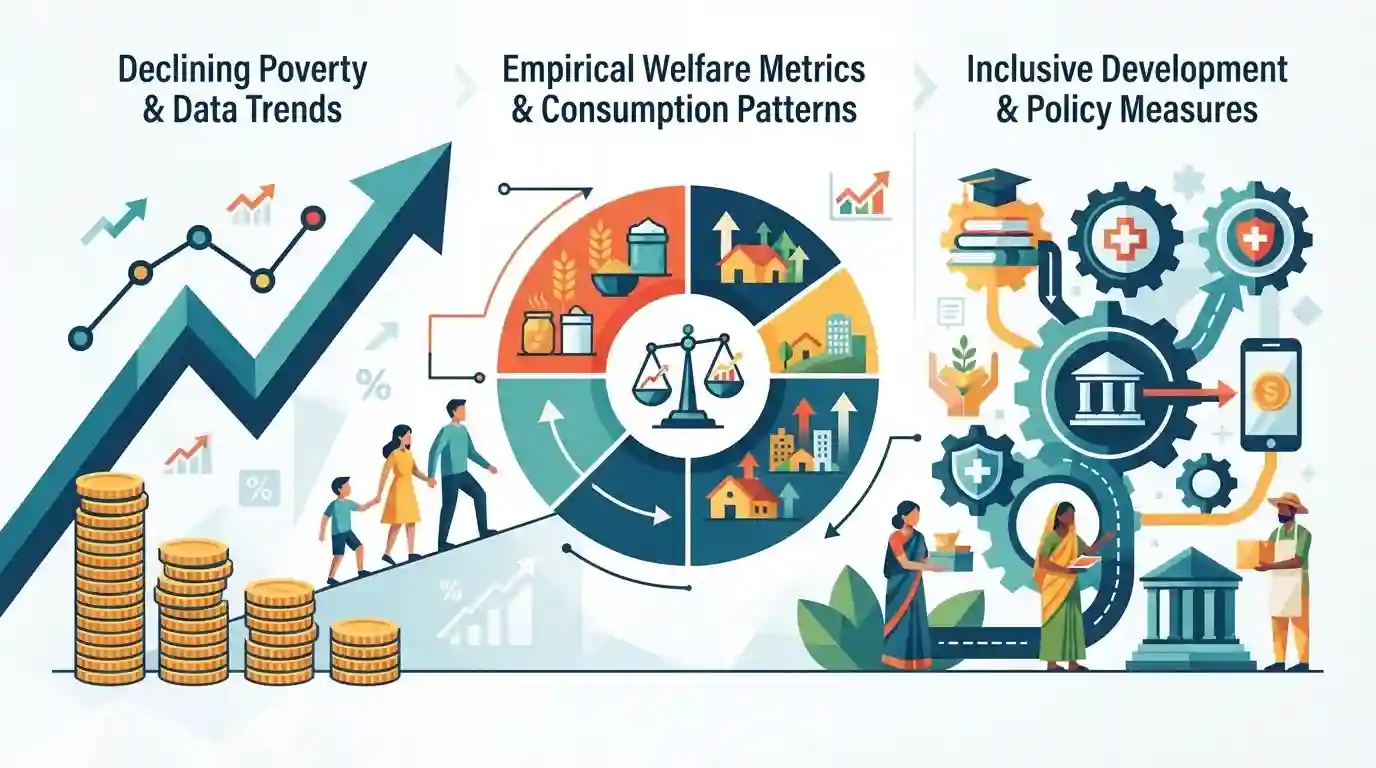
The article examines the latest data and trends concerning declining poverty in India, highlighting the implications of empirical welfare metrics, consumption patterns, and policy measures driving inclusive development.
મુખ્ય મુદ્દા
- Recent empirical data highlights a significant decline in poverty rates across India, reflecting broad-based growth and welfare interventions.
- Debates surrounding poverty measurement involve contrasting methodologies, including consumption expenditure surveys and multi-dimensional indices.
- Tracking structural economic changes and welfare delivery mechanisms remains central to inclusive growth policy discourse in India.
મહત્વપૂર્ણ શબ્દો
Multidimensional Poverty Index

A comprehensive poverty measure that captures simultaneous deprivations across health, education, and standard of living using multiple distinct indicators rather than income alone.
UPSC context
UPSC GS Paper III: Inclusive Growth and issues arising from it, Poverty and Developmental Issues. Important for assessing welfare metrics.
NITI Aayog
The apex public policy think tank of the Government of India providing both directional and policy inputs for economic development and poverty alleviation.
UPSC context
UPSC GS Paper II & III: Statutory, regulatory and various quasi-judicial bodies, Government policies and interventions for development.
સંલગ્ન સ્થિર ખ્યાલો
What is the Alkire-Foster methodology used in India's National Multidimensional Poverty Index?
- Dual Cutoff: A dual-cutoff counting approach that first identifies deprivations in specific indicators and then determines if an individual's weighted deprivations cross a poverty cutoff.
- 12 Indicators: Published by NITI Aayog, India's MPI uses 12 indicators across health, education, and standard of living (including maternal health and bank accounts).
આંતર-વિષય પેટર્ન
Poverty Measurement + Federal Fiscal Architecture
The transition from income-based poverty lines (Tendulkar/Rangarajan committees) to NITI Aayog's Alkire-Foster Multidimensional Poverty Index links statistical welfare economics with federal fiscal devolution and targeted scheme delivery.
Rural Consumption Shifts + Agricultural Distress Dynamics
Evaluating structural declines in rural poverty requires cross-referencing agricultural distress indicators, MGNREGA wage demands, and rural non-farm employment transitions.

MPI indicators (12 dimensions), Alkire-Foster method, and rural-urban poverty gap trends are high-yield for prelims multi-statement MCQs.
સંલગ્ન PYQ · 1
સંલગ્ન PYQ · 1
- 2026PrelimsGS1
Consider the following statements about Multidimensional Poverty Index (MPI) : 1. MPI is calculated using Alkire-Foster methodology. 2. MPI calculated by NITI Aayog has a total of twelve indicators. 3. Maternal Health and Bank Account are common indicators in the MPI of NITI Aayog and MPI of United Nations Development Programme (UNDP). Which of the statements given above is/are correct ?
