Left-Wing Extremism Decline Through Inclusive Development and Justice
Source:Indian Express ↗
Why It Matters
This topic is a staple in GS Paper 3 (Internal Security). UPSC frequently asks candidates to evaluate the government's approach to Naxalism and explicitly questions the linkage between the lack of development and the spread of extremism. The core argument of this article—that justice and inclusion are the true antidotes—provides a perfect framework for Mains answers and Essays.
Summary
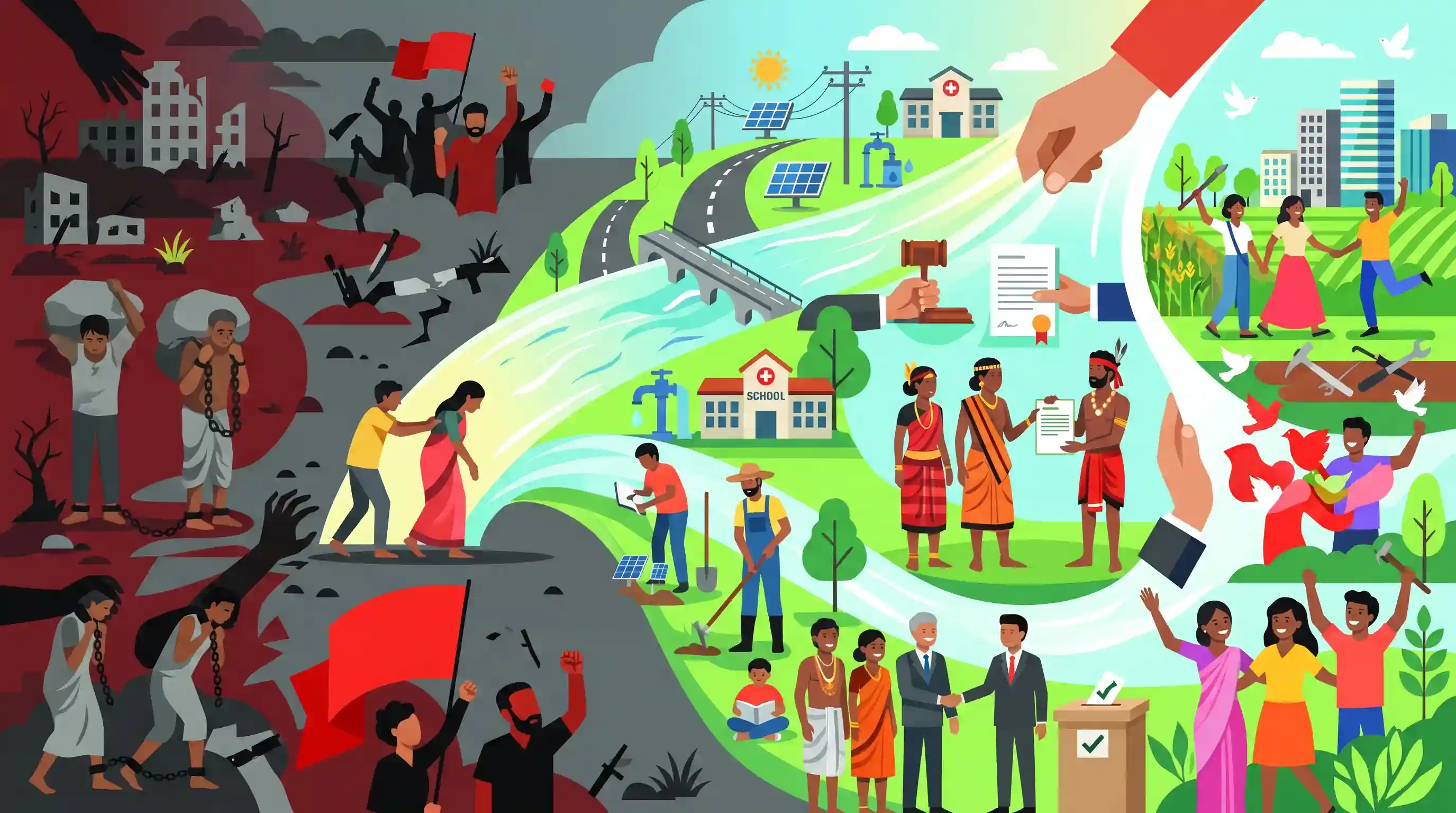
The article emphasizes that the ongoing decline of Left-Wing Extremism (Naxalism) in India highlights the success of development-oriented strategies over purely militaristic ones. It argues that extremism thrives on alienation, poverty, and systemic injustice. Therefore, ensuring progress that is deeply anchored in social justice, tribal rights, and inclusive governance is the most effective and sustainable antidote to insurgency. By addressing the fundamental socio-economic grievances of marginalized communities, the state can dismantle the ideological and material support base of Naxalism.
Key Points
- The incidence and geographical spread of Left-Wing Extremism (LWE) or Naxalism have seen a significant decline in recent years.
- While security interventions have played a role, the root cause of extremism is often rooted in perceived or real marginalization, poverty, and underdevelopment.
- Sustainable peace requires progress that is anchored in social justice, equitable resource distribution, and the inclusion of marginalized communities (especially tribals).
- A purely militaristic approach is insufficient; civil administration and developmental schemes are the ultimate antidotes to radicalization.
Important Terms
Left-Wing Extremism (LWE)

An armed insurgency based on Maoist ideology, aiming to overthrow the state by exploiting tribal marginalization, land alienation, and lack of socio-economic development.
UPSC context
GS Paper III: Internal Security. Tests understanding of the "Development-Extremism" link and non-state actor threats.
SAMADHAN Doctrine
The 2017 comprehensive counter-insurgency framework for LWE, emphasizing Smart leadership, Aggressive strategy, Actionable intelligence, and cutting off funding (No access to financing).
UPSC context
GS Paper III: Security Forces and Their Mandate. Tests knowledge of the government's multi-dimensional operational strategy.
Security-Development Nexus
The symbiotic relationship where security provides the stability for growth, while inclusive development removes the socio-economic grievances that fuel insecurity and violence.
UPSC context
GS Paper III: Internal Security. Fundamental concept for questions on why policing alone cannot solve insurgencies.
PESA Act, 1996
A 1996 law enabling tribal self-rule in Fifth Schedule areas by empowering Gram Sabhas to manage natural resources and resolve local disputes.
UPSC context
GS Paper II: Governance/Polity. Crucial for questions on decentralized governance and tribal rights as a tool against alienation.
Fifth Schedule
Constitutional provisions for the administration of tribal-dominated areas in ten states, providing safeguards for the social and economic interests of Scheduled Tribes.
UPSC context
GS Paper II: Indian Constitution. Tests understanding of special administrative frameworks for vulnerable communities.
National Policy and Action Plan (2015)
The primary strategy since 2015 that combines security operations, developmental interventions, and ensuring rights/entitlements to marginal communities in LWE-affected areas.
UPSC context
GS Paper III: Internal Security. The official policy roadmap for eliminating Naxalism through a holistic approach.
CoBRA (Commando Battalion for Resolute Action)
A specialized jungle warfare unit of the CRPF established to conduct guerrilla-style operations against Maoist insurgents in difficult terrains.
UPSC context
GS Paper III: Security Forces. Specific example of specialized forces tailored for internal security challenges.
Red Corridor
The contiguous belt of districts across central and eastern India (e.g., Chhattisgarh, Jharkhand, Odisha) that has historically faced intense Maoist violence.
UPSC context
GS Paper III: Internal Security. Geographic context for the spread and decline of LWE in India.
Prelims Trap
The SAMADHAN doctrine is a purely socio-economic developmental framework for Left-Wing Extremism areas.
Aspirants often confuse SAMADHAN as merely a welfare or peace-dialogue initiative. It actively mandates aggressive tactical military operations alongside development.
Static Concepts Connected
What are the core components of the SAMADHAN doctrine for Left-Wing Extremism?
- S & A: Focuses on smart leadership and aggressive tactical strategy by security forces to neutralize threats.
- M, A, H: Prioritizes motivation, actionable intelligence, and harnessing technology (e.g., UAVs, smart weapons) for operational efficiency.
- D, A, N: Emphasizes dashboard-based KPIs, specific action plans for each theatre, and choking the financing of LWE groups.
How does the PESA Act 1996 address the root causes of Naxalism?
- Gram Sabha Empowerment: Recognizes the Gram Sabha as the core institution for self-governance, conflict resolution, and local resource management in Schedule V areas.
- Minor Forest Produce: Grants ownership of Minor Forest Produce (MFP) to local tribal communities, securing livelihoods and reducing economic marginalization.
- Land Alienation: Empowers the Gram Sabha to prevent the alienation of land in Scheduled Areas, directly addressing a primary grievance exploited by LWE groups.
Cross-Topic Patterns
Aspirational Districts & LWE overlap
The Aspirational Districts Programme specifically targets many LWE-affected districts, shifting the state's focus from 'security-only' deployments to measurable socio-economic governance indicators.
Critical Minerals vs Tribal Rights
India's push for critical minerals risks repeating past displacement in central India. Balancing mining imperatives with PESA/FRA implementation will dictate whether LWE remains dormant.

GS3 Mains 2026 is highly likely to ask for a critical evaluation of 'security-development convergence' in dismantling the LWE ecosystem.
Linked PYQs · 4
Linked PYQs · 4
- 2022MainsGS3
Naxalism is a social, economic and developmental issue manifesting as a violent internal security threat. In this context, discuss the emerging issues and suggest a multilayered strategy to tackle the menace of Naxalism.
- 2018MainsGS3
Left Wing Extremism (LWE) is showing a downward trend, but still affects many parts of the country. Briefly explain the Government of India's approach to counter the challenges posed by LWE.
- 2025MainsGS3
The Government of India recently stated that Left Wing Extremism (LWE) will be eliminated by 2026. What do you understand by LWE and how are the people affected by it? What measures have been taken by the government to eliminate LWE?
- 2020MainsGS3
What are the determinants of left-wing extremism in Eastern part of India? What strategy should Government of India, civil administration and security forces adopt to counter the threat in the affected areas?
