Geopolitical Shifts and Nuclear Advancement in Iranian Foreign Policy
Source:The Hindu ↗
Why It Matters
Understanding Iran's changing strategic calculus is crucial for UPSC aspirants, as it directly impacts West Asian stability, global energy security, and India's nuanced diplomatic balancing act between Israel, Iran, and the Arab states.
Summary
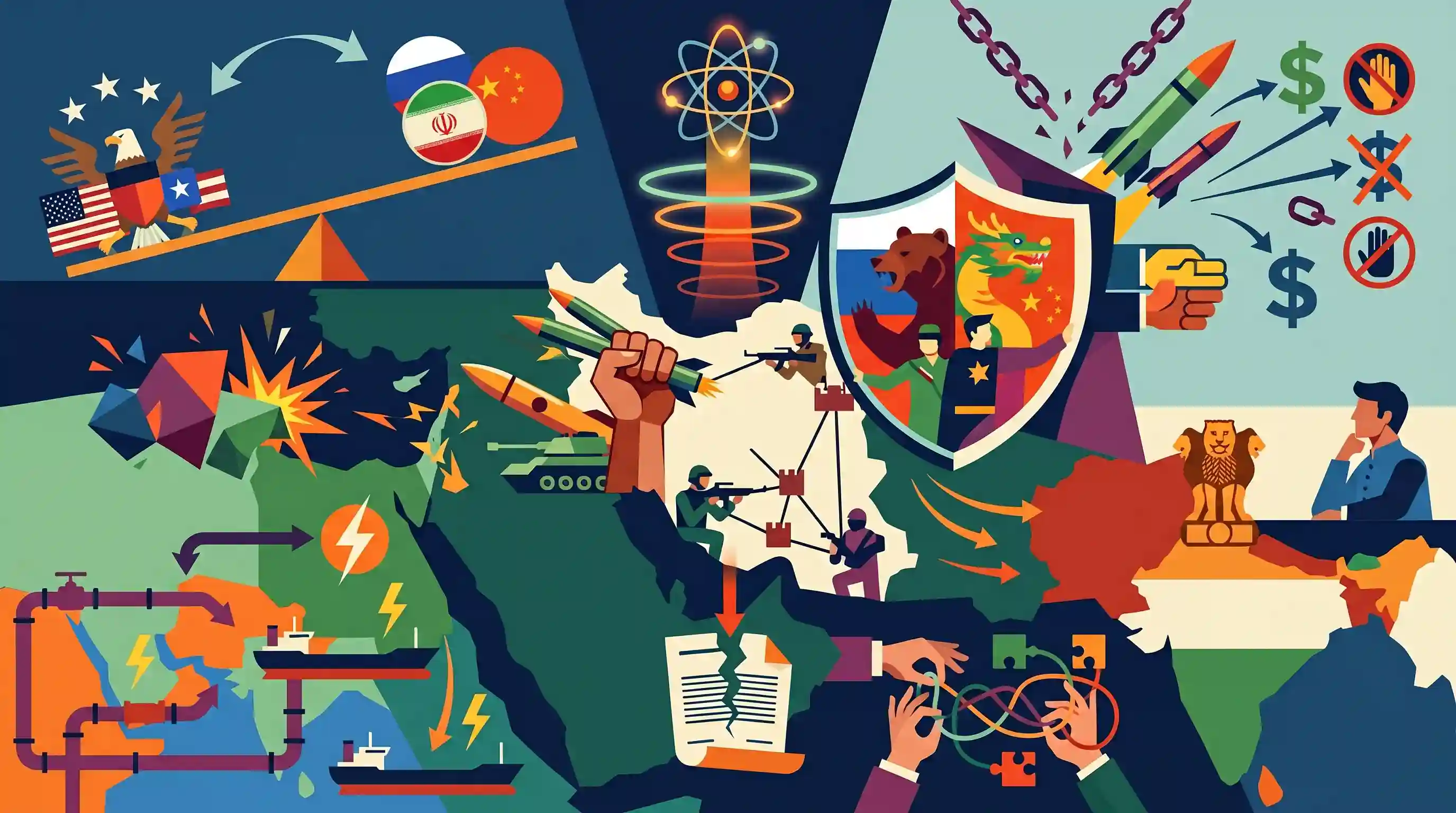
The article analyzes the evolving geopolitical dynamics surrounding Iran, highlighting several 'decisive new factors' that complicate the West Asian security landscape. Key developments include Iran's increasingly assertive military posture, its strategic utilization of the 'Axis of Resistance', and the rapid advancement of its nuclear program following the breakdown of the JCPOA. Furthermore, Iran's deepening alignment with Russia and China serves as a buffer against Western sanctions, fundamentally shifting the regional balance of power. These factors collectively create a complex conundrum for international diplomacy, with profound implications for regional stability, global energy security, and India's strategic interests in the Middle East.
Key Points
- Iran is shifting from 'strategic patience' to a more assertive regional posture, directly countering adversaries and leveraging its 'Axis of Resistance' proxy network.
- The collapse of the JCPOA has allowed Iran to significantly advance its nuclear enrichment capabilities, posing a critical challenge to global non-proliferation efforts.
- To offset Western economic sanctions, Iran is deepening its strategic and military partnerships with Russia and China, altering the geopolitical balance in West Asia.
- These intersecting factors—nuclear advancement, proxy warfare, and Eurasian alignments—present a massive conundrum for US policy and threaten global energy security.
Important Terms
Joint Comprehensive Plan of Action (JCPOA)

A 2015 agreement between Iran and the P5+1 powers to restrict Iran’s nuclear activities in exchange for the lifting of economic sanctions.
UPSC context
GS Paper II (International Relations). Tests nuclear non-proliferation dynamics and their impact on Indian energy security.
Axis of Resistance
An informal Iran-led military and political alliance including Hezbollah, Hamas, and the Houthis, aimed at countering Western and Israeli influence.
UPSC context
GS Paper II (International Relations). Essential for analyzing West Asian security and its implications for the Indian diaspora.
IAEA (International Atomic Energy Agency)
The UN-linked nuclear watchdog responsible for verifying that Iran’s nuclear program remains peaceful and ensuring compliance with international safeguards.
UPSC context
GS Paper II (International Institutions). Tests knowledge of global governance and nuclear security monitoring frameworks.
INSTC (International North-South Transport Corridor)
A 7,200-km multi-mode transit route connecting India, Iran, and Russia, designed to bypass Pakistan for trade with Central Asia and Europe.
UPSC context
GS Paper II (Bilateral Relations). Relevant for India’s strategic autonomy and connectivity alternatives to China’s BRI.
Chabahar Port
A deep-water port in Iran, developed with Indian assistance, providing a strategic trade gateway to Afghanistan and Central Asia bypassing Pakistan.
UPSC context
GS Paper II (Bilateral Relations). Tests India’s regional outreach and counter-balancing strategies in the Indian Ocean Region.
Prelims Trap
"US sanctions universally apply to all Indian investments in Iran, strictly prohibiting Chabahar port development."
India secured a specific US sanctions waiver for the Chabahar port project due to its role in Afghan reconstruction. It is exempt from CAATSA.
Static Concepts Connected
What is the geographic route and strategic aim of the INSTC?
- Geographic Route: A 7,200-km multi-modal network connecting Mumbai (India) to St. Petersburg (Russia) via Bandar Abbas (Iran) and the Caspian Sea.
- Strategic Aim: It completely bypasses Pakistan and the Suez Canal, aiming to reduce freight time and cost by 30-40% for India-Eurasia trade.
- Multi-modal Integration: Integrates ship, rail, and road networks across India, Iran, Azerbaijan, and Russia to secure robust energy and trade supply chains.
How does the IAEA classify enriched uranium for civilian vs. military use?
- Low Enriched Uranium: U-235 concentration under 20% (typically 3-5%). Used safely in commercial light water reactors for civilian energy generation.
- Highly Enriched Uranium: U-235 concentration above 20%. Weapons-grade material generally requires a 90% or higher enrichment threshold.
- IAEA Safeguards: Binding agreements ensuring nuclear materials are not diverted to military programs, utilizing comprehensive unannounced inspections and continuous camera monitoring.
Cross-Topic Patterns
Connectivity vs. China's BRI
Iran acts as a geopolitical pivot. India’s Chabahar and INSTC investments directly compete with the China-Pakistan Economic Corridor (Gwadar), testing India’s ability to bypass Pakistan structurally.
SCO, BRICS and Sanction-Proofing
Iran's strategy reflects a broader 'Axis of Upheaval' theme, leveraging non-Western multilateral platforms (SCO, BRICS) to dilute Western economic sanctions and challenge the US-led unipolar financial order.

Expect a multi-statement Prelims question mapping Iran's proxies (Houthis/Hezbollah) to their operational seas (Red Sea/Mediterranean).
Linked PYQs · 4
Linked PYQs · 4
- 2025MainsGS2
"Energy security constitutes the dominant kingpin of India's foreign policy, and is linked with India's overarching influence in Middle Eastern countries.” How would you integrate energy security with India's foreign policy trajectories in the coming years?
- 2018MainsGS2
In what ways would the ongoing US-Iran Nuclear Pact Controversy affect the national interest of India? How should India respond to this situation?
- 2017MainsGS2
The question of India's Energy Security constitutes the most important part of India's economic progress. Analyze India's energy policy cooperation with West Asian countries.
- 2018MainsGS2
“India’s relations with Israel have, of late, acquired a depth and diversity, which cannot be rolled back.” Discuss.
