Chhattisgarh anti-naxal operations reach strategic turning point
Source:The Hindu ↗
Why It Matters
Provides a contemporary case study on the effectiveness of India's counter-insurgency strategy against Left Wing Extremism, emphasizing the need for a multi-pronged approach that balances military action with socio-economic development and peace dialogues.
Summary
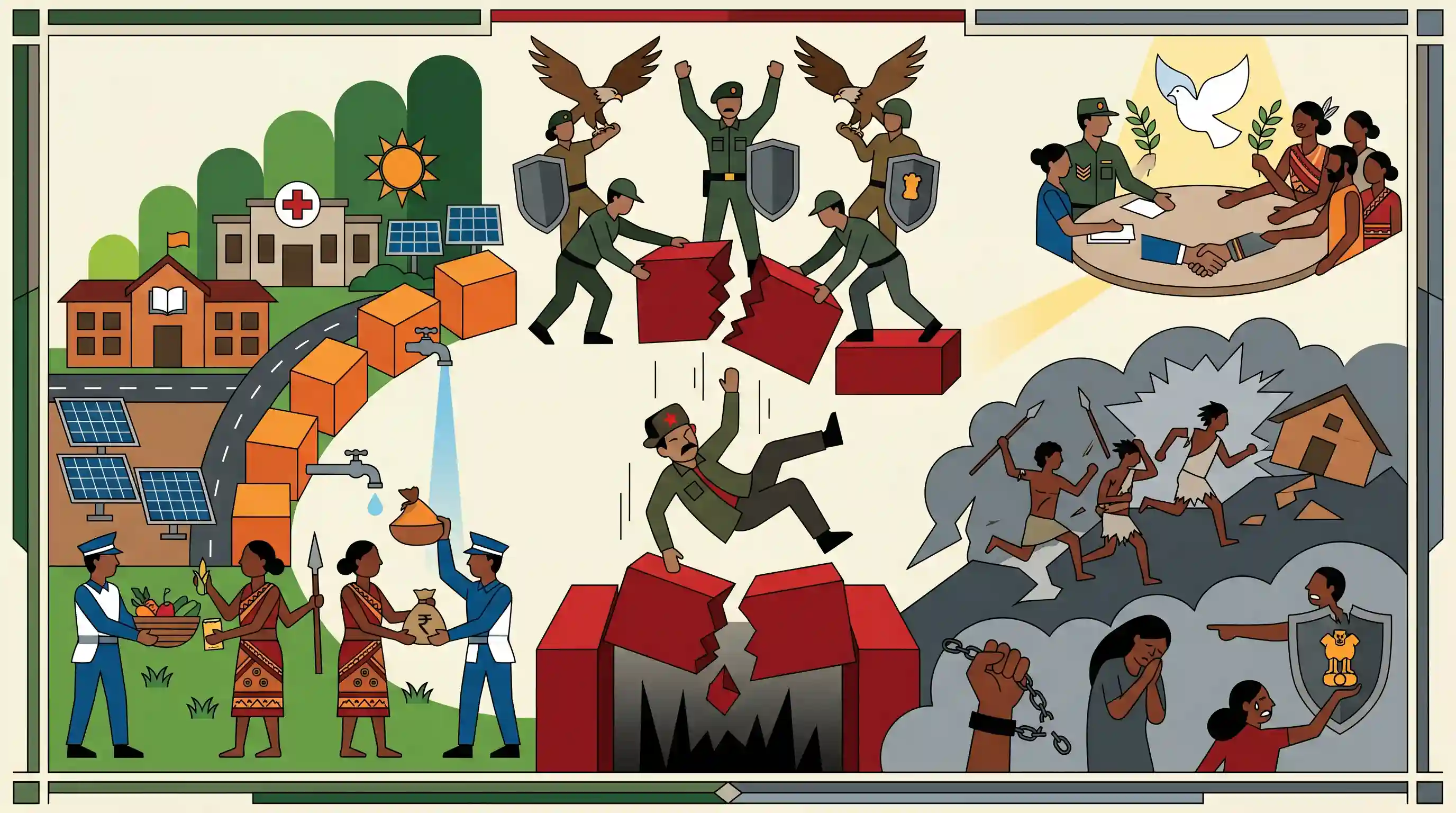
The killing of CPI (Maoist) general secretary Namballa Keshav Rao in Chhattisgarh represents a major strategic victory for Indian security forces and highlights the failure of the Maoists' armed struggle. Alongside military successes, the government's tribal welfare initiatives have significantly eroded the insurgents' support base and recruitment pool. However, the editorial cautions that intensive security operations have also led to tribal casualties, suggesting that the state should use its current position of strength to pursue peace talks rather than relying solely on a policy of annihilation, which risks breeding fresh resentment.
Key Points
- The elimination of CPI (Maoist) general secretary Namballa Keshav Rao (Basavaraju) in a security operation marks a significant blow to the insurgents' militarist strategy.
- There is a noticeable decline in Maoist recruitment and support among the tribal population in south Chhattisgarh, driven by disillusionment with violence and increased state welfare outreach.
- The government aims to eradicate the Maoist threat by 2026 through a combination of intensive security operations and development initiatives.
- The editorial warns against a purely militaristic 'annihilation' policy, arguing that the government should leverage its current advantage to initiate peace talks and prevent further alienation of tribal youth.
Important Terms
Communist Party of India (Maoist)

The primary insurgent group in India, formed in 2004, aiming to overthrow the state through armed struggle. It is banned under the Unlawful Activities (Prevention) Act.
UPSC context
GS Paper III: Internal Security. Tests knowledge of major insurgent groups and their impact on national security.
Left Wing Extremism (LWE)
An armed insurgency, also known as Maoism or Naxalism, motivated by leftist ideologies to dismantle democratic structures in favor of a communist state.
UPSC context
GS Paper III: Internal Security. A recurring theme regarding the "biggest internal security threat" to India.
SAMADHAN Doctrine
The Ministry of Home Affairs' multi-pronged operational strategy to combat Naxalism, focusing on Smart leadership, Aggressive strategy, Actionable intelligence, and No access to financing.
UPSC context
GS Paper III: Internal Security. Tests awareness of government frameworks and counter-insurgency tactics.
Security-Development Nexus
A policy framework suggesting that security operations must be coupled with socio-economic development (infrastructure, welfare) to permanently resolve insurgencies.
UPSC context
GS Paper III: Linkages between development and spread of extremism. Core to answering "Way Forward" questions.
Abujhmarh
A hilly forest region in Chhattisgarh's Bastar division, historically serving as the unmapped and heavily forested nerve center of the Maoist movement.
UPSC context
GS Paper III & I: Internal Security and Geography. Important for locating the geographic focus of LWE operations.
Protracted People’s War
The Maoist military strategy of using guerrilla warfare and mobilizing the rural population to encircle cities and eventually overthrow the state.
UPSC context
GS Paper III: Internal Security. Tests understanding of insurgent ideology and operational methodology.
Prelims Trap
The SAMADHAN doctrine is exclusively a militaristic strategy deployed by the Home Ministry to eliminate Maoists.
SAMADHAN is a holistic approach. While it includes kinetic operations, it heavily emphasizes technology, actionable intelligence, financial asphyxiation, and works in tandem with developmental initiatives.
Static Concepts Connected
What are the core components of the SAMADHAN doctrine against LWE?
- Leadership & Strategy: Stands for Smart leadership, Aggressive strategy, and Motivated training to counter insurgents proactively rather than defensively.
- Intelligence & Tech: Focuses on Actionable intelligence and Harnessing technology (like UAVs, smart tracking, and telecom expansion) to achieve operational superiority in dense forests.
- Financial Asphyxiation: 'No access to financing' is a critical pillar aimed at cutting off extortion networks, money laundering, and disrupting the underlying Maoist economy.
How do constitutional provisions like PESA and FRA act as counter-insurgency tools?
- Democratic decentralization: PESA empowers Gram Sabhas in Schedule V areas with control over minor forest produce, structurally countering Maoist propaganda about state exploitation of tribal resources.
- Land tenure security: The Forest Rights Act (2006) grants individual and community titles, correcting historical injustices of land alienation that have traditionally fueled LWE recruitment.
Cross-Topic Patterns
LWE clearance & Critical Mineral extraction
Eradicating Maoist strongholds in Bastar opens access to critical mineral reserves. This links internal security victories to economic geography, but risks sparking corporate-tribal conflicts if rights are ignored.
Aspirational Districts as Counter-Insurgency
The Aspirational Districts Programme structurally targets LWE-affected regions. This reveals a governance pattern where developmental saturation is leveraged as a non-kinetic tool to eliminate the socio-economic vacuums insurgents exploit.

A 2026 GS3 question will likely evaluate if the 'March 2026 zero-LWE deadline' requires shifting from kinetic ops to political dialogue.
Linked PYQs · 2
Linked PYQs · 2
- 2022MainsGS3
Naxalism is a social, economic and developmental issue manifesting as a violent internal security threat. In this context, discuss the emerging issues and suggest a multilayered strategy to tackle the menace of Naxalism.
- 2018MainsGS3
Left Wing Extremism (LWE) is showing a downward trend, but still affects many parts of the country. Briefly explain the Government of India's approach to counter the challenges posed by LWE.
