Global Crude Oil Market Trends and Retail Fuel Price Determinations
Source:The Hindu ↗
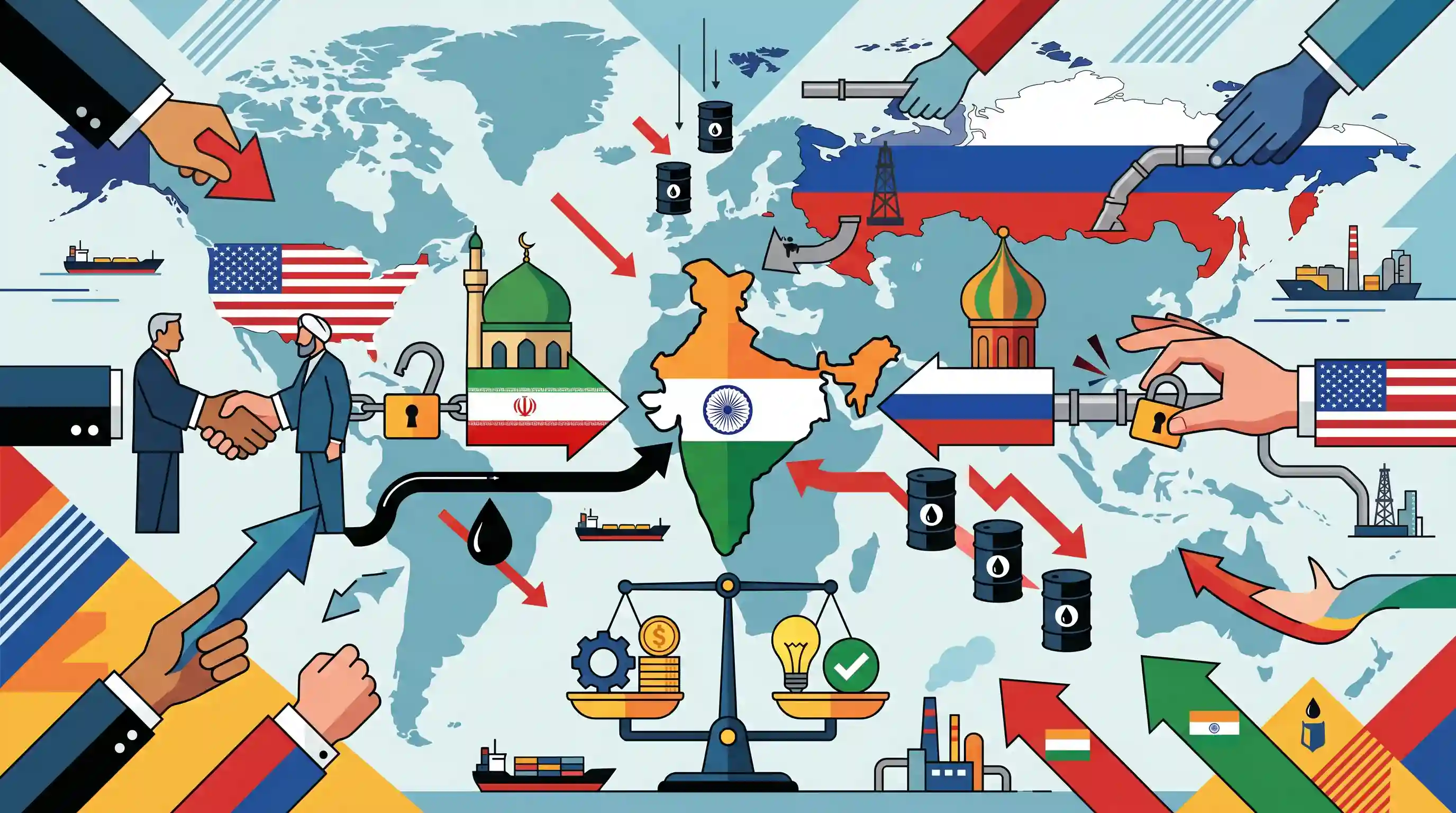
Why It Matters
Fluctuations in global crude oil prices directly impact India's macroeconomic stability, inflation, and current account deficit. Understanding the interplay between geopolitical events (like U.S. sanctions and West Asia tensions) and India's energy security strategy is crucial for analyzing India's strategic autonomy and economic resilience.
Summary
The Indian government stated that potential retail fuel price cuts will be dictated by the evolving global crude oil market, which recently saw a dip in prices due to a prospective U.S.-Iran peace deal. While the agreement could lift sanctions on Iranian oil, the U.S. has simultaneously allowed waivers on Russian oil imports to expire, signaling tighter restrictions. Amid these geopolitical shifts, India’s Petroleum Ministry emphasized that its crude oil procurement strategy—including purchases from Russia and Iran—remains firmly rooted in techno-commercial viability and supply reliability, rather than geopolitical pressures.
Key Points
- The Union Petroleum Ministry announced that decisions on retail fuel price cuts in India will depend on international crude oil price trends.
- Global oil prices, such as the benchmark Brent crude, have recently dipped to around $78.53 per barrel in anticipation of a U.S.-Iran peace deal.
- The potential peace deal could lift U.S. sanctions on Iranian oil, easing global supplies.
- Conversely, the U.S. allowed waivers on Russian oil purchases to expire, with President Donald Trump indicating increased sanctions on Russia.
- India maintains that its crude oil purchases from any nation, including Iran and Russia, are driven strictly by 'techno-commercial viability' and 'reliability of supply'.
- Earlier, escalating tensions in West Asia had pushed crude prices near $120 per barrel, leading Indian oil-marketing companies to hike retail fuel prices.
Important Terms
U.S.-Iran peace deal

A 2026 agreement aimed at ending Middle East hostilities, reopening the Strait of Hormuz, and easing U.S. sanctions on Iranian oil exports.
UPSC context
GS-II: International Relations; effect of policies and politics of developed and developing countries on India’s interests.
Oil Marketing Companies (OMCs)
Public or private entities (e.g., IOCL, BPCL, HPCL) responsible for the refining, distribution, and retail marketing of petroleum products in India.
UPSC context
GS-III: Indian Economy; infrastructure and energy sector pricing mechanisms.
G7 Price Cap
A mechanism imposed by G7 nations to limit Russian oil revenue by prohibiting Western services for exports sold above a specific price threshold.
UPSC context
GS-II: Global groupings and agreements; GS-III: Effect of global geopolitics on energy trade.
Energy Security
The uninterrupted availability of energy sources at an affordable price, achieved through diversified sourcing and domestic production to mitigate global supply shocks.
UPSC context
GS-III: Infrastructure: Energy; crucial for economic development and national security.
Techno-commercial viability
A procurement standard ensuring crude oil is compatible with domestic refinery technology (technical) while remaining cost-effective and reliable (commercial).
UPSC context
GS-III: Economic Development; tests understanding of India’s strategic oil procurement policies.
Strait of Hormuz
A critical maritime chokepoint between the Persian Gulf and Gulf of Oman, through which approximately 20% of global oil supply passes.
UPSC context
GS-I: Geography; GS-II: Geopolitical importance of maritime trade routes.
Prelims Trap
The Government of India determines the retail price of petrol and diesel based on global crude oil fluctuations.
Petrol and diesel were deregulated in 2010 and 2014. Oil Marketing Companies (OMCs), not the government, formally determine retail prices via daily dynamic pricing based on global benchmarks.
Static Concepts Connected
How are retail petrol and diesel prices determined in India?
- Deregulation: Petrol and diesel prices were deregulated in 2010 and 2014, shifting away from the government-controlled Administered Price Mechanism (APM).
- Dynamic Pricing: Oil Marketing Companies (OMCs) revise prices daily based on Trade Parity Price (TPP), factoring in global crude benchmark rates and the INR-USD exchange rate.
- Tax Component: Central Excise Duty and state-level Value Added Tax (VAT) make up roughly 40-50% of the final retail price paid by consumers.
What is the difference between Brent Crude and WTI?
- Origin: Brent is extracted from the North Sea (Europe), while WTI (West Texas Intermediate) is extracted from US oil fields.
- Characteristics: Both are 'light and sweet', but WTI is slightly lighter and has lower sulfur content than Brent, making it easier to refine.
- Benchmark Role: Brent dictates prices for nearly two-thirds of the world's traded crude (including India's Indian Basket), while WTI primarily serves as the US benchmark.
Cross-Topic Patterns
Crude prices & Current Account Deficit (CAD)
A $10/barrel rise in crude typically widens India’s CAD by ~0.5% of GDP and stokes imported inflation, linking Middle East geopolitics directly to the RBI's monetary policy and inflation targeting.
Secondary sanctions vs. Strategic Autonomy
India's crude procurement from Russia and Iran, despite expiring US waivers and CAATSA threats, perfectly illustrates the application of 'strategic autonomy' balancing Western pressure with domestic energy security.

Expect a 2026 Prelims statement comparing Brent/WTI crude properties, or testing the macroeconomic impact of crude prices on India's CAD.
Linked PYQs · 3
Linked PYQs · 3
- 2025MainsGS2
"Energy security constitutes the dominant kingpin of India's foreign policy, and is linked with India's overarching influence in Middle Eastern countries.” How would you integrate energy security with India's foreign policy trajectories in the coming years?
- 2012MainsGS2
How have the US sanctions against Iran affected India's bilateral relations with Iran?
- 2020PrelimsGS1
The term 'West Texas Intermediate', sometimes found in news, refers to a grade of
