Mob Lynching and Rule of Law Challenges in India
Source:Indian Express ↗
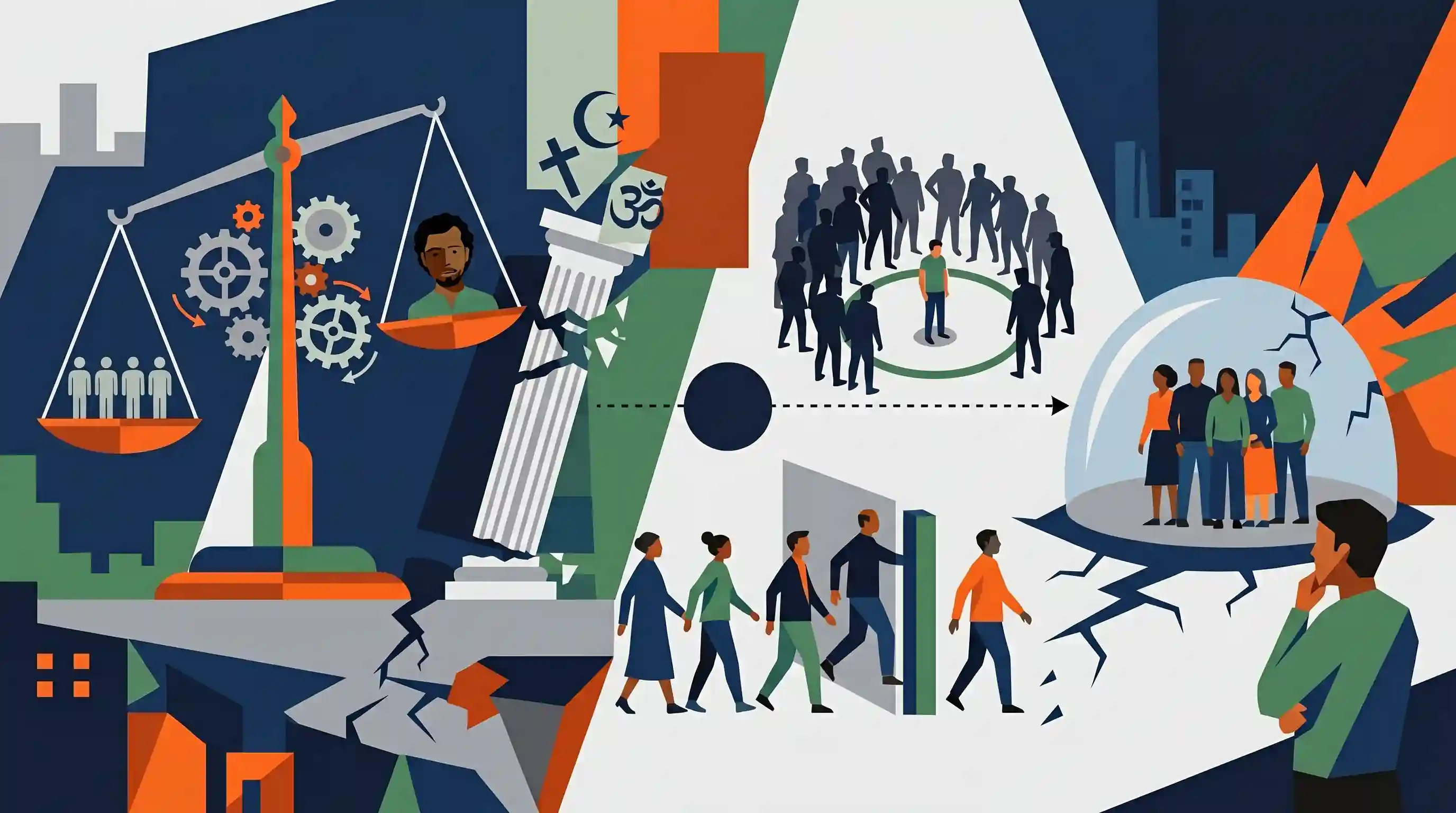
Why It Matters
Mob violence and the unequal application of justice challenge the constitutional guarantee of equality before the law (Article 14) and the protection of life and liberty (Article 21). For UPSC aspirants, understanding the socio-political and ethical dimensions of hate crimes is critical for evaluating internal security, social harmony, and the efficacy of governance frameworks.
Summary
Reflecting on a decade since the tragic mob lynching of Mohammed Akhlaq in Dadri, the article underscores a troubling transformation in India's socio-political landscape. Drawing parallels to systemic miscarriages of justice, it argues that the rule of law is severely compromised when the severity of a crime is judged by the identity of its victim. The piece highlights how the normalization of vigilantism, coupled with an indifferent or slow criminal justice system, creates a culture of impunity. Ultimately, it raises profound questions about the survival of secularism, minority rights, and collective societal conscience in contemporary India.
Key Points
- The 10-year retrospective on the Dadri mob lynching of Mohammed Akhlaq highlights a systemic failure to deliver swift justice in cases of targeted vigilante violence.
- The narrative raises the concern that the criminal justice system and societal conscience often weigh the gravity of a crime against the socio-religious identity of the victim.
- Prolonged delays, witness hostility, and lack of accountability in mob violence cases create a culture of impunity, emboldening extra-constitutional actors.
- The normalization of hate crimes reflects deepening communal polarization and an erosion of foundational constitutional values like secularism, pluralism, and fraternity.
- Highlights the ethical deficit in governance and policing when the state apparatus fails to protect marginalized communities and uphold the rule of law impartially.
Prelims Trap
The Indian Penal Code (IPC) explicitly defined and penalized 'mob lynching' as a distinct crime.
The IPC never specifically defined mob lynching; it was prosecuted under general murder or riot sections. It is the new Bharatiya Nyaya Sanhita (BNS) 2023 that officially codifies it.
Static Concepts Connected
What are the Tehseen Poonawalla guidelines on mob lynching?
- Nodal Officers: States must appoint a Nodal Officer (not below SP rank) in each district to prevent mob violence and vigilantism.
- Fast-track courts: Establish designated fast-track courts to try mob violence cases daily and conclude trials within six months.
- Victim Compensation: State governments are mandated to formulate a victim compensation scheme under CrPC Section 357A (now BNSS Sec 396).
How does the BNS 2023 penalize mob lynching?
- Specific Offence: Section 103(2) of BNS explicitly penalizes murder by a group of five or more persons acting together.
- Defined Grounds: The crime must be motivated by race, caste, community, sex, place of birth, language, or personal belief.
- Punishment: Offenders face life imprisonment or the death penalty, putting the crime at par with murder.
Cross-Topic Patterns
Mob justice & administrative ethics
GS4 links vigilante justice to the breakdown of administrative ethics, testing a civil servant's ability to withstand majoritarian pressure and uphold Constitutional morality against mobocracy.
Digital radicalization & public order
GS3 internal security often connects real-world vigilantism to the spread of fake news on social media, making combating digital radicalization critical for maintaining public order.

A Mains GS2 or GS4 question in 2026 will likely evaluate BNS 2023's new mob lynching provisions against the Tehseen Poonawalla guidelines.
Linked PYQs · 5
Linked PYQs · 5
- 2015MainsGS2
Khap Panchayats have been in the news for functioning as extra-constitutional authorities, often delivering pronouncements amounting to human rights violations. Discuss critically the actions taken by the legislative, executive and the judiciary to set the things right in this regard.
- 2021MainsGS2
Though the Human Rights Commissions have contributed immensely to the protection of human rights in India, yet they have failed to assert themselves against the mighty and powerful. Analyzing their structural and practical limitations, suggest remedial measures.
- 2018MainsGS1
Communalism arises either due to power struggle or relative deprivation.' Argue by giving suitable illustrations.
- 2022MainsGS1
Are tolerance, assimilation and pluralism the key elements in the making of an Indian form of secularism? Justify your answer.
- 2023MainsGS4
Is conscience a more reliable guide when compared to laws, rules and regulations in the context of ethical decision-making ? Discuss.
