Experts Raise Concerns Over Western Ghats Infrastructure
Source:The Hindu ↗
Why It Matters
This article serves as an excellent, multi-dimensional case study on infrastructure-induced disasters in ecologically sensitive areas. It integrates the physical geography of landslides, meteorological drivers of extreme weather (Kelvin and Rossby waves), and environmental governance loopholes (SEIAA clearances), matching prominent UPSC themes across GS1, GS2, and GS3 papers.
Summary
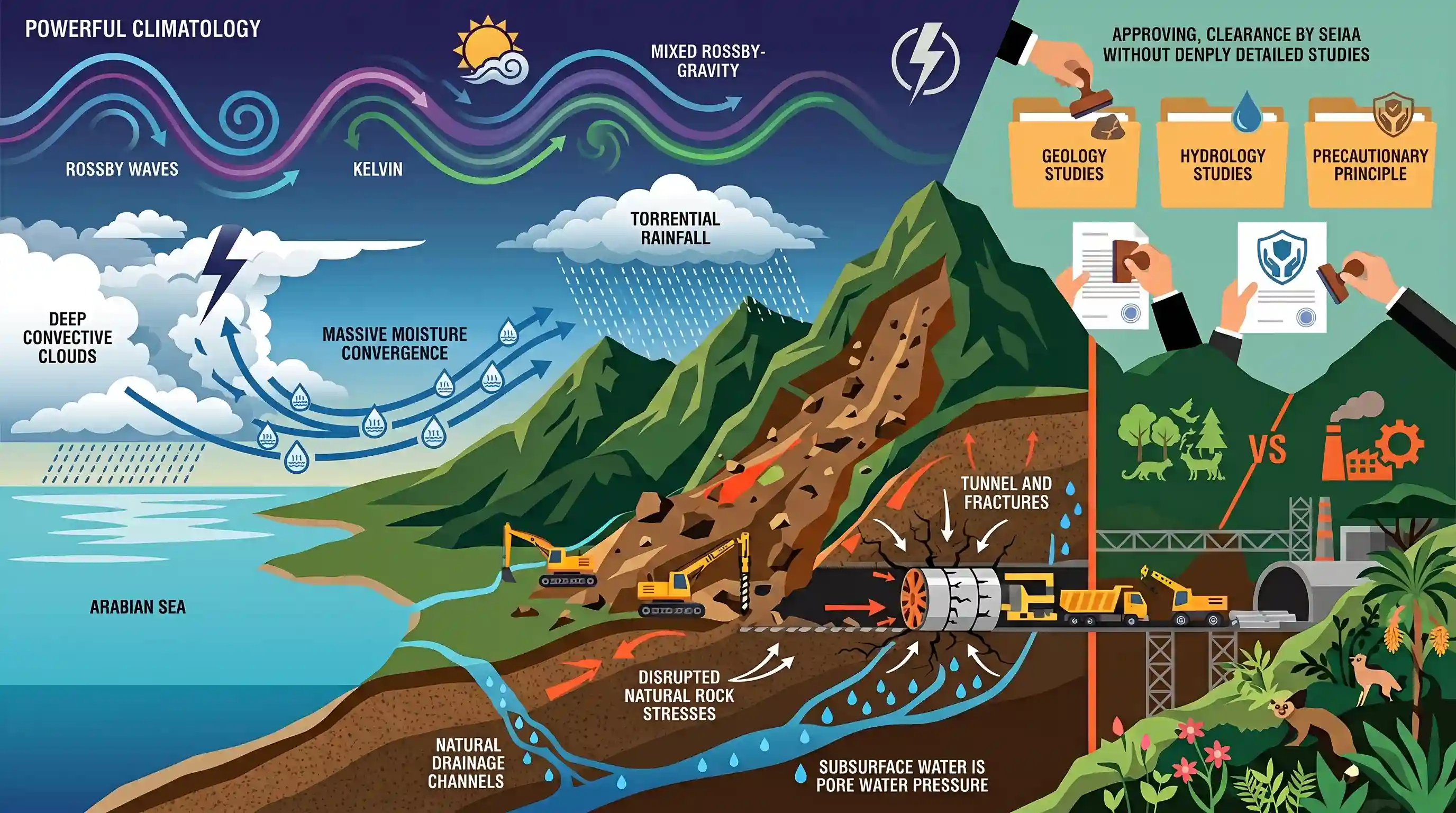
Following a debris slip disaster at Kalladi (near the under-construction Wayanad tunnel road project site in Kerala), environmentalists and geoscientists have raised alarms over large infrastructure projects in the ecologically vulnerable Western Ghats. Experts point out that the project was cleared by the State Environmental Impact Assessment Authority (SEIAA) without detailed geological and hydrological studies, disregarding the precautionary principle. Mechanically, tunnelling disrupts natural rock-soil stresses, triggers fractures, and raises subsurface pore water pressure when intersecting natural drainage. Additionally, scientists link the intensifying rainfall regimes in the region to invisible atmospheric waves (such as Rossby, Kelvin, and Mixed Rossby-Gravity waves) that organize deep convective clouds and cause heavy moisture convergence over the Arabian Sea and the Western Ghats, compounding the vulnerability to landslides.
Key Points
- Wayanad Tunnel Road Project Slip: A massive debris slip occurred at Kalladi, near the entrance of the under-construction Kozhikode–Wayanad tunnel road project, reinforcing concerns regarding mega-infrastructure projects in fragile mountain ecosystems.
- Geological Disruption of Tunnelling: Geoscientists point out that tunnelling alters natural stress distribution, creates subsurface fractures, and weakens soil cohesion. Intersecting natural drainage paths increases pore water pressure, leading to foundation shifts and landslides.
- Loopholes in Clearance & Governance: Environmentalists highlighted that the project was cleared by the State Environmental Impact Assessment Authority (SEIAA) without detailed hydrological or geological studies, bypassing the precautionary principle and imposing unscientific mitigation terms (such as demanding 'no vibrations during blasting').
- Meteorological Aggravation by Atmospheric Waves: CUSAT scientists state that global atmospheric waves—specifically Kelvin, Rossby, and Mixed Rossby-Gravity waves—significantly intensify heavy rainfall over the Western Ghats by organizing deep convective cloud systems and increasing moisture convergence.
- Demand for Independent Assessments: Critics and environmentalists are demanding an immediate halt to the tunnel project, revocation of the SEIAA environmental clearance, and the implementation of a comprehensive, independent Environmental and Social Impact Assessment (ESIA) by an expert panel.
Important Terms
Environmental Impact Assessment (EIA) Notification

A statutory mechanism under India's Environment (Protection) Act, 1986, requiring prior environmental appraisal and clearance for specified developmental, infrastructure, and industrial projects.
UPSC context
GS Paper III (Environmental Impact Assessment); tests knowledge of environmental governance, regulatory clearances, and sustainable development.
Precautionary Principle
A core environmental jurisprudence principle asserting that if an action risks causing serious or irreversible harm, protective measures must be taken even in the absence of absolute scientific certainty.
UPSC context
GS Paper III (Environment) and GS IV (Ethics); tests understanding of risk-averse development planning and hazard mitigation.
State Environmental Impact Assessment Authority (SEIAA)
A state-level regulatory body in India constituted by the Union Environment Ministry to grant or reject environmental clearances for Category 'B' projects under the EIA Notification.
UPSC context
GS Paper III (Environmental Governance) & GS II (Statutory Bodies); tests knowledge of decentralized environmental administration.
National Institute of Advanced Studies (NIAS)
A premier Indian multidisciplinary research institution located in Bengaluru, conducting advanced research in natural sciences, social sciences, and humanities to inform policy-making.
UPSC context
GS Paper III (Science & Technology / Disaster Management); tests awareness of national institutes providing scientific policy inputs.
Cochin University of Science and Technology (CUSAT)
A highly reputed state university in Kerala known for advanced atmospheric research, particularly on weather patterns, monsoons, and extreme climatic events affecting the region.
UPSC context
GS Paper III (Science & Technology / Climatology); tests knowledge of regional institutions studying monsoon variability and atmospheric waves.
Prelims Trap
Landslides in both the Himalayas and the Western Ghats are primarily driven by active tectonic instability and deep-seated rock fractures.
Western Ghats landslides are primarily meteorological and anthropogenic in origin, acting on highly weathered clay/laterite soils, unlike the tectonically driven, deep-seated bedrock failures of the active Himalayas.
Static Concepts Connected
How do Himalayan landslides geologically differ from those in the Western Ghats?
- Tectonic Origin: Himalayas are young fold mountains characterized by active tectonic instability, steep slopes, and highly fractured rocks. Western Ghats are stable, older fault-blocks.
- Material type: Himalayan slopes are prone to deep rock-sliding due to structural failures. Western Ghats feature thick, highly weathered, clayey, and lateritic soil overburdens prone to shallow debris flows.
- Primary triggers: Himalayan slides are triggered by earthquakes, road-cutting, and rain. Western Ghats slides are almost purely triggered by heavy monsoon precipitation combined with human slope modification.
What is the environmental clearance classification under the EIA Notification 2006?
- Category A Projects: These projects require environmental clearance from the central MoEFCC based on recommendations of the Expert Appraisal Committee (EAC).
- Category B Projects: These are appraised at the state level by the State Environmental Impact Assessment Authority (SEIAA) and the State Level Expert Appraisal Committee (SEAC).
- B1 vs B2 Subcategories: Category B is subdivided into B1 (which requires a mandatory detailed Environmental Impact Assessment report) and B2 (which is generally exempted from EIA).
Cross-Topic Patterns
Disaster Management + EIA Reforms
Bypassing detailed geological and hydrological studies during state-level SEIAA clearances directly compromises disaster resilience, showing the critical need to integrate disaster management with environmental clearance protocols.
Climatology + Infrastructure Design
As equatorial wave systems increase extreme rain events, infrastructure engineering must transition from using historical rainfall averages to dynamic, wave-linked predictive climate models.

Multi-statement questions in 2026 may contrast Himalayan vs Ghats landslide mechanics alongside equatorial wave precipitation triggers.
Linked PYQs · 4
Linked PYQs · 4
- 2021MainsGS1
Differentiate the causes of landslides in the Himalayan region and Western Ghats.
- 2021MainsGS3
Describe the various causes and the effects of landslides. Mention the important components of the National Landslide Risk Management Strategy.
- 2019MainsGS3
Disaster preparedness is the first step in any disaster management process. Explain how hazard zonation mapping will help disaster mitigation in the case of landslides.
- 2016PrelimsGS1
'Gadgil Committee Report' and 'Kasturirangan Committee Report', sometimes seen in the news, are related to
