ISRO Launch Vehicle Debris Recovery and Space Safety
Source:The Hindu ↗
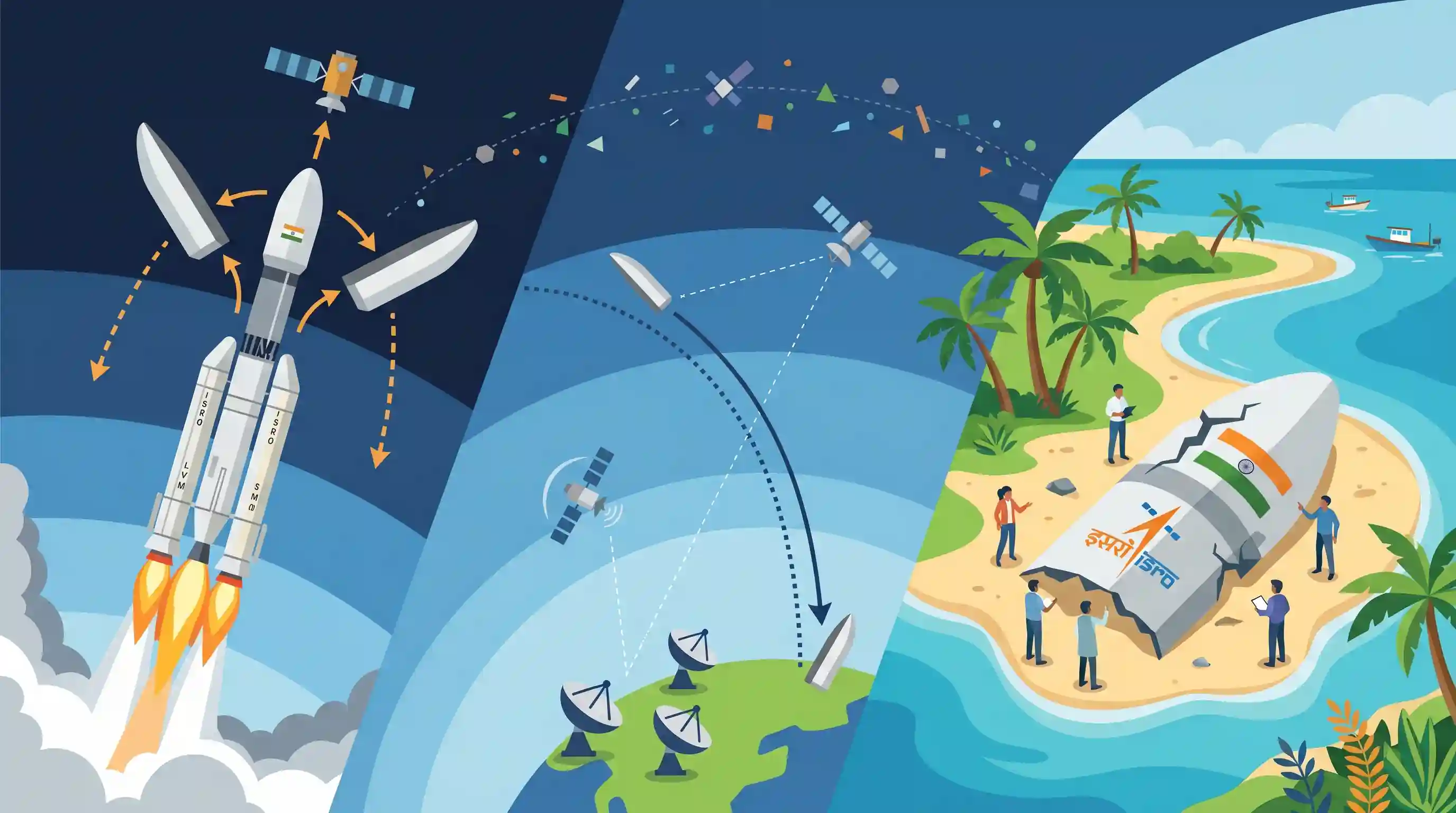
Why It Matters
Space debris and the mechanical specifics of India's launch vehicles (like LVM3/GSLV Mk III) are direct fixtures of the UPSC GS3 Space syllabus and Prelims. This incident serves as a practical example of space junk return, tying into Kessler Syndrome and international space liability discussions.
Summary
Debris suspected to be a Payload Fairing (PLF) from ISRO's Launch Vehicle Mark-3 (LVM-3) was discovered on an uninhabited island in the Maldives, bearing the ISRO logo and Indian national emblem. Preliminary assessments suggest it may have originated from recent heavy-lift missions like the LVM3-M6/BlueBird Block-2 or CMS-03. This follows a similar debris recovery in Sri Lanka. While no damage to life or property was reported, such incidents bring to light the environmental and safety considerations surrounding space debris, launch vehicle stage jettisoning, and the tracking responsibilities of space-faring nations.
Key Points
- Debris identified as a Payload Fairing (PLF) with an ISRO logo washed ashore on an uninhabited island near L. Kunahandhoo, Maldives.
- The debris is suspected to be from ISRO's Launch Vehicle Mark-3 (LVM-3), likely from recent commercial launches like the LVM3-M6/BlueBird Block-2 or CMS-03 missions.
- A similar piece of debris was previously recovered in Trincomalee, Sri Lanka, highlighting the widespread geographical impact of falling space hardware.
- LVM3 is ISRO's heaviest rocket, a three-stage launch vehicle featuring two solid strap-on motors, a liquid core stage, and a cryogenic upper stage.
- The incident underscores the growing concern of space debris management and the tracking of jettisoned launch vehicle stages as global space activity increases.
Important Terms
Launch Vehicle Mark-3 (LVM3)

ISRO's most powerful three-stage heavy-lift rocket, nicknamed 'Bahubali.' It can carry 4,000 kg to Geosynchronous Transfer Orbit (GTO) and is the designated vehicle for the Gaganyaan human spaceflight mission.
UPSC context
GS Paper III (Space Technology); critical for understanding India's heavy-lift capabilities and indigenous launch infrastructure.
Payload Fairing (PLF)
A protective nose cone at the top of a rocket that shields the satellite from aerodynamic heating and pressure during ascent through the atmosphere before being jettisoned.
UPSC context
GS Paper III (Science & Tech); technical knowledge of launch stages and orbital debris management.
LVM3-M6 Mission
A December 2025 commercial mission that deployed the BlueBird Block-2 satellite, marking the heaviest commercial payload (~6,100 kg) ever launched from Indian soil.
UPSC context
GS Paper III (Science/Economy); tests awareness of ISRO's commercial successes through NewSpace India Limited (NSIL).
CMS-03 (GSAT-7R)
A multi-band strategic communication satellite (also GSAT-7R) launched in late 2025 to provide secure, real-time networking for the Indian Navy across the Indian Ocean Region.
UPSC context
GS Paper III (Security/Science); relevant for maritime domain awareness and strategic space assets.
AST SpaceMobile
A U.S.-based aerospace firm collaborating with ISRO to launch satellites that provide 4G/5G cellular broadband connectivity directly to standard, unmodified smartphones from space.
UPSC context
GS Paper III (Science); tracks global trends in telecommunications and international commercial space partnerships.
Space Debris
Defunct human-made objects in space, including spent rocket stages and satellite fragments, which pose risks to active spacecraft and maritime safety upon re-entry.
UPSC context
GS Paper III (Environment/Science); involves international laws like the Space Liability Convention and orbital sustainability.
Prelims Trap
Liability for damage caused by space debris on the Earth's surface is fault-based.
Under the 1972 UN Space Liability Convention, a launching state has ABSOLUTE liability for damage caused on Earth's surface, not fault-based. Fault-based only applies in space.
Static Concepts Connected
What is the stage configuration of the Launch Vehicle Mark-3 (LVM3)?
- First Stage (Solid): Two S200 solid strap-on motors that provide the massive initial thrust required at liftoff.
- Second Stage (Liquid): An L110 core stage powered by twin Vikas engines, utilizing liquid fuel.
- Third Stage (Cryogenic): The C25 upper stage utilizing highly efficient liquid hydrogen and liquid oxygen.
What are the key international legal frameworks governing space debris?
- Outer Space Treaty: The foundational 1967 treaty declaring states are internationally responsible for all national activities in outer space.
- Liability Convention (1972): Imposes absolute liability on launching states to pay compensation for damage caused by their space objects on Earth's surface.
- Mitigation Guidelines: Voluntary guidelines by UNCOPUOS aimed at limiting the generation of new space debris during missions.
Cross-Topic Patterns
Space Situational Awareness (SSA) imperative
Debris incidents tie directly into ISRO's Project NETRA, highlighting India's strategic shift from merely launching satellites to actively managing space traffic and mitigating the Kessler syndrome.
Space fallout in the Indian Ocean Region
The recovery of ISRO hardware in Sri Lanka and Maldives intersects with India's diplomatic footprint in the IOR, necessitating coordinated bilateral debris recovery protocols under the Neighborhood First policy.

Expect a Prelims question pairing Project NETRA with the UN Space Liability Convention, testing absolute vs fault-based space liability.
Linked PYQs · 2
Linked PYQs · 2
- 2018PrelimsGS1
With reference to India's satellite launch vehicles, consider the following statements: 1. PSLVs launch the satellites useful for Earth resources monitoring whereas GSLVs are designed mainly to launch communication satellites. 2. Satellites launched by PSLV appear to remain permanently fixed in the same position in the sky, as viewed from a particular location on Earth. 3. GSLV Mk III is a four-staged launch vehicle with the first and third stages using solid rocket motors; and the second and fourth stages using liquid rocket engines. Which of the statements given above is/are correct?
- 2011MainsGS2
Write a short note on the 'Kessler syndrome' with reference to space debris.
