Union Budget 2026 structural reforms and fiscal consolidation policy
Source:The Hindu ↗
Why It Matters
Understanding the nuances of the Union Budget is crucial for aspirants to analyze government policies, fiscal management strategies, and their broader impacts on the Indian economy, forming a core component of the GS3 syllabus.
Summary
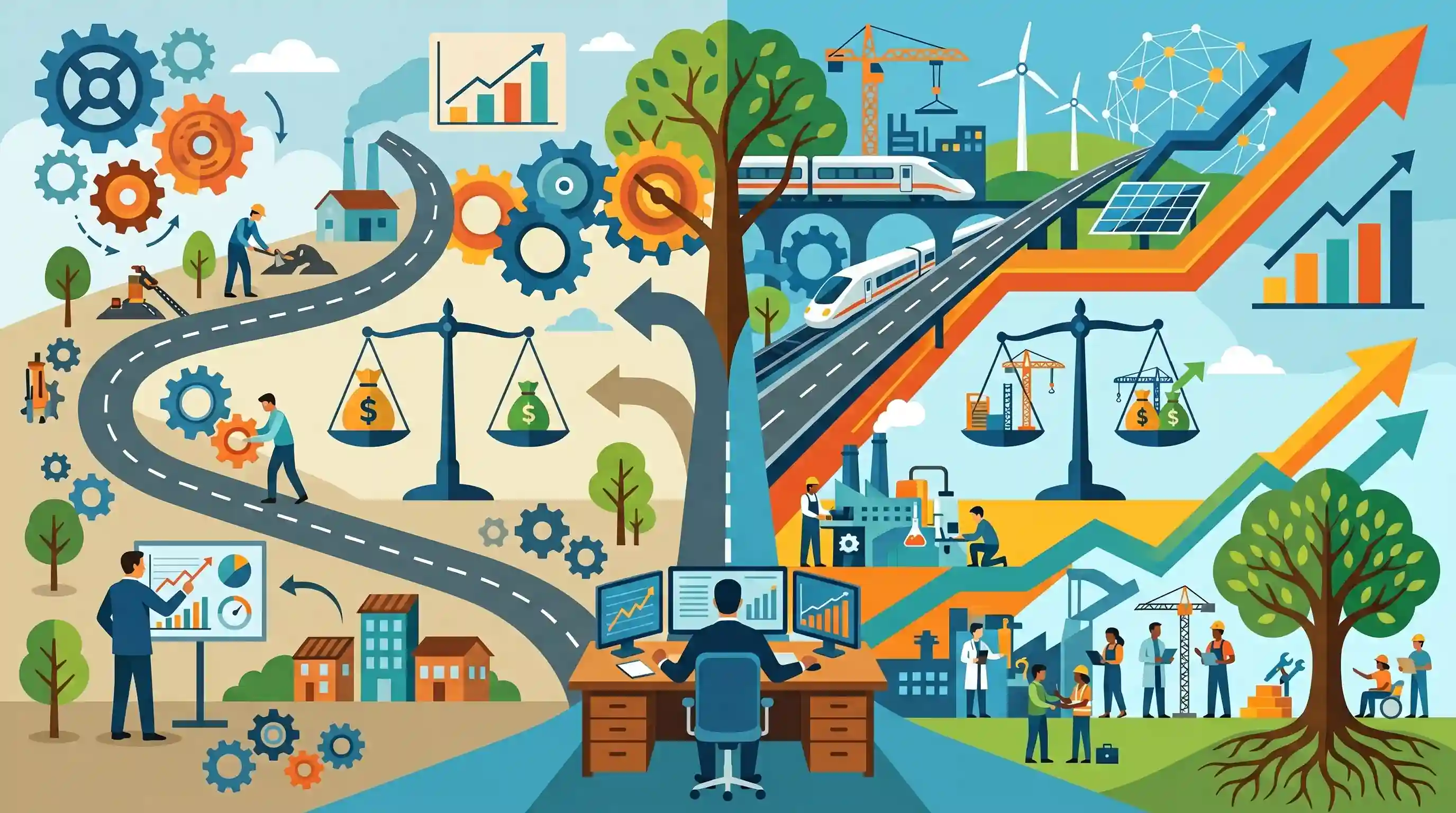
This analysis of the Union Budget 2026 evaluates whether the budgetary provisions represent a significant 'turning point' characterized by bold structural reforms, or merely 'tinkering' through incremental adjustments. Key parameters for this debate include the allocation of capital expenditure versus revenue expenditure, the trajectory of fiscal consolidation in line with macroeconomic stability, and the overall impact on employment generation and inclusive growth. The article underscores the challenge of balancing immediate welfare needs with long-term infrastructure investment to sustain economic momentum.
Key Points
- The debate over Union Budget 2026 centers on whether it introduces transformative structural reforms ('turning point') or relies on incremental policy adjustments ('tinkering').
- A critical area of evaluation is the balance between capital expenditure (aimed at long-term asset creation and infrastructure) and revenue expenditure (focused on welfare schemes and subsidies).
- Fiscal consolidation remains a key focus, assessing the government's adherence to a steady fiscal glide path towards lower fiscal deficits while maintaining macroeconomic stability.
- The budget's effectiveness is measured against its capacity to generate employment, drive inclusive growth, and stimulate private sector investment.
Important Terms
Union Budget

The 'Annual Financial Statement' (Article 112) detailing the government's estimated receipts and expenditures for the upcoming financial year.
UPSC context
GS III: Government Budgeting. Essential for understanding constitutional mandates and the government's annual economic roadmap.
Fiscal Consolidation
Policies aimed at reducing the government's fiscal deficit and debt-to-GDP ratio to maintain long-term macroeconomic stability.
UPSC context
GS III: Fiscal Policy. Tests understanding of debt sustainability and the balance between spending and financial health.
Capital Expenditure (Capex)
Government spending on the creation or acquisition of physical assets like infrastructure, which generates long-term economic returns and jobs.
UPSC context
GS III: Investment Models. Focuses on the multiplier effect of public investment on GDP growth.
FRBM Act (2003)
A 2003 law that provides a statutory framework for fiscal discipline, targeting specific reductions in deficits and public debt.
UPSC context
GS III: Fiscal Policy. A key legislative mechanism for ensuring transparency and inter-generational equity in management.
Fiscal Deficit
The total gap between government expenditure and its non-debt receipts, indicating the total amount the government needs to borrow.
UPSC context
GS III: Indian Economy. The primary metric used to assess the nation's fiscal health and borrowing pressure.
Revenue Expenditure
Government spending on day-to-day operational needs like salaries, pensions, and interest payments that do not result in asset creation.
UPSC context
GS III: Government Budgeting. Tests the ability to analyze the quality of government spending (consumption vs. investment).
Inclusive Growth
Economic growth that creates opportunities for all segments of society and ensures equitable distribution of benefits, especially to marginalized groups.
UPSC context
GS III: Inclusive Growth. A recurring theme in Mains regarding social justice and equitable development.
Prelims Trap
"Grants-in-aid to States for creating capital assets are classified as Capital Expenditure."
They are recorded as Revenue Expenditure because the Centre doesn't own the resulting asset. However, they are added to direct capex to calculate 'Effective Capital Expenditure'.
Static Concepts Connected
How does Capital Expenditure differ from Revenue Expenditure in macroeconomic impact?
- Asset Creation: Capex creates permanent assets or reduces liabilities, whereas revenue expenditure funds operational costs, salaries, and subsidies.
- Multiplier Effect: Capex has a high multiplier (up to 4.80) that crowds in private investment; revenue expenditure has a lower multiplier (~0.98).
- Effective Capex: Calculated by adding grants-in-aid given to States for capital assets to the Centre's direct capex.
What are the core fiscal consolidation anchors suggested by the N.K. Singh Committee?
- Debt-to-GDP Anchor: Targets a combined debt-to-GDP ratio of 60%, divided into 40% for the Centre and 20% for the States.
- Escape Clause: Allows for a 0.5% deviation from deficit targets during structural reforms, national security crises, or severe economic shocks.
Cross-Topic Patterns
Capex multiplier + Cooperative federalism
The Centre's reliance on 'Effective Capital Expenditure' hinges on state capacity to execute infrastructure projects, linking macroeconomic fiscal policy directly with center-state financial relations.
Fiscal consolidation vs welfare populism
Balancing the FRBM debt glide path against immediate electoral demands often shifts government focus from supply-side structural reforms to demand-side revenue expenditure tinkering.

Capex multiplier effects and the exact components of 'Effective Capital Expenditure' are highly probable Prelims 2026 targets.
Linked PYQs · 4
Linked PYQs · 4
- 2021MainsGS3
Distinguish between Capital Budget and Revenue Budget. Explain the components of both these Budgets.
- 2017MainsGS3
One of the intended objectives of the Union Budget 2017-18 is to 'transform, energise and clean India'. Analyse the measures proposed in the Budget 2017-18 to achieve the objective.
- 2024MainsGS3
Examine the pattern and trend of public expenditure on social services in the post-reforms period in India. To what extent this has been in consonance with achieving the objective of inclusive growth?
- 2021MainsGS3
“Investment in infrastructure is essential for more rapid and inclusive economic growth.” Discuss in the light of India's experience.
