Crackdown on protests and regional instability in Iran
Source:The Hindu ↗
Why It Matters
The ongoing conflict underscores the volatile geopolitics of the Middle East, particularly around the strategic chokepoints of the Strait of Hormuz and Persian Gulf, which are crucial for global energy security. India relies heavily on this region for its hydrocarbon needs and diaspora security, making the interplay of major powers (US, Iran, Israel) and regional proxies a direct concern for India's foreign policy and economic stability.
Summary
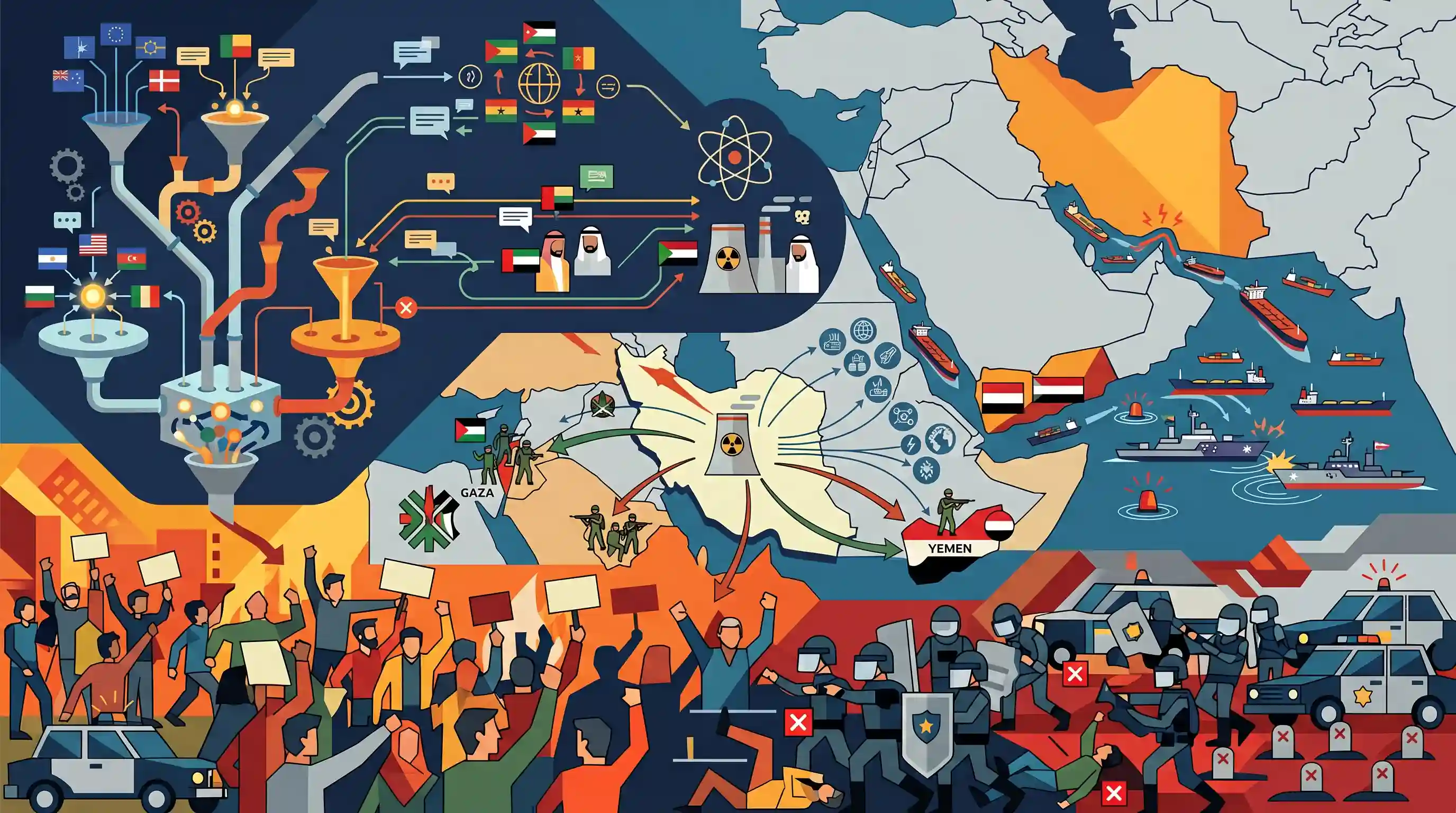
Activists report that over 7,000 people have died in Iran’s crackdown on nationwide protests following the 12-day Iran-Israel war in June. Despite intense domestic unrest, Iran is engaged in indirect negotiations with the US regarding its nuclear programme, facilitated by regional mediators such as Qatar and Oman. The geopolitical environment remains volatile, with US military reinforcements moving to the Middle East, recent maritime skirmishes in the strategic Strait of Hormuz, and Iran maintaining its engagement with regional proxy groups including Hamas and the Houthis.
Key Points
- Human rights activists report the death toll in Iran's crackdown on nationwide protests has reached at least 7,002.
- The internal unrest follows a 12-day war between Iran and Israel in June, during which the US struck Iranian nuclear sites.
- Iran is reportedly negotiating with the US over its nuclear programme, utilizing Qatar and Oman as key mediators.
- Regional tensions remain high, highlighted by recent skirmishes in the strategic Strait of Hormuz and ongoing Iranian engagement with proxy groups like Hamas and the Houthis.
Important Terms
Hamas

A Palestinian Sunni-Islamist militant and political organization that has governed the Gaza Strip since 2007; it is a primary actor in the Israel-Palestine conflict.
UPSC context
GS Paper 2: International Relations; critical for understanding West Asian geopolitics, non-state actors, and India's balancing act in the Middle East.
Houthi rebels
An Iranian-backed Zaidi Shia militant group (Ansar Allah) in Yemen that controls Sana'a; they are a key faction in the Yemeni Civil War.
UPSC context
GS Paper 2: International Relations; pertains to the Red Sea security crisis, maritime trade disruptions, and Iran-Saudi regional rivalry.
Strait of Hormuz
A strategic maritime chokepoint between Iran and Oman connecting the Persian Gulf to the Gulf of Oman; it handles over 20% of global oil.
UPSC context
GS Paper 1 (Geography) and GS Paper 3 (Energy Security); vital for India's crude oil supply and regional stability.
Joint Comprehensive Plan of Action (JCPOA)
The 2015 landmark agreement between Iran and world powers (P5+1) aimed at limiting Iran's nuclear programme in exchange for lifting economic sanctions.
UPSC context
GS Paper 2: International Relations; tests knowledge of nuclear diplomacy, global sanctions regimes, and their impact on India’s Chabahar Port project.
Axis of Resistance
An informal Tehran-led anti-Western and anti-Israeli political-military alliance including the Syrian government, Hezbollah, Hamas, and the Houthi movement.
UPSC context
GS Paper 2: International Relations; essential for analyzing Iran's strategic depth and proxy warfare in the Middle East.
Prelims Trap
"The Strait of Hormuz is bordered by Iran to the north and the United Arab Emirates to the south."
While the UAE is nearby, the actual chokepoint of the Strait of Hormuz lies strictly between Iran to the north and Oman's Musandam Peninsula exclave to the south.
Static Concepts Connected
What are the key maritime chokepoints surrounding the Arabian Peninsula?
- Strait of Hormuz: Connects the Persian Gulf to the Gulf of Oman and Arabian Sea. It is bordered by Iran and Oman.
- Bab-el-Mandeb: Connects the Red Sea to the Gulf of Aden and Arabian Sea. It is bordered by Yemen, Djibouti, and Eritrea.
What are the core components of the Joint Comprehensive Plan of Action (JCPOA)?
- Signatories: A 2015 nuclear agreement between Iran and the P5+1 countries (US, UK, France, Russia, China, Germany) plus the European Union.
- Core Objective: Aimed to progressively lift international economic sanctions on Iran in exchange for strict limitations and IAEA inspections of its nuclear program.
Cross-Topic Patterns
Maritime Chokepoints + Imported Inflation
Skirmishes in the Strait of Hormuz threaten 20% of global oil transit, directly linking West Asian geopolitical instability to India's widening Current Account Deficit (CAD) and imported inflation.
Proxy Militias + Maritime Corridors
Iran's backing of Houthi rebels connects Persian Gulf tensions to Red Sea shipping disruptions, indirectly threatening the viability of the proposed India-Middle East-Europe Economic Corridor (IMEC).

Mapping of West Asian chokepoints (Hormuz/Bab-el-Mandeb) paired with their bordering nations is highly probable for Prelims 2026.
Linked PYQs · 3
Linked PYQs · 3
- 2024PrelimsGS1
Consider the following statements : Statement-I : Sumed pipeline is a strategic route for Persian Gulf oil and natural gas shipments to Europe. Statement-II : Sumed pipeline connects the Red Sea with the Mediterranean Sea. Which one of the following is correct in respect of the above statements?
- 2025MainsGS2
"Energy security constitutes the dominant kingpin of India's foreign policy, and is linked with India's overarching influence in Middle Eastern countries.” How would you integrate energy security with India's foreign policy trajectories in the coming years?
- 2018MainsGS2
“India’s relations with Israel have, of late, acquired a depth and diversity, which cannot be rolled back.” Discuss.
