Snakebite notified as disease to address rural public health data gaps
Source:tribuneindia ↗
Why It Matters
Snakebite envenoming is a Neglected Tropical Disease (NTD) with a high mortality rate in rural India. Understanding government health schemes (like SARPA), decentralized action plans (DAPSE), and the concept of 'notifiable diseases' is critical for answering questions on public health administration and governance in HPAS Prelims.
Summary
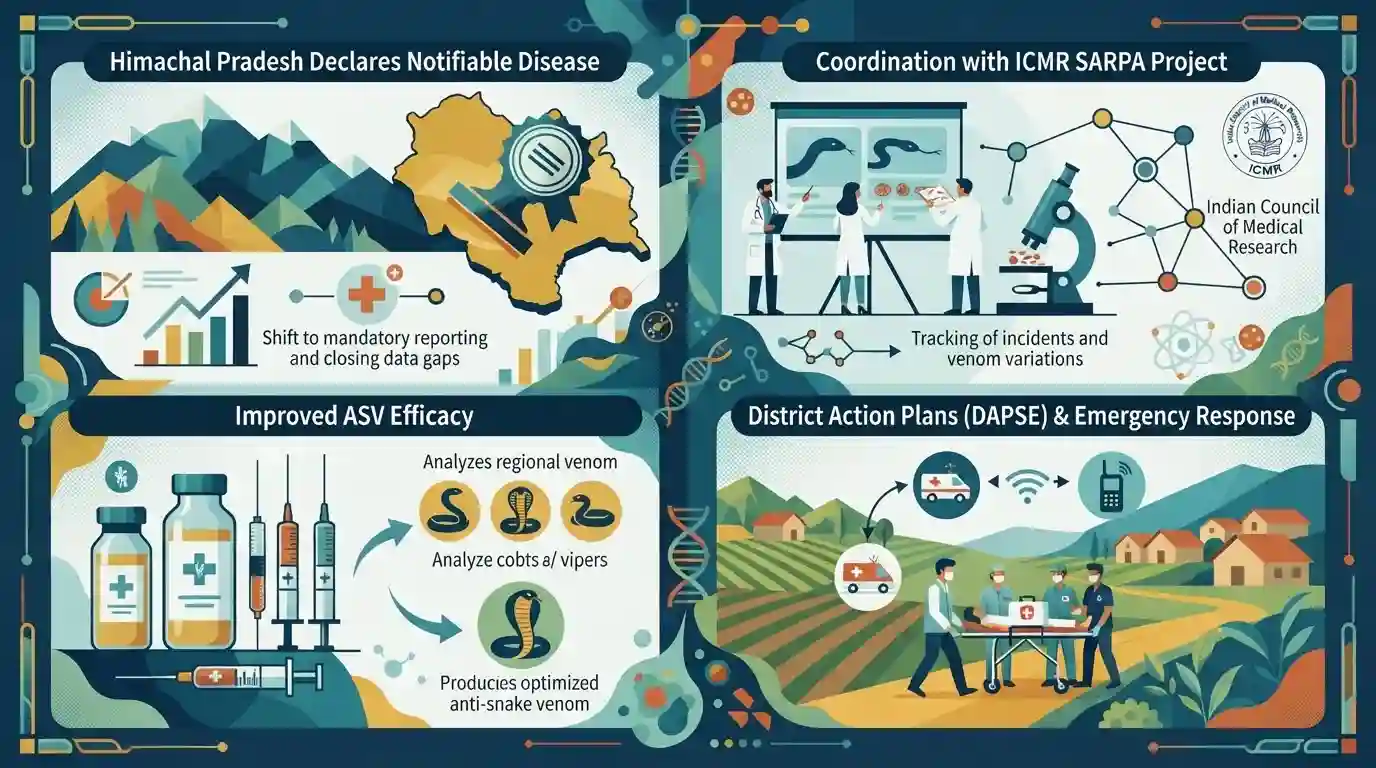
Himachal Pradesh has officially declared snakebite a notifiable disease to address significant data gaps in morbidity and mortality reporting. In coordination with the Indian Council of Medical Research’s SARPA project, the state aims to rigorously track snakebite incidents and study regional variations in snake venom, which will help improve the efficacy of anti-snake venom (ASV). Furthermore, the implementation of District Action Plans for Prevention and Control of Snakebite Envenoming (DAPSE) seeks to streamline emergency public health responses. This initiative targets the high burden of envenoming caused by local species such as kraits, cobras, and vipers, particularly in rural and agricultural communities.
Key Points
- Himachal Pradesh has declared snakebite a notifiable disease to ensure mandatory and comprehensive reporting across all government and private healthcare facilities.
- The ICMR has initiated the SARPA project to systematically document snakebite incidence, mortality, and geographical variations in snake venom across India.
- District Action Plans for Prevention and Control of Snakebite Envenoming (DAPSE) are being rolled out to improve local emergency responses and anti-snake venom (ASV) distribution.
- The state hosts several venomous species, including the common krait, spectacled cobra, Russell's viper, and the Himalayan pit viper, contributing to high rural morbidity.
Important Terms
Snakebite Awareness, Response, Prevention & Action (SARPA)

An ICMR-led multi-state research project under the 'Zero Snakebite Death Initiative.' It aims to develop a community-based, replicable national model to prevent and manage snakebite envenoming through awareness, digital surveillance, and better healthcare access.
UPSC context
GS Paper 2 (Health) & GS Paper 3 (Science & Tech). Demonstrates public health strategies tackling neglected tropical diseases.
District Action Plans for Prevention and Control of Snakebite Envenoming (DAPSE)
Decentralized plans, first implemented by Himachal Pradesh, designed to translate national snakebite policies into local public health interventions. They focus on surveillance, first-aid, awareness, and inter-departmental coordination.
UPSC context
GS Paper 2 (Health/Governance) & Disaster Management. Illustrates localized, inter-agency public health administration and crisis response.
Notifiable Disease
A disease legally required to be reported to public health authorities upon diagnosis. Making snakebites notifiable improves epidemiological surveillance, addresses data gaps, and ensures critical resources like anti-snake venom are optimally deployed.
UPSC context
GS Paper 2 (Health). Tests knowledge of disease surveillance, healthcare data management, and public health statutory mechanisms.
Indian Council of Medical Research (ICMR)
India's apex body for the formulation, coordination, and promotion of biomedical research. It leads initiatives like the SARPA project to scientifically study regional snake venoms, improving the efficacy of anti-snake venom treatments.
UPSC context
GS Paper 2 (Health/Institutions) & GS Paper 3 (Science & Technology). Key for questions on national health research infrastructure.
Prelims Trap
"India's polyvalent anti-snake venom (ASV) is highly effective against all venomous snake species found across the Indian subcontinent."
India's polyvalent ASV is primarily manufactured for the "Big Four" snakes. It is often ineffective against regional species like the Himalayan pit viper or King Cobra.
Static Concepts Connected
What defines a Neglected Tropical Disease (NTD) under WHO guidelines?
- Definition: A diverse group of conditions primarily affecting impoverished communities in tropical areas, often lacking global funding.
- Snakebite Status: Snakebite envenoming was added to WHO's list of high-priority NTDs in 2017 to boost global antivenom access.
- Other Examples: Other prominent NTDs in India include dengue, rabies, leprosy, and lymphatic filariasis (elephantiasis).
How is a disease declared "notifiable" in India?
- State Jurisdiction: Since Public Health is a State subject, state governments typically declare diseases notifiable within their jurisdictions.
- Legal Backing: Declarations are enforced under the Epidemic Diseases Act, 1897, or specific State Public Health Acts.
- Mandatory Reporting: It mandates all private and government clinics to report cases to authorities, eliminating epidemiological data gaps.
Cross-Topic Patterns
Snakebites and the 'One Health' Approach
The National Action Plan (NAP-SE) employs a 'One Health' framework, integrating human healthcare, wildlife ecology, and environmental data, much like India's strategy for rabies and zoonotic disease management.
Climate change altering snake habitats
Warming temperatures in Himalayan states are enabling lowland venomous species to migrate to higher altitudes, expanding the geographical burden of snakebites into previously unexposed rural areas.

Expect a 2026 multi-statement question linking WHO's Neglected Tropical Diseases, India's ASV limitations, and the One Health approach.
Linked PYQs · 3
Linked PYQs · 3
- 2024HPAS_PRELIMSGS1
Consider the following Health programmes and policy : (1) The National Health Policy (2) National Health Mission (NHM) (3) National Rural Health Mission (NRHM) (4) National Urban Health Mission (NUHM) With reference to the Health programmes and policy mentioned above, in terms of their starting year which one of the following is the correct order year ? Choose the correct answer from the options given below :
- 2024HPAS_PRELIMSGS1
With reference to the steady decline in the mortality rate over the years, consider the following statements : (1) Control of epidemics such as cholera and smallpox (2) Expansion in incidence of malaria and tuberculosis (3) Contraction of education and decreased literacy (4) Improved sanitation and hygiene. Choose the correct answer from the options given below :
- 2023HPAS_PRELIMSGS1
Match List I with List II : | List-I (District) | List-II (Wildlife Sanctuary) | |---|---| | (a) Kinnaur | (i) Rupi Bhaba | | (b) Chamba | (ii) Sechu Tuan Nala | | (c) Mandi | (iii) Kibber | | (d) Lahaul and Spiti | (iv) Nargu | Choose the correct answer from the options given below : Code: (a) (b) (c) (d)
