South African floods claim dozens of lives amid climate shift
Source:The Hindu ↗
Why It Matters
Provides a tangible international case study on the devastating impacts of climate change and extreme weather, directly relevant to GS3 Disaster Management and Environment syllabi. It also highlights the practical necessity of international climate finance mechanisms like the Green Climate Fund.
Summary
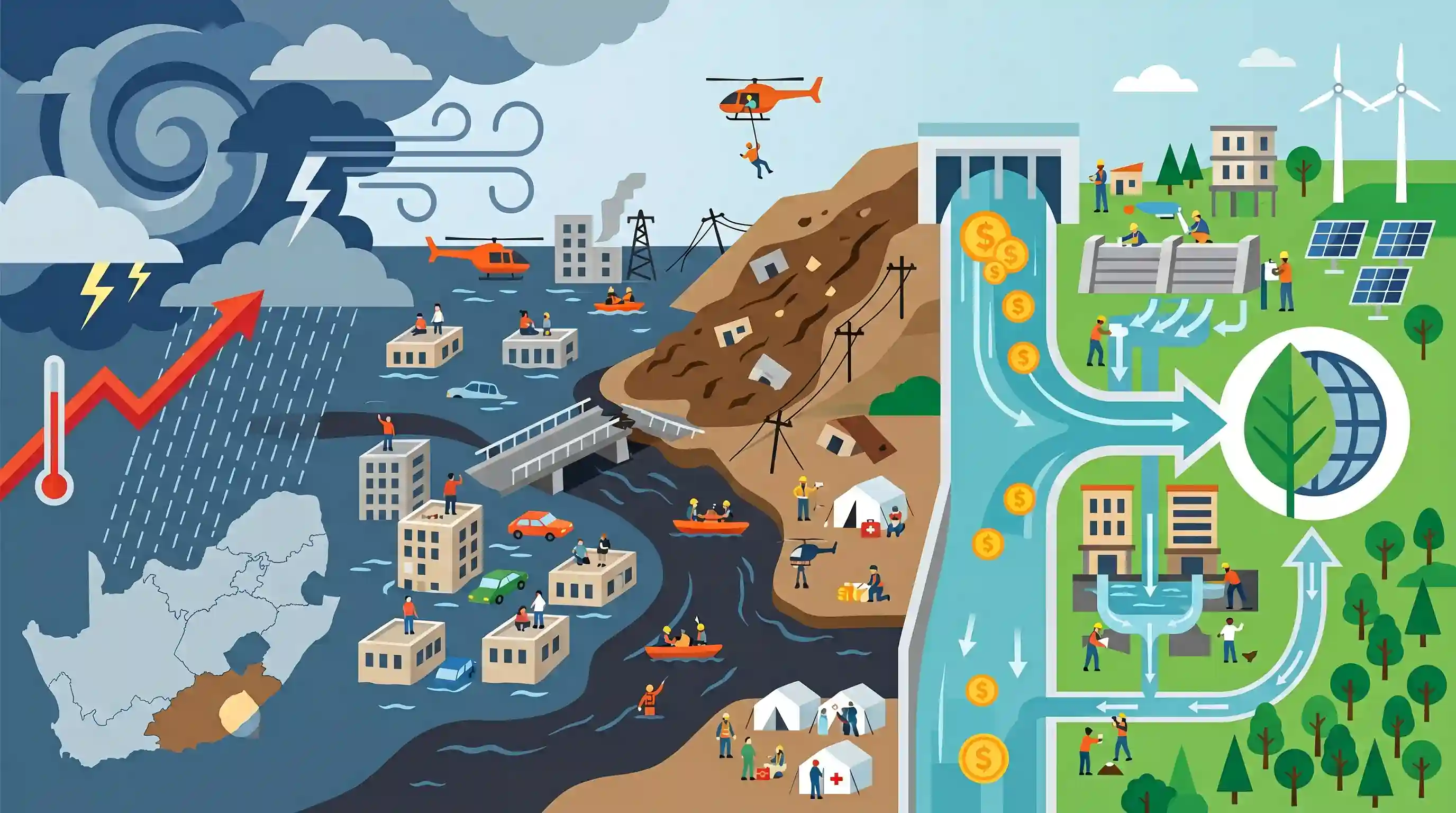
Catastrophic floods in South Africa’s Eastern Cape province, driven by extreme weather patterns and climate change, have resulted in a death toll of at least 86. The region experienced intense rainfall, landslides, and gale-force winds, causing widespread infrastructure destruction, particularly around Mthatha. The event underscores the acute vulnerability of developing nations to climate-induced disasters and highlights the critical role of climate financing entities, such as the Green Climate Fund, in supporting global adaptation and disaster mitigation efforts.
Key Points
- Severe floods in South Africa's Eastern Cape province have resulted in at least 86 fatalities, driven by unprecedented extreme weather.
- President Cyril Ramaphosa attributed the catastrophic events directly to climate change, noting the increased frequency of such disasters.
- The floods involved intense rainfall, landslides, and gale-force winds, causing massive infrastructure damage, particularly in the city of Mthatha.
- The incident highlights the acute vulnerability of developing nations to climate variability and the critical need for climate finance mechanisms like the Green Climate Fund to support adaptation and mitigation.
Important Terms
Green Climate Fund (GCF)

The world's largest dedicated fund established under the UNFCCC to assist developing countries in greenhouse gas reduction (mitigation) and climate-resilient development (adaptation).
UPSC context
GS Paper III (Environment); focuses on global climate finance mechanisms and India's role in international environmental agreements.
Climate Change Adaptation
Adjustments in ecological, social, or economic systems to moderate potential damages or benefit from opportunities associated with actual or expected climatic stimuli.
UPSC context
GS Paper III (Environment/Disaster Management); tests understanding of resilience strategies for vulnerable populations in developing nations.
Disaster Mitigation
Structural or non-structural measures taken to minimize the adverse impacts of natural hazards and environmental degradation before a disaster occurs.
UPSC context
GS Paper III (Disaster Management); essential for answers on the disaster management cycle and reducing infrastructure vulnerability.
Climate Finance
Financial resources—drawn from public, private, and alternative sources—directed toward local, national, or transnational projects that address climate change mitigation and adaptation.
UPSC context
GS Paper III (Economy/Environment); involves North-South cooperation, climate justice, and the principle of Common but Differentiated Responsibilities (CBDR).
South African Weather Service (SAWS)
South Africa's national meteorological service mandated to provide reliable weather and climate information, including early warnings to safeguard lives and property.
UPSC context
GS Paper III (Disaster Management); serves as an institutional case study for early warning systems and international meteorological cooperation.
Prelims Trap
The Green Climate Fund was established at COP27 to compensate developing countries for unavoidable climate impacts.
This conflates the GCF, established at COP16 (2010) for adaptation and mitigation, with the Loss and Damage Fund agreed upon at COP27 specifically to compensate for unavoidable climate disasters.
Static Concepts Connected
What are the key climate finance funds under the UNFCCC framework?
- Global Environment Facility: Established in 1991, it serves as an operating entity of the financial mechanism for the UNFCCC, Convention on Biological Diversity (CBD), and others.
- Green Climate Fund: Created at COP16 (2010) specifically to support developing countries in limiting or reducing greenhouse gas emissions and adapting to climate change.
- Adaptation Fund: Established under the Kyoto Protocol to finance concrete adaptation projects and programmes in developing country Parties that are particularly vulnerable to climate impacts.
What is the Coalition for Disaster Resilient Infrastructure (CDRI)?
- Launch & Origins: Launched by the Indian Prime Minister at the 2019 UN Climate Action Summit in New York.
- Core Objective: To promote the resilience of new and existing infrastructure systems to climate and disaster risks in support of sustainable development.
- Headquarters: The CDRI Secretariat is based in New Delhi, India, reinforcing India's global leadership in disaster risk reduction.
Cross-Topic Patterns
CDRI + Climate Finance architecture
South Africa's infrastructure collapse mirrors global south vulnerabilities, linking GS-3 disaster management directly to India's leadership in CDRI and demands for operationalizing the UNFCCC Loss and Damage Fund.
Urban Flooding + Extreme Weather Anomalies
Widespread infrastructure failure in Mthatha connects geographically disparate events (like recent Dubai or Chennai floods) to a common theme of shifting precipitation patterns and inadequate urban hazard zonation.

Expect a multi-statement 2026 Prelims question contrasting the origin and mandates of the GCF, Adaptation Fund, and Loss & Damage Fund.
Linked PYQs · 5
Linked PYQs · 5
- 2024MainsGS3
Flooding in urban areas is an emerging climate-induced disaster. Discuss the causes of this disaster. Mention the features of two such major floods in the last two decades in India. Describe the policies and frameworks in India that aim at tackling such floods.
- 2017MainsGS3
'Climate change' is a global problem. How India will be affected by climate change? How Himalayan and coastal states of India will be affected by climate change?
- 2015PrelimsGS1
Which of the following statements regarding 'Green Climate Fund' is/are correct? 1. It is intended to assist the developing countries in adaptation and mitigation practices to counter climate change. 2. It is founded under the aegis of UNEP, OECD, Asian Development Bank and World Bank. Select the correct answer using the code given below.
- 2023MainsGS1
Comment on the resource potentials of the long coastline of India and highlight the status of natural hazard preparedness in these areas.
- 2021MainsGS3
Describe the various causes and the effects of landslides. Mention the important components of the National Landslide Risk Management Strategy.
