Iran Protests Escalation And Internet Blackouts Impacting Stability
Source:The Hindu ↗
Why It Matters
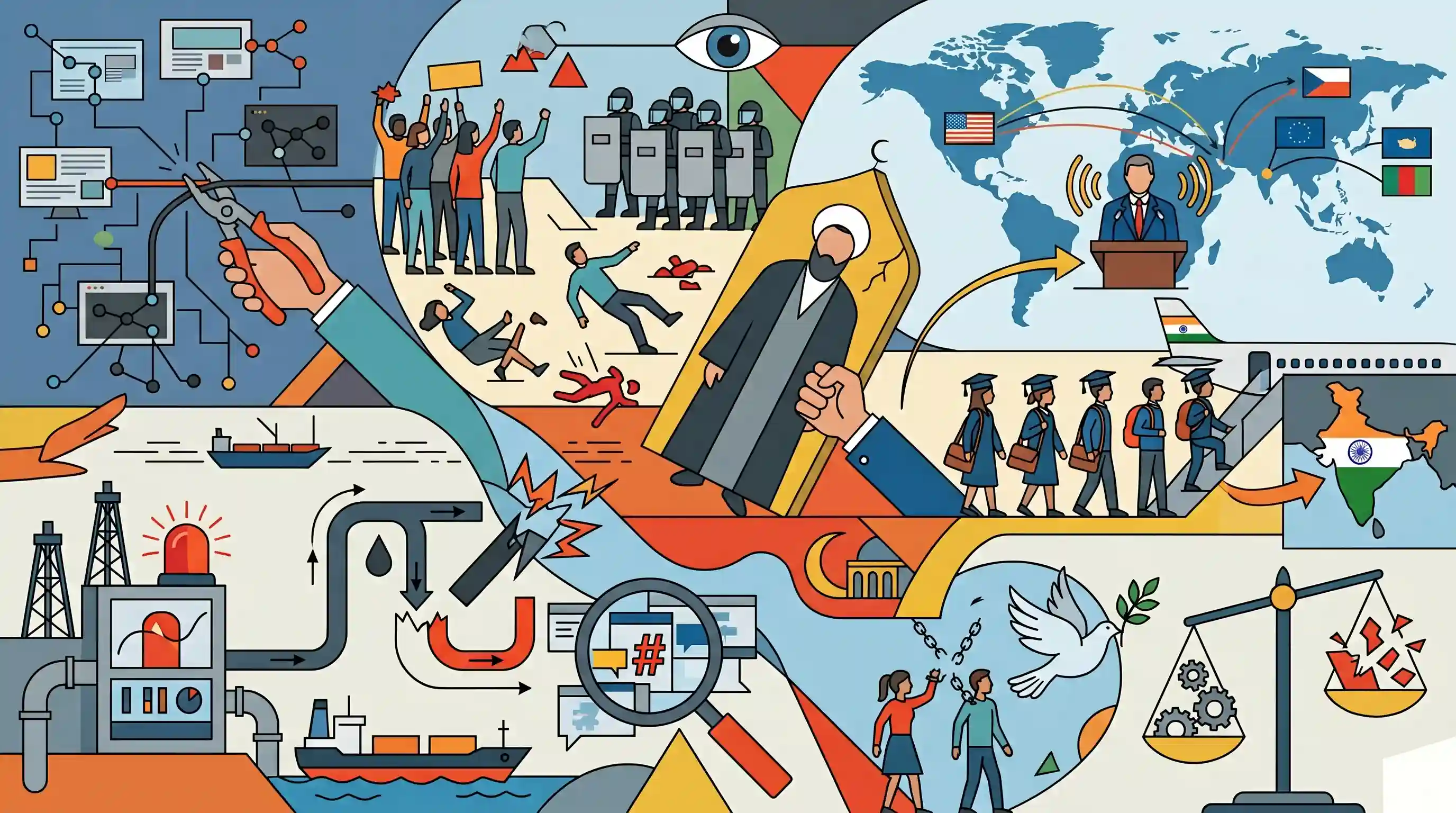
The domestic crisis in Iran poses significant strategic implications for India, directly affecting West Asian stability, energy security, and the safety of the Indian diaspora. Additionally, the extensive use of internet blackouts to suppress dissent provides a critical case study on the intersection of state security, digital rights, and the regulation of communication networks.
Summary
Widespread anti-government protests in Iran, initially triggered by economic grievances, have evolved into a major challenge against clerical rule, resulting in over 3,000 deaths according to the US-based rights group HRANA. The Iranian regime responded with severe crackdowns and an eight-day near-total internet blackout, monitored by global internet watchdog NetBlocks. The resulting instability has led to the evacuation of Indian students from the region and drawn international commentary, with US President Donald Trump claiming credit for halting mass executions. The unrest raises serious concerns regarding human rights, digital authoritarianism, and regional stability in the geopolitically critical West Asian region.
Key Points
- The death toll in Iran's anti-government protests has exceeded 3,000 according to rights group HRANA, illustrating severe state repression.
- Protests originally sparked by economic hardship have escalated into nationwide demands to end the Islamic Republic's clerical rule.
- An eight-day near-total internet blackout was imposed by the Iranian government to disrupt communication, with NetBlocks reporting only a marginal restoration of connectivity.
- The escalating conflict necessitated the evacuation of Indian students, highlighting the vulnerability of the Indian diaspora in unstable regions.
- US President Donald Trump claimed diplomatic credit for allegedly halting mass executions in Iran, underscoring the ongoing geopolitical tension between the US and Iran.
Important Terms
HRANA (Human Rights Activists News Agency)

A US-based NGO and news agency that documents human rights violations in Iran. It provides independent data on arrests, executions, and deaths during periods of civil unrest.
UPSC context
GS Paper 2: International Relations/Human Rights. Relevant for assessing non-state monitors in conflict zones and verifying human rights benchmarks.
NetBlocks
A London-based independent watchdog that monitors global internet connectivity and cybersecurity. It tracks state-sponsored internet blackouts, social media restrictions, and their economic impact during political crises.
UPSC context
GS Paper 3: Internal Security/Cyber-governance. Tests understanding of digital rights, "digital authoritarianism," and the technical tracking of state-led communication shutdowns.
Internet Shutdowns
The deliberate disruption of internet or electronic communications by a state, typically to curb dissent. In India, these are regulated under the Temporary Suspension of Telecom Services Rules, 2017.
UPSC context
GS Paper 2: Fundamental Rights (Article 19). Linked to the Anuradha Bhasin case regarding the proportionality and legality of communication bans.
Indian Diaspora
Indian citizens living abroad (NRIs/OCIs). In West Asia, this group exceeds 8 million, serving as a vital source of remittances and a priority for Indian consular protection.
UPSC context
GS Paper 2: International Relations. Focuses on the "Connect West" policy and the safety of nationals in volatile geopolitical regions.
Energy Security
The uninterrupted availability of affordable energy. For India, this relies heavily on stability in West Asia and the security of maritime chokepoints like the Strait of Hormuz.
UPSC context
GS Paper 3: Economy/Security. Tests knowledge of India's crude oil dependency, strategic reserves, and the economic impact of regional instability.
Strategic Autonomy
A foreign policy framework where a nation makes independent decisions based on its own national interests, without being coerced by other states or alliances.
UPSC context
GS Paper 2: International Relations. Crucial for understanding how India balances ties with rival powers (e.g., Iran vs. US/Israel).
Prelims Trap
"The Supreme Court explicitly declared the right to internet access as a standalone Fundamental Right under Article 21."
In the Anuradha Bhasin case, the SC held it is protected under Article 19(1)(a) and 19(1)(g) as a medium of expression and trade, not an absolute standalone right under Article 21.
Static Concepts Connected
What is the legal framework governing internet shutdowns in India?
- Governing Rules: Governed by the Temporary Suspension of Telecom Services (Public Emergency or Public Safety) Rules, 2017, framed under the Indian Telegraph Act, 1885.
- Issuing Authority: Orders can only be issued by the Secretary to the Ministry of Home Affairs (Centre) or the Home Secretary of a State.
- Review Mechanism: A mandated Review Committee must assess the validity of the shutdown order within 5 working days.
Why is Iran's geography strategically critical for India's foreign policy?
- Chabahar Port: Provides direct sea-land access to Afghanistan and Central Asia, completely bypassing Pakistan's overland transit denial.
- INSTC Gateway: Serves as a crucial maritime node for the International North-South Transport Corridor linking India to Russia/Europe.
- Energy Chokepoint: Proximity to the Strait of Hormuz, a global maritime chokepoint vital for India's oil and LNG imports.
Cross-Topic Patterns
Diaspora evacuation operations
Evacuations mirror operations like Ganga or Kaveri. UPSC often tests India's foreign policy framework for protecting its 10-million strong West Asian diaspora amid regional volatility.
Digital rights vs Internal Security
Iran’s 8-day blackout highlights the dual-use of internet controls, echoing India's own governance challenges in balancing public order with Article 19 protections during internal unrest.

Expect a multi-statement Prelims question on the Temporary Suspension of Telecom Rules, 2017, linked to Art 19 fundamental rights.
Linked PYQs · 4
Linked PYQs · 4
- 2018MainsGS2
In what ways would the ongoing US-Iran Nuclear Pact Controversy affect the national interest of India? How should India respond to this situation?
- 2017MainsGS2
The question of India's Energy Security constitutes the most important part of India's economic progress. Analyze India's energy policy cooperation with West Asian countries.
- 2025MainsGS2
"Energy security constitutes the dominant kingpin of India's foreign policy, and is linked with India's overarching influence in Middle Eastern countries.” How would you integrate energy security with India's foreign policy trajectories in the coming years?
- 2024MainsGS3
Social media and encrypting messaging services pose a serious security challenge. What measures have been adopted at various levels to address the security implications of social media? Also suggest any other remedies to address the problem.
