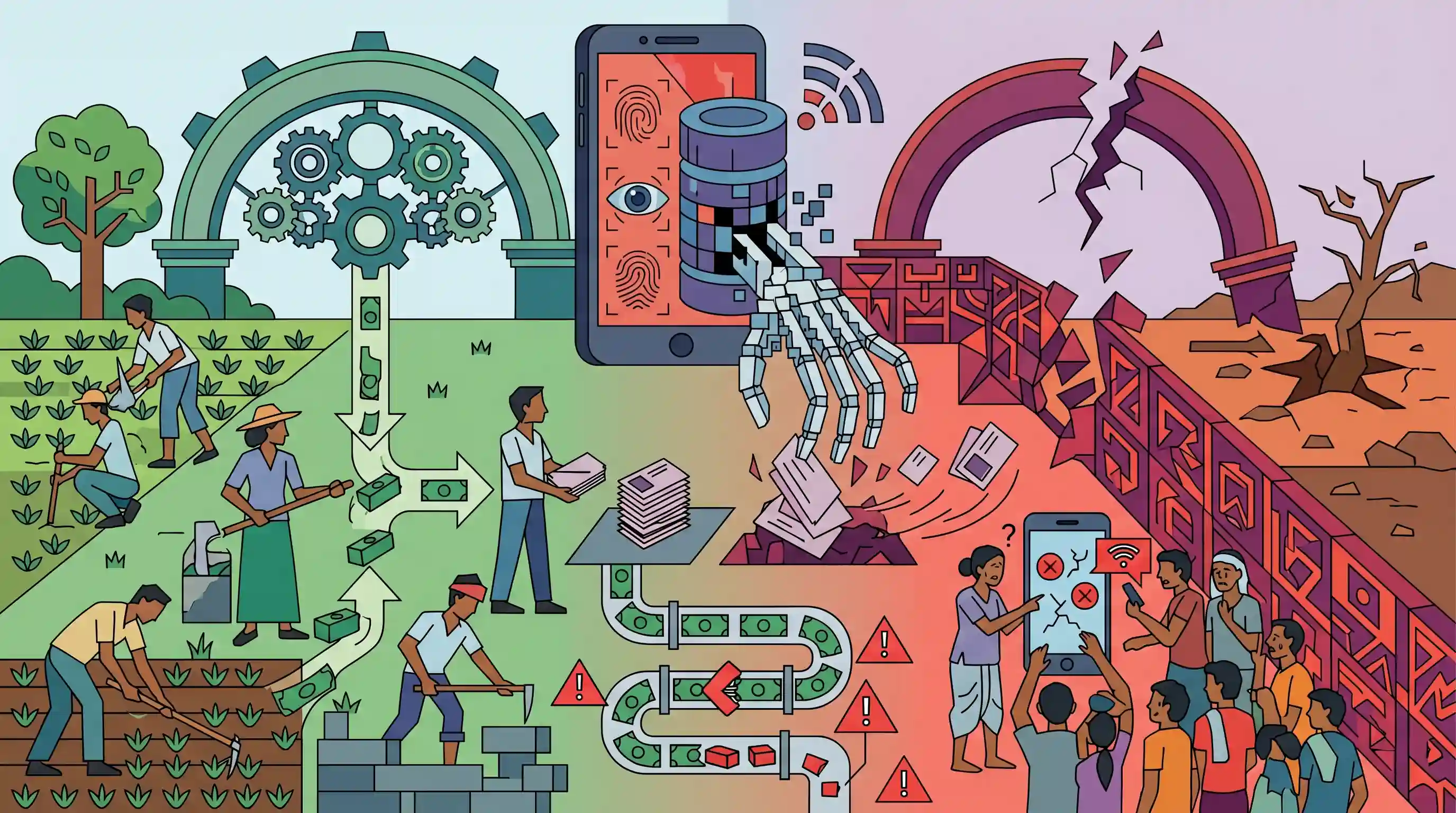
Technological mandates threaten implementation of rural job guarantee
Source:The Hindu ↗
Why It Matters
The issue highlights the critical tension between techno-solutionism in governance (such as ABPS and NMMS) and the realities of rural India, offering an excellent case study for UPSC aspirants on how e-governance can inadvertently lead to the exclusion of marginalized sections from statutory welfare schemes like MGNREGA.
Summary
The article argues that the Mahatma Gandhi National Rural Employment Guarantee Act (MGNREGA) is being systematically dismantled through restrictive technological mandates and chronic underfunding. The mandatory rollout of the Aadhaar-Based Payment System (ABPS) and the National Mobile Monitoring System (NMMS) app for attendance has created immense hardship for rural workers, leading to mass job card deletions, payment delays, and exclusion due to digital illiteracy and poor network connectivity. These e-governance measures, rather than enhancing transparency, act as barriers that deny the most vulnerable their legal right to work, exacerbating rural distress and effectively sounding the death knell for India's crucial rural employment safety net.
Key Points
- The Mahatma Gandhi National Rural Employment Guarantee Act (MGNREGA) is facing an existential crisis due to a combination of systemic administrative hurdles, technological mandates, and inadequate budgetary allocations.
- The mandatory implementation of the Aadhaar-Based Payment System (ABPS) has led to mass wrongful deletions of job cards and widespread payment failures due to demographic mismatches and seeding bottlenecks.
- The National Mobile Monitoring Software (NMMS) app, required for daily geotagged attendance, penalizes vulnerable workers due to poor internet connectivity and the lack of smartphone access, disproportionately affecting women.
- Chronic underfunding and delayed wage payments violate the 15-day statutory guarantee of the Act, deliberately suppressing the true demand for work and deepening rural distress.
- E-governance interventions in the scheme demonstrate a back-end integration bias that prioritizes technological compliance over user-centric welfare delivery.
Important Terms
Mahatma Gandhi National Rural Employment Guarantee Act (MGNREGA)

A 2005 social security law guaranteeing 100 days of unskilled manual work per year to rural households. It provides a legal "right to work" and acts as a demand-driven safety net.
UPSC context
GS Paper 2 (Welfare Schemes) and GS Paper 3 (Employment). Tests understanding of social safety nets and rural distress.
Aadhaar-Based Payment System (ABPS)
A digital payment system using Aadhaar numbers as financial addresses for wage transfers. It requires linking Aadhaar with job cards and bank accounts, and is mandatory for MGNREGA wage payments.
UPSC context
GS Paper 2 (E-governance) and GS Paper 3 (Inclusive Growth). Tests knowledge of digital infrastructure and technological barriers.
National Mobile Monitoring System (NMMS)
A mobile application by the Ministry of Rural Development for capturing real-time, geo-tagged attendance and photographs at MGNREGA worksites to enhance transparency and eliminate ghost beneficiaries.
UPSC context
GS Paper 2 (E-governance). Evaluates the impact of technology on grassroots implementation and the digital divide.
Direct Benefit Transfer (DBT)
A government mechanism for transferring subsidies and welfare benefits directly into the bank accounts of beneficiaries. It aims to reduce leakages, eliminate intermediaries, and ensure transparent delivery.
UPSC context
GS Paper 2 (Government Policies) and GS Paper 3 (Subsidies). Tests concepts of administrative efficiency and public finance management.
Ministry of Rural Development
The nodal Union Ministry responsible for formulating and implementing policies for rural development, including MGNREGA, rural infrastructure, and poverty alleviation programs across India.
UPSC context
GS Paper 2 (Governance/Ministries). Tests knowledge of executive institutions and their role in social welfare delivery.
UIDAI
A statutory authority under the Aadhaar Act, 2016, responsible for issuing the 12-digit Aadhaar number and managing the biometric and demographic database for national identity authentication.
UPSC context
GS Paper 2 (Statutory Bodies). Tests understanding of identity frameworks and their role in the JAM trinity.
Prelims Trap
The Central Government is responsible for paying the unemployment allowance if MGNREGA work is not assigned within 15 days.
The Centre bears 100% of unskilled wage costs, but under the Act, the statutory liability to pay the unemployment allowance falls entirely on the respective State governments.
Static Concepts Connected
What are the core statutory financial guarantees provided under MGNREGA?
- Time-bound allocation: Work must be provided within 15 days of demand, failing which a state-funded unemployment allowance becomes legally due.
- Wage timeline: Wages must be paid within 15 days of the closure of the muster roll.
- Delay compensation: Workers are legally entitled to 0.05% of the unpaid wages per day as compensation for delayed payments.
How does the Aadhaar-Based Payment System (ABPS) function for welfare schemes?
- Aadhaar as identity: It uses the beneficiary's Aadhaar number as their primary financial address instead of standard bank account details.
- NPCI mapping: Requires the beneficiary's Aadhaar to be successfully seeded with their bank account and mapped to the NPCI mapper.
- Authentication vulnerability: Fails if there are demographic mismatches (e.g., spelling errors in names) between the job card, bank account, and Aadhaar database.
Cross-Topic Patterns
E-governance vs. Rights-based Welfare
The tension between digital efficiency tools (ABPS, NMMS) and statutory rights (Right to Work, Right to Food) is a recurring GS2 theme highlighting the exclusionary impact of India's digital divide.
Fiscal Federalism and Scheme Funding
Delayed wage disbursements often stem from delayed Central fund releases, aggravating State-Centre fiscal relations since States are legally forced to bear the burden of unemployment allowances.

A GS2 question assessing if mandatory tech interventions like ABPS and NMMS are subverting statutory welfare rights is highly probable.
Linked PYQs · 4
Linked PYQs · 4
- 2025MainsGS2
e-governance projects have a built-in bias towards technology and back-end integration than user-centric designs. Examine.
- 2021MainsGS2
Has digital illiteracy, particularly in rural areas, coupled with lack of Information and Communication Technology (ICT) accessibility hindered socio-economic development? Examine with justification.
- 2011PrelimsGS1
Among the following who are eligible to benefit from the “Mahatma Gandhi National Rural Employment Guarantee Act”?
- 2006PrelimsGS1
Consider the following statements in respect of welfare schemes launched by the Ministry of Rural Development, Government of India. 1. Drinking water for rural areas in one of the components of the Bharat Nirman Plan. 2. NREGA 2005 provides that statutory minimum wage for agricultural workers must be paid.
