Dearness Allowance Hike Impact on Central Government Fiscal Burden
Source:The Hindu ↗
Why It Matters
The article highlights the practical application of inflation indices like CPI-IW, a frequent topic in Prelims. For Mains, it provides a real-world example of committed government expenditure, which is crucial for answering questions on public finance, fiscal deficit management, and the balance between welfare and fiscal prudence.
Summary
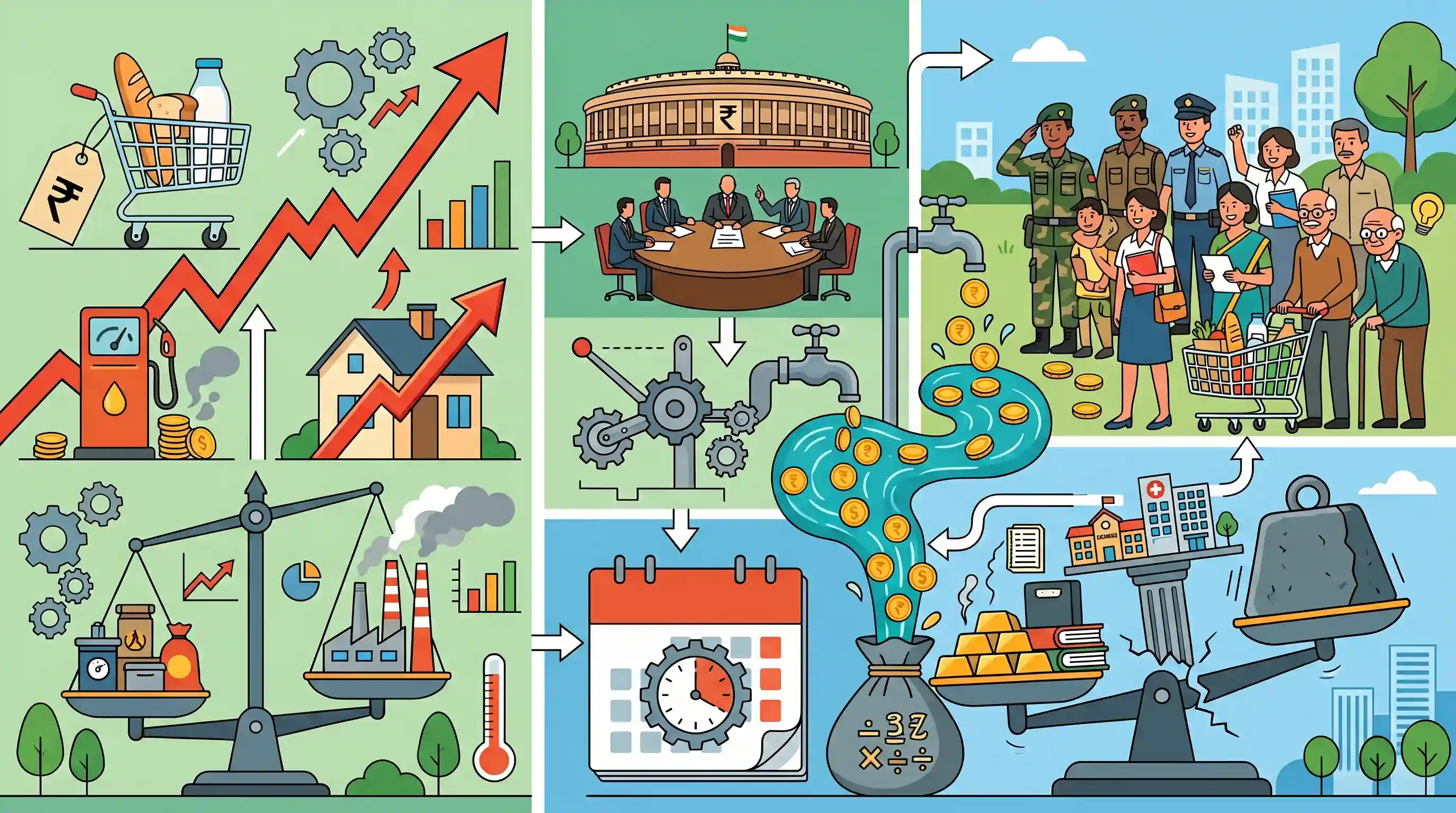
The Union Cabinet has announced a 3% increase in Dearness Allowance (DA) for Central government employees and Dearness Relief (DR) for pensioners, raising the total allowance to 58% effective from July 1, 2025. This inflation-offsetting measure is based on the 7th Central Pay Commission's formula, which uses the Consumer Price Index for Industrial Workers (CPI-IW) data. While the move brings relief to over 1.17 crore employees and pensioners against the rising cost of living, it adds a substantial committed fiscal burden of over ₹10,000 crore annually to the government's expenditure.
Key Points
- The Union Cabinet approved a 3% hike in Dearness Allowance (DA) and Dearness Relief (DR), bringing the total to 58%, effective from July 1, 2025.
- This hike benefits 49.19 lakh Central government employees and 68.72 lakh pensioners, serving to offset the impact of inflation.
- The financial implication of this hike on the public exchequer is estimated at ₹10,083.96 crore per annum.
- DA and DR adjustments are calculated based on the 7th Central Pay Commission's accepted formula, which relies heavily on the Consumer Price Index for Industrial Workers (CPI-IW) compiled by the Labour Bureau.
Important Terms
Dearness Allowance (DA)

A cost-of-living adjustment paid to government employees and pensioners to mitigate the impact of inflation on real income. It is calculated as a percentage of basic salary and revised biannually.
UPSC context
GS Paper III (Economy); relevant for inflation-linked compensation, public expenditure management, and social security for government employees.
Consumer Price Index for Industrial Workers (CPI-IW)
A price index measuring changes in the cost of living for industrial workers. It serves as the official benchmark for wage indexation and Dearness Allowance (DA) revision in India.
UPSC context
GS Paper III (Economy); tests knowledge of inflation indices, their base years (2016), and their specific administrative applications.
Labour Bureau
An attached office of the Ministry of Labour and Employment responsible for compiling and publishing indices including CPI-IW, CPI-AL, and CPI-RL, and conducting various labour-related surveys.
UPSC context
GS Paper III (Economy); important for understanding the institutional framework of data collection and labour statistics in India.
7th Central Pay Commission (CPC)
An ad hoc body appointed to review and recommend changes to the salary structure, allowances, and pensions for central government employees and the armed forces.
UPSC context
GS Paper II (Governance) & GS Paper III (Economy); relevant for executive decisions on public sector pay and fiscal implications.
Committed Expenditure
Government spending that is legally or contractually obligated, such as interest payments, salaries, and pensions. High levels of this expenditure reduce a government's fiscal flexibility.
UPSC context
GS Paper III (Economy/Budgeting); critical for analyzing fiscal deficits, revenue expenditure, and the government's ability to fund developmental projects.
Prelims Trap
"Dearness Allowance (DA) adjustments for government employees are based on the CPI-Combined index."
False. DA and DR are calculated using the Consumer Price Index for Industrial Workers (CPI-IW) compiled by the Labour Bureau, not the CPI-Combined used by the RBI.
Static Concepts Connected
Who compiles the different variations of the Consumer Price Index (CPI) in India?
- CPI-IW, CPI-AL, CPI-RL: Compiled by the Labour Bureau (Ministry of Labour and Employment). It is explicitly used for calculating Dearness Allowance for government employees.
- CPI-Combined: Compiled by the National Statistical Office (NSO) under MoSPI. This index is used by the RBI for its headline inflation targeting framework.
How do DA and DR hikes impact government budgeting?
- Revenue Expenditure: Salaries, pensions, and DA hikes do not create productive assets or reduce liabilities, classifying them strictly as revenue expenditure.
- Committed Expenditure: They form a major part of the government's non-discretionary spending. High committed expenditure restricts the fiscal space available for capital expenditure (capex) and welfare schemes.
Cross-Topic Patterns
Inflation Targeting vs. Wage-Price Spirals
DA hikes boost disposable income to offset inflation, but this can inadvertently stimulate demand-pull inflation, creating a cyclical wage-price spiral that complicates the RBI's monetary policy goals.
Spillover effect on State Finances
Central DA hikes trigger similar demands from state government employees, straining state exchequers, widening their revenue deficits, and challenging sub-national FRBM Act fiscal consolidation targets.

Expect a Prelims question matching inflation indices (CPI-IW, CPI-AL, CPI-C) to their compiling agencies and specific usage (DA vs RBI).
Linked PYQs · 5
Linked PYQs · 5
- 2015PrelimsGS1
Which of the following brings out the 'Consumer Price Index Number for Industrial Workers?
- 2020PrelimsGS1
Consider the following statements: 1. The weightage of food in Consumer Price Index (CPI) is higher than that in Wholesale Price Index (WPI). 2. The WPI does not capture changes in the prices of services, which CPI does. 3. Reserve Bank of India has now adopted WPI as its key measure of inflation and to decide on changing the key policy rates. Which of the statements given above is/are correct?
- 2010PrelimsGS1
With reference to India, consider the following statements : 1. The Wholesale Price Index (WPI) in India is available on a monthly basis only. 2. As compared to Consumer Price Index for Industrial Workers (CPI(IW)), the WPI gives less weight to food articles. Which of the statements given above is/are correct ?
- 2019MainsGS3
The public expenditure management is a challenge to the Government of India in the context of budget making during the post-liberalization period. Clarify it.
- 2022MainsGS2
Besides the welfare schemes, India needs deft management of inflation and unemployment to serve the poor and the underprivileged sections of the society. Discuss.
