Mexico Landslides Highlight Disaster Risks and Post-Disaster Health
Source:The Hindu ↗
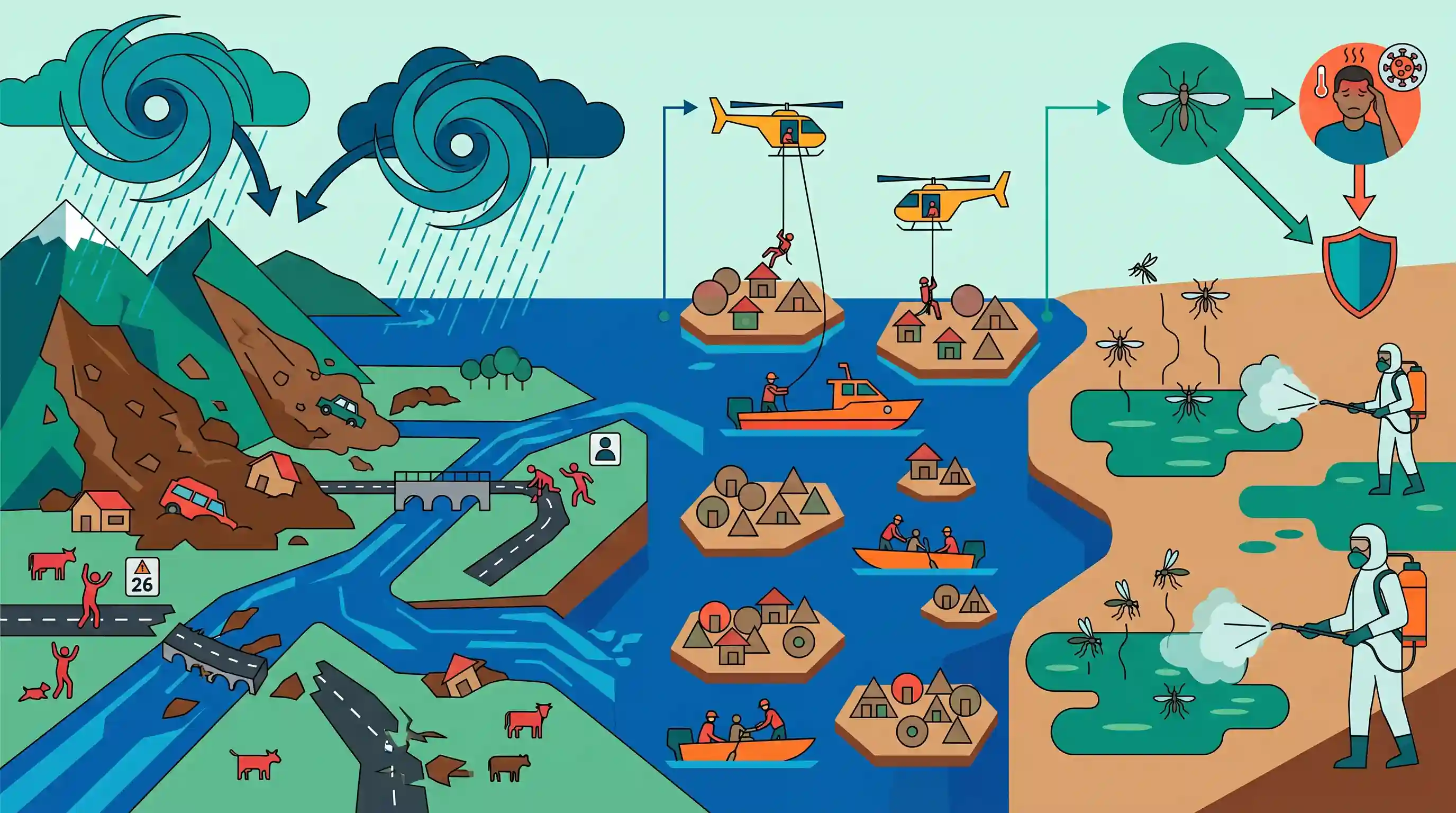
Why It Matters
Demonstrates the cascading consequences of extreme weather events (tropical storms leading to floods and landslides) and highlights post-disaster health risks (vector-borne diseases). It serves as a practical case study for disaster preparedness, response, and mitigation strategies in the UPSC syllabus.
Summary
Severe landslides and flooding, triggered by the convergence of two tropical storms, have killed at least 26 people and isolated over 300 communities across central and eastern Mexico. Heavy rainfall caused rivers to overflow, destroying homes and infrastructure. Extensive rescue operations are currently underway, and health authorities are taking preventive measures, such as fumigation, to mitigate the risk of post-disaster vector-borne diseases like dengue fever.
Key Points
- Torrential rains caused by the convergence of two tropical storms triggered devastating landslides and flooding in central and eastern Mexico, resulting in at least 26 fatalities.
- The hardest-hit states include Veracruz, Hidalgo, and Puebla, with over 300 communities completely isolated due to destroyed infrastructure.
- The Cazones river overflowed, exacerbating the flood situation and destroying homes and properties in villages like Chapula.
- Health officials have initiated large-scale fumigation drives in the affected areas to curb the spread of vector-borne diseases like dengue fever from stagnant floodwaters.
- The disaster underscores the compounding impacts of extreme weather events and the necessity for robust disaster preparedness and rapid post-disaster response mechanisms.
Prelims Trap
"Dengue fever spreading after floods is a secondary water-borne biological disaster."
Dengue is vector-borne, not water-borne (like cholera or typhoid). Floodwaters simply create the stagnant breeding grounds for mosquitoes.
Static Concepts Connected
What is the Fujiwhara Effect in climatology?
- Vortex interaction: Occurs when two cyclonic vortices come within ~1,400 km of each other and begin to orbit a common center.
- Possible outcomes: The storms may merge, alter each other's tracks unpredictably, or significantly amplify regional extreme precipitation.
- SST driver: Intensification is fueled by rising Sea Surface Temperatures (SSTs) providing sustained thermal convection.
What characterizes a cascading multi-hazard disaster?
- Domino effect: A primary trigger (tropical storm) induces secondary hazards (riverine flooding), which in turn causes tertiary events (landslides).
- Biological aftermath: Post-disaster stagnant waters often trigger secondary biological hazards (vector-borne epidemics), requiring integrated health responses.
- Mitigation strategy: Mitigation demands comprehensive Multi-Hazard Risk and Vulnerability Assessment (HRVA) mapping to predict overlapping spatial vulnerabilities.
Cross-Topic Patterns
Climate anomalies & biological disasters
Rising SSTs amplify tropical storms and expand the geographical footprint and breeding windows of vectors like Aedes mosquitoes, bridging climatology with public health.
Himalayan slope vulnerability parallels
The Mexican disaster mirrors India's Himalayan vulnerability, where extreme cyclonic rainfall meets unregulated slope cutting, highlighting the critical need for Landslide Hazard Zonation.

Fujiwhara effect + rising SSTs + cascading multi-hazard impacts highly probable as a multi-statement Prelims geography question in 2026.
Linked PYQs · 4
Linked PYQs · 4
- 2019MainsGS3
Disaster preparedness is the first step in any disaster management process. Explain how hazard zonation mapping will help disaster mitigation in the case of landslides.
- 2021MainsGS3
Describe the various causes and the effects of landslides. Mention the important components of the National Landslide Risk Management Strategy.
- 2024MainsGS1
What is sea surface temperature rise? How does it affect the formation of tropical cyclones?
- 2024MainsGS3
Flooding in urban areas is an emerging climate-induced disaster. Discuss the causes of this disaster. Mention the features of two such major floods in the last two decades in India. Describe the policies and frameworks in India that aim at tackling such floods.
