Maithon Dam floating solar project deadlock resolved in West Bengal
Source:the-statesman ↗
কেন এটি গুরুত্বপূর্ণ
Highlights the expansion of floating solar energy infrastructure in India and underscores the importance of the Damodar Valley Corporation (DVC) and major dams like Maithon in India's energy landscape. It is highly relevant for geography and environmental studies in the WBCS Prelims.
সারসংক্ষেপ
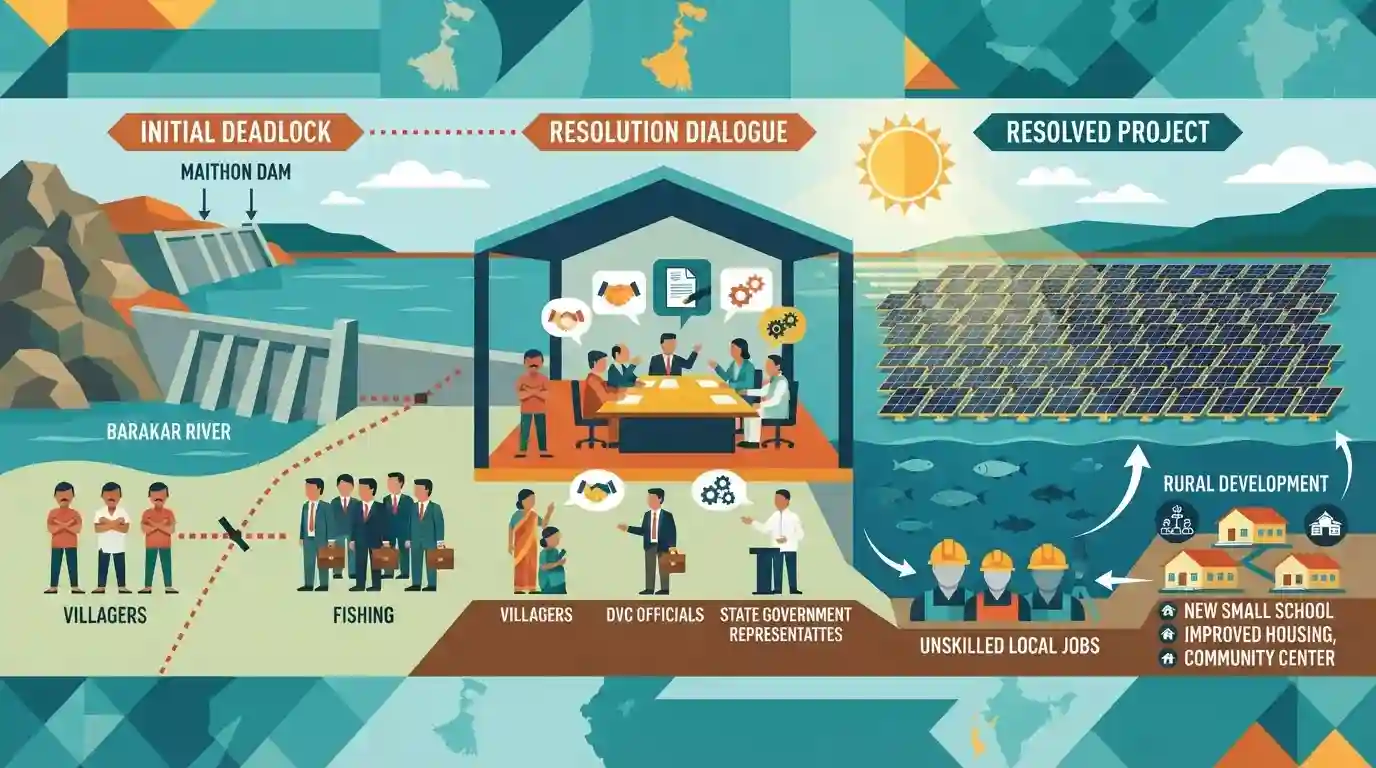
The deadlock over West Bengal's largest floating solar power project (234 MW) at the Maithon Dam has been successfully resolved. Initiated by the Damodar Valley Corporation (DVC) and built by Oriana Power on the Barakar River, the Rs 1200 crore project initially faced local opposition regarding unresolved compensation from the original dam construction and fears of disruption to fishing. Following meetings between DVC, state officials, and villagers, an agreement was reached guaranteeing unskilled jobs for locals and CSR-funded rural development, clearing the path for this major clean energy initiative.
মূল বিষয়
- West Bengal's largest floating solar power project (234 MW) is being constructed at the Maithon Dam on the Barakar River at the Jharkhand-Bengal border.
- The Rs 1200 crore project, initiated by the Damodar Valley Corporation (DVC) and contracted to Oriana Power, faced delays due to protests by local residents over unfulfilled historical promises and livelihood fears.
- The deadlock was resolved after DVC and state authorities assured locals of 100% unskilled job reservations, CSR investments in village infrastructure, and minimal impact on fishing and boating activities.
- DVC is also developing other floating solar plants, including a 228 MW project at Konar Dam and a 14 MW array at Mejia Thermal Power Station.
গুরুত্বপূর্ণ শব্দ
Damodar Valley Corporation (DVC)

Established in 1948 as independent India's first multipurpose river valley project. Modelled on the US Tennessee Valley Authority, it was created to manage flood control, irrigation, and power generation across the resource-rich Damodar basin.
UPSC context
Important for GS 1 (Geography) and GS 3 (Infrastructure). Tests knowledge of post-independence river basin planning and statutory bodies.
Maithon Dam
A major dam built by the DVC on the Barakar River at the Jharkhand-West Bengal border. It features South Asia's first underground hydel power station and is being developed for a 234 MW floating solar power project.
UPSC context
Relevant for Prelims (Geography - Maps) and GS 3 (Infrastructure). Tests spatial knowledge of Indian reservoirs and renewable energy sites.
Barakar River
The primary tributary of the Damodar River in eastern India. Originating in the Chota Nagpur Plateau, it flows through Jharkhand and West Bengal and hosts key hydroelectric dams like Tilaiya and Maithon.
UPSC context
High yield for Prelims (Indian Drainage System). Tests knowledge of regional tributaries, basin geography, and associated infrastructure.
Floating Solar Photovoltaic (FSPV)
An innovative energy system where solar panels are mounted on platforms floating on reservoirs. This conserves valuable land, reduces water evaporation, and improves panel efficiency through the natural cooling effect of the water.
UPSC context
Crucial for GS 3 (Renewable Energy). Tests understanding of clean energy technologies, water-energy nexus, and schemes like PM-SSY.
Oriana Power
A private Indian renewable energy company and Engineering, Procurement, and Construction (EPC) contractor. It recently secured the contract to build the 234 MW grid-tied floating solar PV project at the Maithon Dam.
UPSC context
Marginal relevance for GS 3. Illustrates private sector participation (EPC contractors) in scaling India's renewable energy infrastructure.
প্রিলিমস ফাঁদ
"Maithon Dam is built directly across the main Damodar River."
While it falls under the Damodar Valley Corporation (DVC) network, the Maithon Dam is actually built across the Barakar River, the principal tributary of the Damodar.
সংযুক্ত স্থির ধারণা
What is the geographical profile of the Damodar River system?
- Origin & Flow: Rises in the Palamu hills of the Chota Nagpur Plateau in Jharkhand, flowing eastwards through a rift valley.
- Key Tributaries: The Barakar, Konar, Bokaro, and Haharo rivers form its principal tributaries.
- DVC Network: Includes major dams like Maithon (Barakar), Tilaiya (Barakar), Panchet (Damodar), and Konar (Konar River).
What are the core advantages of Floating Solar Photovoltaic (FSPV) technology?
- Higher Efficiency: Water's natural cooling effect keeps panels from overheating, yielding 10-15% higher energy generation than standard ground-mounted systems.
- Water Conservation: Covering large portions of the reservoir surface significantly reduces water loss through evaporation.
- Land Neutrality: Bypasses the complex, controversial process of agricultural land acquisition required for traditional large-scale solar parks.
আন্তঃবিষয় প্যাটার্ন
Legacy Dams to Solar Hubs
Post-independence river valley projects (like DVC) are repurposing their vast reservoir surface areas to meet modern renewable energy targets, circumventing major land acquisition hurdles.
Just Transition & CSR
Green energy mega-projects face 'old' infrastructure resistance over livelihoods and historical displacement. Utilizing CSR funds to secure local consent highlights the socio-economic dimension of India's green transition.

Expect a map-based matching question on Damodar tributaries (Barakar, Konar) paired with statements on floating solar efficiency in 2026.
সংযুক্ত PYQ · 3
সংযুক্ত PYQ · 3
- 2017WBCS_PRELIMSGS1
The Damodar Valley Corporation (DVC) is
- 2021WBCS_PRELIMSGS1
Mukutmanipur Dam is located across the following river :
- 2024WBCS_PRELIMSGS1
Wind Energy Project was set up in West Bengal at:
