Direct benefit transfer leakages and ghost beneficiary tracking
Source:Indian Express ↗
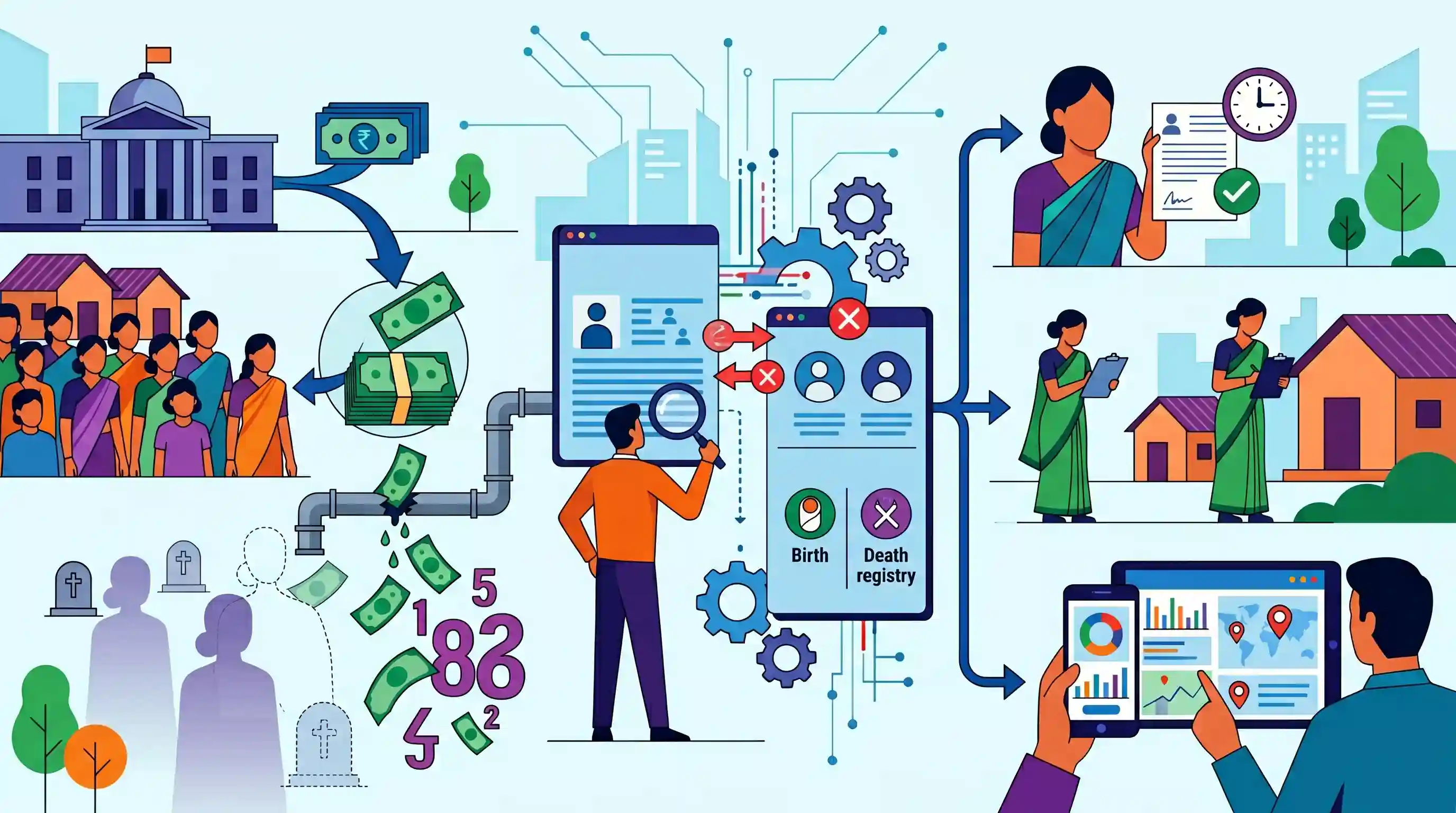
Why It Matters
Highlights a critical flaw in Direct Benefit Transfer (DBT) schemes: the lack of dynamic tracking post-enrollment. It underscores the necessity of continuous digital monitoring, interoperable databases (like linking welfare schemes to birth/death portals), and localized human oversight (Anganwadi workers) to prevent fiscal drain and ensure transparency in public funds.
Summary
An audit of Karnataka's Gruha Lakshmi scheme, which provides Rs 2,000 monthly to women household heads, revealed that funds are still being transferred to about 2.5 lakh deceased beneficiaries, leading to an estimated Rs 70 crore misappropriation. The discrepancy was uncovered through cross-referencing data with the E-Janma portal. To combat these leakages, the state government plans to implement mandatory life certificates, deploy Anganwadi workers to track deaths locally, and develop a technology-based monitoring application, shifting away from reliance solely on initial e-KYC enrollments.
Key Points
- Approximately 2.5 lakh deceased women continued receiving Rs 2,000 monthly under the Gruha Lakshmi scheme, causing Rs 70 crore in leakage.
- The loophole resulted from families failing to report deaths after the initial e-KYC verification was completed during the 2023 rollout.
- Data from the E-Janma birth and death certificate portal helped the Women and Child Development Department uncover the ghost beneficiaries.
- To combat the issue, the government will implement regular tech-based life status verification and deploy Anganwadi workers to monitor and report local deaths.
- The scheme commands a massive state budget, with Rs 28,608 crore allocated for 1.25 crore beneficiaries in the 2025-26 financial year.
Important Terms
Gruha Lakshmi scheme

Karnataka's flagship social security scheme providing ₹2,000 monthly to women heads of households via Direct Benefit Transfer to promote financial independence.
UPSC context
GS Paper 2 (Welfare Schemes); GS Paper 3 (Social Justice). Tests knowledge of state-level poverty alleviation and women empowerment models.
E-Janma portal
Karnataka's centralized e-governance platform for the digital registration and issuance of birth and death certificates, integrated with the Seva Sindhu portal.
UPSC context
GS Paper 2 (E-Governance). Tests application of digital tools in improving administrative transparency and curbing welfare leakages.
Direct Benefit Transfer (DBT)
A governance mechanism where subsidies or cash benefits are transferred directly to beneficiaries' bank accounts, bypassing intermediaries to reduce corruption and delays.
UPSC context
GS Paper 2/3 (Governance/Economy). A core concept involving the 'JAM Trinity' (Jan Dhan, Aadhaar, Mobile) for efficient public service delivery.
Ghost Beneficiaries
Ineligible or non-existent individuals on government beneficiary lists, including deceased persons or duplicate profiles, that cause misappropriation of public funds.
UPSC context
GS Paper 2 (Governance). Tests understanding of challenges in welfare targeting, leakages, and the need for periodic data verification/audits.
Life Certificate (Jeevan Pramaan)
A certificate (often digital/biometric) proving a beneficiary is alive; required periodically to maintain eligibility for pensions or long-term financial assistance.
UPSC context
GS Paper 2 (Governance). Tests mechanisms for ensuring accountability and preventing fraud in long-term government payouts.
Department of Women and Child Development (Karnataka)
The state nodal agency responsible for implementing social welfare programs for women and children, including the Gruha Lakshmi and Anganwadi initiatives.
UPSC context
GS Paper 2 (Institutional Framework). Tests the role of specialized administrative bodies in delivering development interventions at the grass-roots level.
Prelims Trap
Aadhaar-linked Direct Benefit Transfer automatically eliminates all ghost beneficiaries by tracking real-time demographic changes.
Aadhaar ensures unique identity at enrollment but does not automatically track life status. Without periodic dynamic verification, deceased individuals remain in the system as ghost beneficiaries.
Static Concepts Connected
How does Aadhaar address leakages in welfare delivery?
- De-duplication: Aadhaar provides a unique biometric identity, stopping individuals from registering multiple times under fake names.
- Direct targeting: By linking bank accounts with Aadhaar, funds are deposited directly to the verified beneficiary, cutting out middlemen.
- Limitation: While Aadhaar proves identity, it does not prove eligibility or 'life status', necessitating additional periodic verifications.
What is the Jeevan Pramaan initiative?
- Digital verification: It is an Aadhaar-based biometric authentication system to generate Digital Life Certificates for pensioners.
- Removes physical presence: It eliminates the requirement for elderly pensioners to physically visit disbursing agencies to prove they are alive.
- Dynamic tracking: It dynamically tracks life status, preventing 'ghost' leakages—a model now being adapted for other social security schemes.
Cross-Topic Patterns
Tech + Grassroots Human Intelligence
Relying purely on digital databases causes backend bias. Deploying Anganwadi workers to verify deaths proves technology must be supplemented by grassroots human monitoring for effective welfare administration.
Breaking Data Silos via APIs
The leakage was only caught by cross-referencing DBT lists with the E-Janma portal. This highlights the critical governance need for inter-departmental API integration to maintain dynamic registries.

Mains GS-2 will likely feature a question evaluating the limitations of Aadhaar-DBT and the need for dynamic tracking to stop leakages.
Linked PYQs · 3
Linked PYQs · 3
- 2015MainsGS3
In what way could replacement of price subsidy with Direct Benefit Transfer (DBT) change the scenario of subsidies in India ? Discuss.
- 2023MainsGS2
e-governance, as a critical tool of governance, has ushered in effectiveness, transparency and accountability in governments. What inadequacies hamper the enhancement of these features ?
- 2019MainsGS2
Performance of welfare schemes that are implemented for vulnerable sections is not so effective due to absence of their awareness and active involvement at all stages of policy process. Discuss.
