Gujarat renewable energy hybrid project for industrial power
Source:renewablewatch ↗
Why It Matters
It demonstrates the practical application of Green Energy Open Access and captive power generation rules, highlighting private sector investments in hybrid (solar-wind) energy to meet decarbonization targets, particularly in leading renewable energy states like Gujarat.
Summary
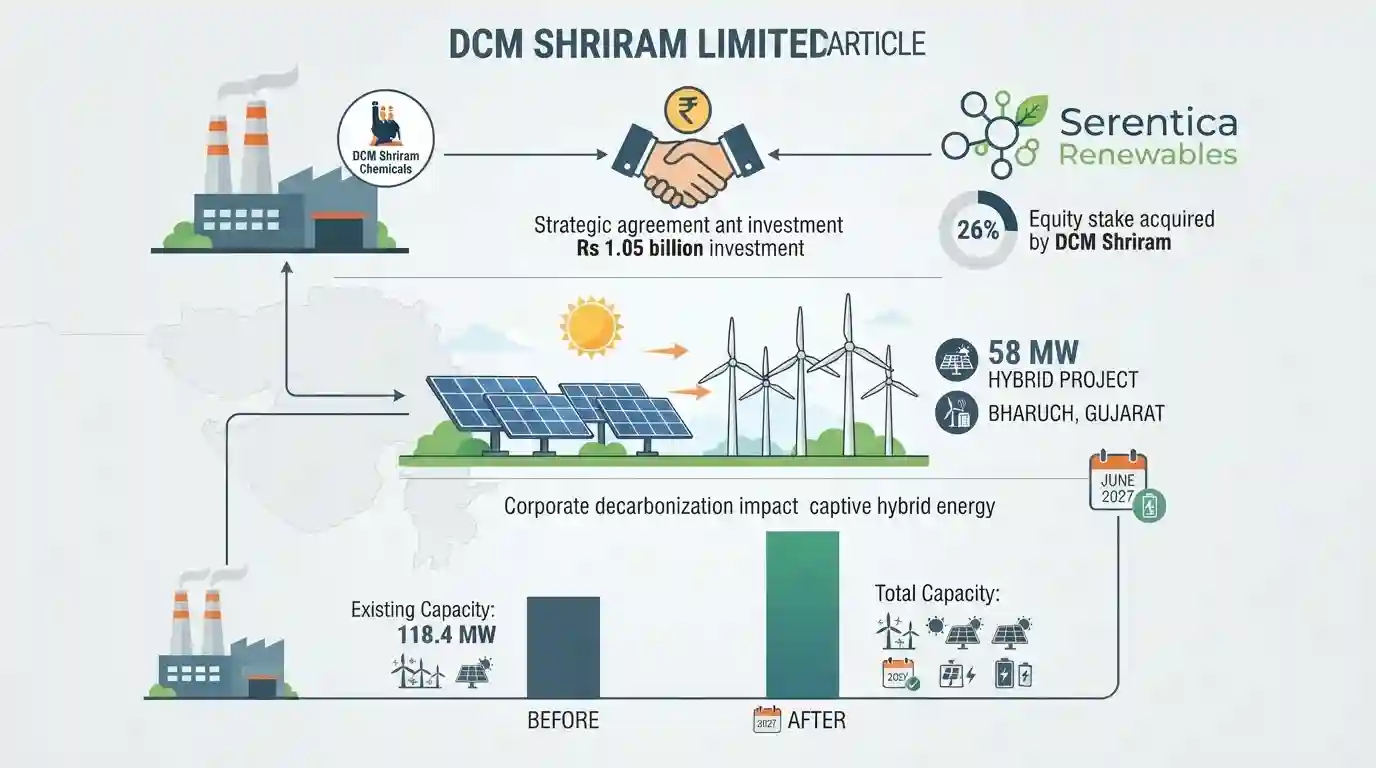
DCM Shriram Limited has entered into a strategic agreement with Serentica Renewables to establish a 58 MW hybrid renewable energy project (combining solar and wind power) in Bharuch, Gujarat. To secure captive power, DCM Shriram will invest up to Rs 1.05 billion to acquire at least a 26% equity stake in Serentica. Expected to be operational by June 2027, this project will significantly boost DCM Shriram Chemicals' total renewable energy capacity to 176.4 MW, illustrating the growing industrial reliance on captive hybrid energy projects for corporate decarbonization.
Key Points
- DCM Shriram Limited has partnered with Serentica Renewables to develop a 58 MW solar-wind hybrid renewable energy project in Bharuch, Gujarat.
- DCM Shriram will invest up to Rs 1.05 billion to acquire a minimum 26% equity stake in Serentica Renewables for this captive power arrangement.
- This investment will increase DCM Shriram Chemicals' total renewable energy portfolio from 118.4 MW to 176.4 MW.
- The project aligns with the corporate decarbonization trend, utilizing captive renewable power generation and green open access regulations.
- The project is slated for completion by June 2027.
Important Terms
Green Energy Open Access Rules

Rules notified by India in 2022 to accelerate renewable energy adoption by allowing consumers with a load of 100 kW or more to purchase green power from preferred sources under a simplified regulatory process.
UPSC context
GS Paper III (Infrastructure: Energy). Tests knowledge of regulatory reforms enabling private participation and decentralized renewable energy transition in India.
Captive Power Plant
A power facility set up by an industrial consumer for its own use, requiring the user to hold at least 26% ownership and consume at least 51% of the generated electricity under Indian regulations.
UPSC context
GS Paper III (Infrastructure: Energy). Evaluates regulatory rules (like Electricity Rules 2026), industrial energy self-reliance, and corporate decarbonization frameworks.
Solar-Wind Hybrid Policy
A policy framework issued in 2018 to promote large grid-connected wind-solar PV hybrid systems, optimizing land and transmission infrastructure usage while reducing the variability and fluctuations of renewable power generation.
UPSC context
GS Paper III (Energy, Infrastructure). Assesses policy frameworks for improving grid stability, optimizing land resources, and accelerating clean energy transition goals.
Serentica Renewables India Private Limited
A leading Indian renewable energy developer focused on providing round-the-clock carbon-free power and hybrid solar-wind-storage solutions to help hard-to-abate industries meet their decarbonization goals.
UPSC context
GS Paper III (Economic Development, Infrastructure). Relevant as a case study of private sector investment driving corporate energy transitions and clean energy infrastructure.
DCM Shriram Limited
A prominent Indian industrial conglomerate with diversified operations in chemicals, sugar, agribusiness, and plastics, increasingly adopting captive green energy to transition toward low-carbon manufacturing.
UPSC context
GS Paper III (Industrial Growth, Energy). Illustrates how large corporate players utilize hybrid captive energy projects for industrial decarbonization.
Prelims Trap
A captive power plant requires the user to hold 51% ownership and consume 26% of the power.
The Electricity Rules, 2005 state the inverse: the captive consumer must hold at least 26% equity and consume at least 51% of generated energy.
Static Concepts Connected
What are the regulatory requirements for Captive Power Plants and Wind-Solar Hybrids?
- Ownership Threshold: Under Electricity Rules 2005, captive users must own at least 26% of the equity shareholding of the generating plant.
- Consumption Mandate: Captive users are legally required to consume at least 51% of the aggregate electricity generated annually.
- Hybrid Policy Ratio: The National Wind-Solar Hybrid Policy 2018 requires one resource's rated capacity to be at least 25% of the other's.
How do the Green Energy Open Access Rules, 2022 facilitate corporate green transitions?
- Lowered Threshold: Reduced the open access transaction limit from 1 MW to 100 kW, democratizing green power access for small commercial users.
- Access Mechanisms: Grants consumers access to green power through direct purchase, bilateral agreements, or captive generation routes.
- Surcharge Relief: Waives cross-subsidy and transmission surcharges for green open access to make commercial green power economically viable.
Cross-Topic Patterns
Green Open Access + ESG reporting
Liberalized open-access rules directly help firms meet SEBI's Business Responsibility and Sustainability Report (BRSR) mandates, integrating energy laws with corporate financial compliance.
Grid Intermittency + Hybrid Generation
Blending solar and wind leverages complementary diurnal generation cycles, minimizing energy storage requirements and solving grid frequency instability issues under GS-3 Infrastructure.

Questions testing precise regulatory criteria of 'captive generating plants' and 'hybrid projects' under Electricity Rules are highly likely.
Linked PYQs · 2
Linked PYQs · 2
- 2025GPSC_PRELIMSGS1
Under the Green Open Access Rules, 2022, the minimum size of the renewable energy project eligible for open access is
- 2026GPSC_PRELIMSGS1
Which of the following statement/s is/are correct regarding Renewable Energy Installed Capacity in India? 1. Wind energy is second only to solar energy in the Indian renewable sector. 2. Biomass power capacity accounts for around 30% of India's total renewable energy. 3. India ranks among the top three countries in the world in Hydropower Installed Capacity. Choose the correct option from the following.
