Hyundai Talegaon Plant Investment and Indirect Tax Reforms
Source:Indian Express ↗
Why It Matters
It provides a concrete, contemporary example of how structural tax reforms (like a GST rejig) can immediately spur large-scale industrial investment (FDI) and capacity expansion, which is essential for answering questions on industrial policy, taxation, and economic growth.
Summary
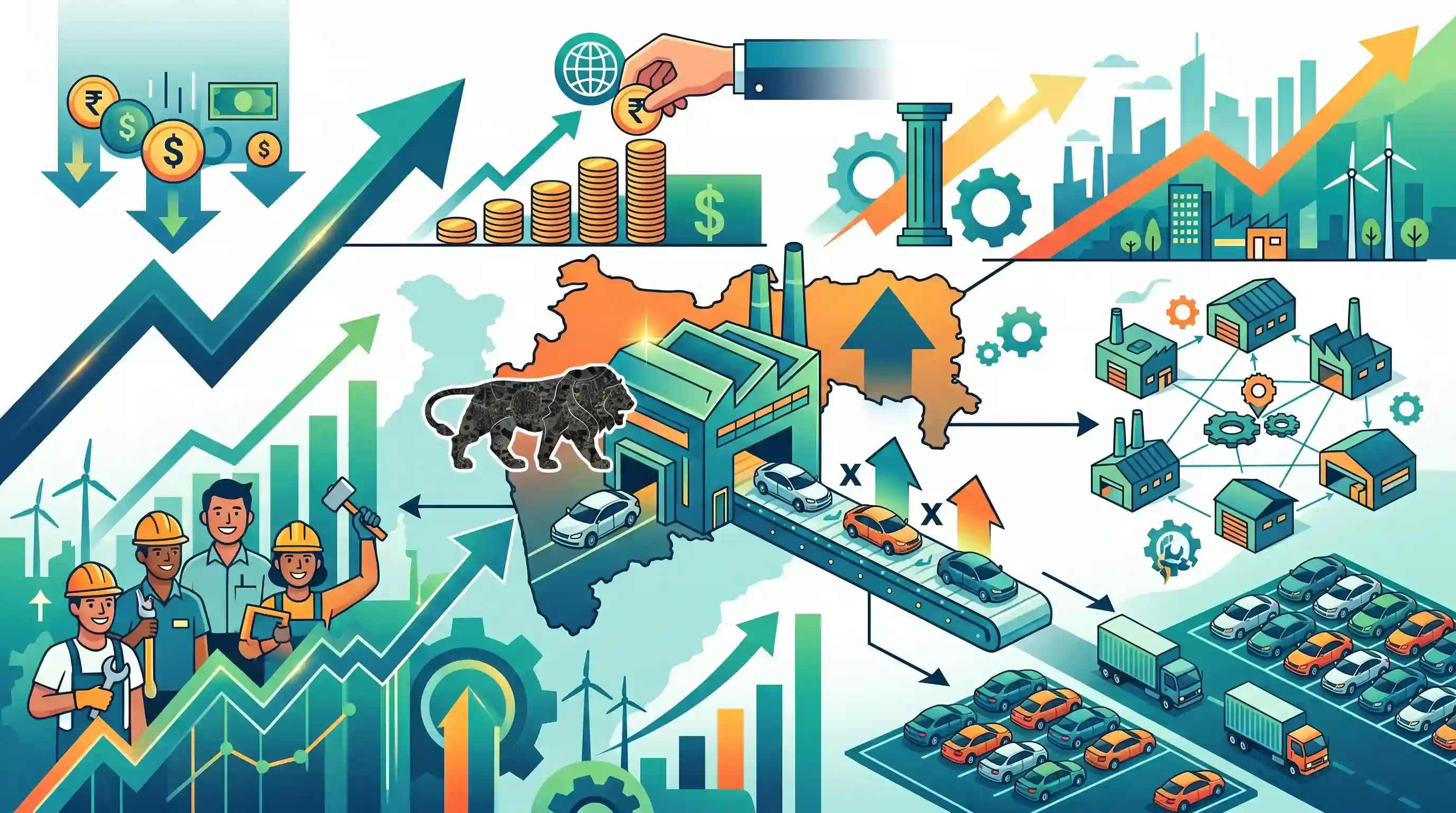
Following a recent GST rate rejig announcement, Hyundai has scaled up its investment commitment for its Talegaon manufacturing plant in Maharashtra by 60%, taking the total to Rs 11,000 crore. This development highlights the direct positive correlation between favorable indirect tax reforms and the attraction of Foreign Direct Investment (FDI) in India's manufacturing sector. The substantial capital infusion will enhance domestic automotive manufacturing capacity, align with the Make in India initiative, generate employment, and strengthen the local auto-ancillary supply chain, underscoring the broader economic impact of strategic industrial policies.
Key Points
- Hyundai has increased its investment commitment for its Talegaon plant in Maharashtra by 60%, raising the total to Rs 11,000 crore.
- The investment hike directly follows a GST rate rejig announcement, illustrating how favorable and rationalized indirect tax policies incentivize industrial capital expenditure.
- The capital infusion will boost the domestic automotive manufacturing sector, contributing significantly to the 'Make in India' initiative.
- Large-scale manufacturing investments in the auto sector drive job creation and stimulate growth for MSMEs in the ancillary supply chain.
Important Terms
Goods and Services Tax (GST)

A comprehensive, destination-based indirect tax levied on the supply of goods and services, subsuming multiple central and state taxes into a unified national market.
UPSC context
GS III: Indian Economy/Taxation. Tests knowledge of indirect tax reforms and their role in sector-specific demand revival.
Foreign Direct Investment (FDI)
A long-term investment by a foreign entity into a domestic business or project, typically involving technology transfer, management control, and capital infusion.
UPSC context
GS III: Investment Models. Tests understanding of external capital flows, ease of doing business, and economic growth drivers.
Make in India
A flagship government initiative launched in 2014 to facilitate investment, foster innovation, and transform India into a global design and manufacturing hub.
UPSC context
GS III: Changes in Industrial Policy. Tests awareness of strategies to increase manufacturing's share of GDP to 25%.
Manufacturing Sector
The secondary sector of the economy focused on processing raw materials into finished goods; it is vital for job creation and self-reliance.
UPSC context
GS III: Industrial Growth. Tests comprehension of sectoral contributions to GDP and challenges like the "stagnation" of manufacturing.
Industrial Policy
Government measures—including rules, subsidies, and tax incentives—designed to guide the development and regulation of a country's industries.
UPSC context
GS III: Effects of Liberalization. Tests understanding of the transition from state-led to market-oriented industrial frameworks since 1991.
Auto-ancillary Supply Chain
The network of manufacturers producing specialized components for the primary automobile industry, significantly impacting MSME growth and local employment.
UPSC context
GS III: Manufacturing/MSMEs. Tests knowledge of industrial value chains and the multiplier effect of large manufacturing investments.
Prelims Trap
Hyundai's Rs 11,000 crore capital infusion for the Talegaon plant represents a Greenfield Foreign Direct Investment.
It is a Brownfield investment because Hyundai acquired an existing facility (formerly General Motors) to upgrade and expand, rather than building a plant entirely from scratch.
Static Concepts Connected
What distinguishes Greenfield from Brownfield Foreign Direct Investment?
- Greenfield FDI: Involves establishing a completely new facility from the ground up, generating fresh employment and physical infrastructure.
- Brownfield FDI: Involves acquiring, leasing, or expanding an existing operational facility, allowing for much faster market entry.
How does the Goods and Services Tax (GST) eliminate the cascading effect in manufacturing?
- Input Tax Credit: Through the seamless flow of credit, manufacturers offset taxes paid on raw materials against taxes payable on final goods.
- Value Addition Taxation: By taxing only the incremental value added at each stage, the system prevents levying a 'tax on tax', lowering final costs.
Cross-Topic Patterns
Competitive Federalism + Uniform GST
With a uniform GST removing state-level tax-break wars, states like Maharashtra now compete for FDI purely on infrastructure, logistics, and ease of doing business.
Auto Sector PLI + Backward Linkages
Mega investments by primary auto manufacturers act as anchors for the PLI scheme, directly driving growth and technological upgrades in MSME auto-ancillary supply chains.

Greenfield vs Brownfield FDI concepts coupled with GST input tax credit mechanics will likely form a multi-statement Prelims question.
Linked PYQs · 5
Linked PYQs · 5
- 2019MainsGS3
Enumerate the indirect taxes which have been subsumed in the Goods and Services Tax (GST) in India. Also, comment on the revenue implications of the GST introduced in India since July 2017.
- 2023MainsGS3
Faster economic growth requires increased share of the manufacturing sector in GDP, particularly of MSMEs. Comment on the present policies of the Government in this regard.
- 2016MainsGS3
Justify the need for FDI for the development of the Indian economy. Why there is gap between MOUs signed and actual FDIs? Suggest remedial steps to be taken for increasing actual FDIs in India.
- 2017PrelimsGS1
What is/are the most likely advantages of implementing 'Goods and Services Tax (GST)'? 1. It will replace multiple taxes collected by multiple authorities and will thus create a single market in India. 2. It will drastically reduce the 'Current Account Deficit' of India and will enable it to increase its foreign exchange reserves. 3. It will enormously increase the growth and size of economy of India and will enable it to overtake China in the near future. Select the correct answer using the code given below:
- 2017MainsGS3
Industrial growth rate has lagged-behind in the overall growth of Gross-Domestic-Product (GDP) in the post-reform period." Give reasons. How far the recent changes in Industrial-Policy are capable of increasing the industrial growth rate?
