Delhi Heatwave Triggers GRAP 1 and Record Power Demand Surge
Source:Indian Express ↗
Why It Matters
The simultaneous crisis of heatwaves, high power demand, and poor air quality in Delhi exemplifies the compounding nature of urban climate disasters. It is highly relevant for UPSC aspirants studying the statutory role of the CAQM, IMD's color-coded weather warnings, and the resilience of urban infrastructure.
Summary
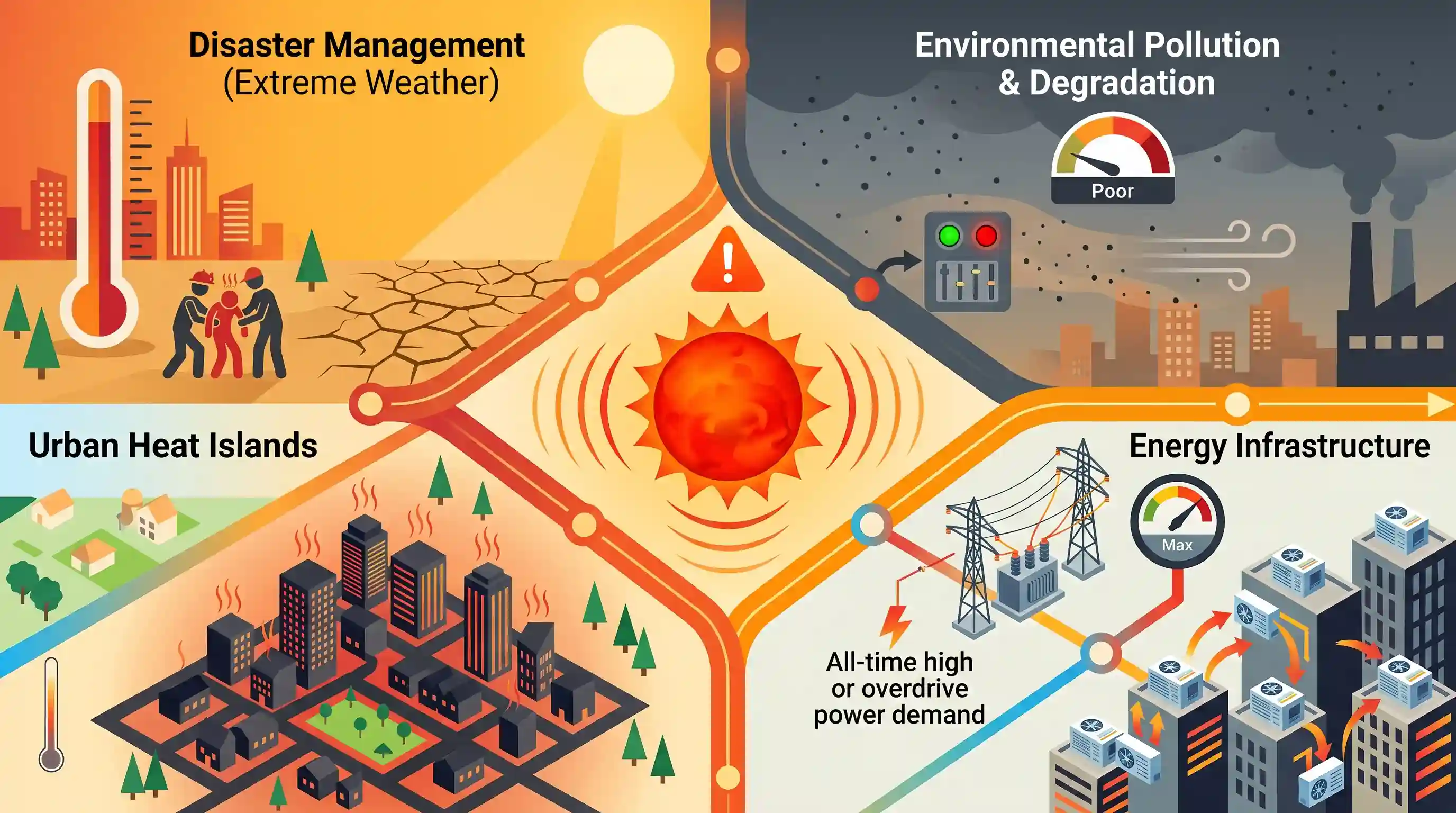
A severe heatwave in Delhi, with temperatures exceeding 45°C, has led the IMD to issue an orange alert. The extreme heat, combined with dry, dust-raising winds, has deteriorated the air quality to the 'Poor' category, prompting the CAQM to invoke Stage-1 of the Graded Response Action Plan (GRAP). Concurrently, the intense heat has driven Delhi's peak power demand to an all-time May high of 7,776 MW. This situation highlights the intersecting challenges of climate-induced extreme weather, environmental pollution, and urban energy security.
Key Points
- Delhi recorded a maximum temperature of over 45°C, prompting the IMD to issue a color-coded 'orange alert' for severe heatwave conditions.
- Driven by hot, dust-raising westerly winds, Delhi's Air Quality Index (AQI) worsened to the 'Poor' category.
- The Commission for Air Quality Management (CAQM) activated Stage-1 of the Graded Response Action Plan (GRAP) across the NCR, which includes stricter enforcement against polluting vehicles and dust-control measures.
- Surging cooling needs pushed Delhi's peak power demand to a record 7,776 MW, placing significant pressure on the grid and distribution networks.
Important Terms
Graded Response Action Plan (GRAP)

An emergency framework of stage-wise measures (Stages I-IV) implemented to combat air pollution in Delhi-NCR, activated based on specific Air Quality Index (AQI) thresholds and forecasts.
UPSC context
GS Paper 3 (Environment). Crucial for understanding urban pollution management, administrative coordination, and emergency environmental interventions in the National Capital Region.
Commission for Air Quality Management (CAQM)
A statutory body established in 2021 as an overarching authority to oversee air quality management, research, and inter-state coordination across Delhi-NCR and adjoining states.
UPSC context
GS Paper 2 (Statutory Bodies) & GS Paper 3 (Environment). Tests knowledge of specialized governance structures for cross-border environmental issues.
India Meteorological Department (IMD)
India's principal agency for meteorological observations, weather forecasting, and seismology, functioning under the Ministry of Earth Sciences to issue color-coded alerts for extreme weather events.
UPSC context
GS Paper 1 (Geography) & GS Paper 3 (Disaster Management). Important for understanding the institutional framework for early warning systems.
Heatwave (IMD Criteria)
A meteorological condition defined by IMD when maximum temperatures reach ≥40°C in plains (≥30°C in hills) or exceed the regional normal by 4.5°C to 6.4°C.
UPSC context
GS Paper 1 (Geography) & GS Paper 3 (Disaster Management). Essential for technical definitions of natural disasters and climate change impacts.
State Load Dispatch Centre (SLDC)
The apex state-level body responsible for real-time monitoring, grid control, and ensuring the integrated operation of the power system by balancing electricity supply and demand.
UPSC context
GS Paper 3 (Infrastructure/Energy). Relevant for discussing urban energy security, grid management during peak demand, and the Electricity Act, 2003.
Central Pollution Control Board (CPCB)
A statutory organization established in 1974 that provides technical services to the Ministry of Environment and coordinates the activities of State Pollution Control Boards.
UPSC context
GS Paper 3 (Environment). A fundamental institutional topic regarding the implementation of environmental laws like the Air and Water Acts.
Prelims Trap
"The Graded Response Action Plan (GRAP) is a nationwide emergency framework implemented by the CPCB."
GRAP is specific to the Delhi-NCR region and is implemented by the CAQM, a statutory body. It is not a nationwide framework run by the CPCB.
Static Concepts Connected
What are the IMD's criteria for declaring a heatwave in India?
- Baseline Thresholds: Maximum temperature must reach at least 40°C for plains, 37°C for coastal areas, and 30°C for hilly regions.
- Departure vs Absolute: Declared if the departure from normal is 4.5°C to 6.4°C, or if the absolute maximum temperature crosses 45°C regardless of the normal baseline.
What is the statutory mandate of the Commission for Air Quality Management (CAQM)?
- Statutory Origin: Established via the CAQM Act 2021, replacing the Supreme Court-mandated EPCA to provide a permanent, statutory mechanism for addressing NCR air quality.
- Overarching Jurisdiction: Its jurisdiction covers Delhi-NCR and adjoining states (Punjab, Haryana, Rajasthan, UP), giving its orders precedence over respective State Pollution Control Boards.
Cross-Topic Patterns
Urban Heat Islands & Grid Resilience
Severe heat amplifies the Urban Heat Island effect, skyrocketing nighttime cooling demands and stressing power grids. This directly links climate disaster management (heatwaves) to urban energy infrastructure resilience.
Summer Westerlies & Particulate Pollution
While winter smog dominates the discourse, summer dust-raising westerly winds significantly spike PM10 and PM2.5 levels, triggering GRAP protocols entirely independently of crop stubble burning.

Expect a multi-statement question integrating IMD heatwave criteria, UHI impacts on grid stability, and CAQM's statutory jurisdiction.
Linked PYQs · 4
Linked PYQs · 4
- 2022MainsGS1
Discuss the meaning of colour-coded weather warnings for cyclone prone areas given by India Meteorological Department.
- 2013MainsGS1
Bring out the causes for the formation of heat islands in the urban habitat of the world.
- 2021MainsGS3
Describe the key points of the revised Global Air Quality Guidelines (AQGs) recently released by the World Health Organisation (WHO). How are these different from its last update in 2005? What changes in India's National Clean Air Programme are required to achieve these revised standards?
- 2016PrelimsGS1
In the cities of our country, which among the following atmospheric gases are normally considered in calculating the value of Air Quality Index? 1. Carbon dioxide 2. Carbon monoxide 3. Nitrogen dioxide 4. Sulfur dioxide 5. Methane Select the correct answer using the code given below.
