DAY-NRLM Evaluation Reveals Shift of SHG Funds to Household Expenses
Source:Indian Express ↗
Why It Matters
Provides empirical, government-backed data on the operational shortcomings of a flagship poverty alleviation scheme (DAY-NRLM). It acts as perfect fodder for Mains questions analyzing the efficacy of microfinance, SHGs, and women empowerment initiatives, contrasting stated policy goals against ground-level realities.
Summary
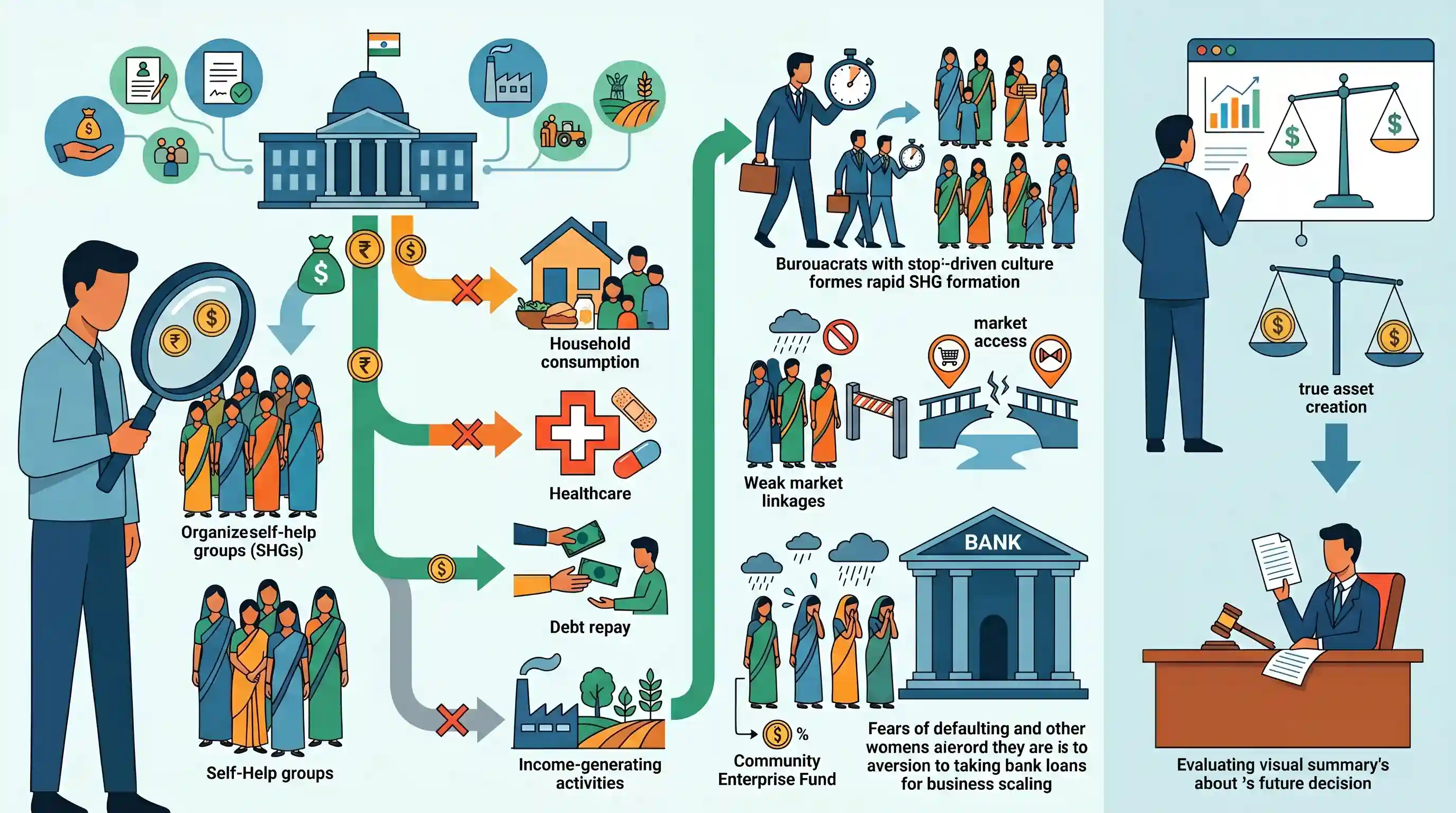
A government-commissioned evaluation of the Deendayal Antyodaya Yojana-National Rural Livelihoods Mission (DAY-NRLM) has uncovered significant challenges in its core objective of fostering rural enterprises. Conducted by Sambodhi Research on behalf of NITI Aayog's DMEO, the study found that funds allocated to women Self-Help Groups (SHGs)—such as the Revolving Fund—are predominantly utilized for household consumption, healthcare, and debt repayment rather than income-generating activities. The evaluation points to a target-driven administrative culture that prioritizes the rapid formation of SHGs over ensuring viable business ecosystems and market linkages. Consequently, SHG members show a strong aversion to taking bank loans for business scaling due to weak market demand and fears of defaulting. With only a minuscule percentage accessing the Community Enterprise Fund, the findings raise structural questions about the microfinance model's efficacy in true asset creation. This critical assessment will shape the Finance Ministry's decision on extending DAY-NRLM into the 16th Finance Commission cycle.
Key Points
- A third-party evaluation of DAY-NRLM revealed that financial support given to women SHGs for starting businesses is largely being spent on household expenses, debt repayment, and immediate consumption.
- Only a small fraction of SHGs access enterprise-focused funds, with 49.9% utilizing the Community Investment Fund (CIF), 41.8% securing bank loans, and a mere 3.8% accessing the Community Enterprise Fund (CEF).
- The target-driven approach pushes officials to form SHGs hastily, often in areas lacking viable business opportunities or necessary market linkages.
- Even when group-level enterprises are formed, members are hesitant to take bank loans to scale operations due to weak market demand and the fear of defaulting.
- This evaluation, commissioned by NITI Aayog's DMEO, is crucial as the Finance Ministry requires a third-party assessment to decide whether centrally funded schemes like DAY-NRLM will continue beyond March 2026 into the 16th Finance Commission cycle.
Important Terms
Deendayal Antyodaya Yojana-National Rural Livelihoods Mission (DAY-NRLM)

Flagship poverty alleviation scheme (Ministry of Rural Development) launched in 2011. It organizes rural poor, primarily women, into Self-Help Groups (SHGs) and federations to enhance livelihoods through financial inclusion, skill development, and market linkages.
UPSC context
GS 2 (Welfare Schemes) and GS 3 (Inclusive Growth). Tests knowledge of rural poverty alleviation and institutional frameworks for women's empowerment.
Self-Help Groups (SHGs)
Informal associations of 10–25 members, typically rural women, who pool small savings to provide mutual credit. They serve as the primary institutional unit for delivering welfare and microfinance under the DAY-NRLM framework.
UPSC context
GS 2 (Development Processes). Tests understanding of community-based organizations in social justice, women's empowerment, and rural governance.
Development Monitoring and Evaluation Office (DMEO)
An attached office of NITI Aayog (established 2015) that serves as the apex body for monitoring and evaluating government schemes. It ensures data-driven policy improvements and assesses the outcome-based efficacy of major central programs.
UPSC context
GS 2 (Governance). Tests awareness of monitoring and evaluation mechanisms used for evidence-based policy making and administrative accountability.
Revolving Fund (RF)
A one-time catalytic grant (₹20,000–₹30,000) provided to SHGs to boost their internal corpus. It helps build a financial track record, enabling groups to access larger bank loans for livelihood activities.
UPSC context
GS 3 (Economy). Tests technical knowledge of micro-credit mechanisms and their role in building financial discipline among the rural poor.
Community Investment Fund (CIF)
A capitalization fund (up to ₹2.5 lakh) provided to SHGs through their federations. Unlike the Revolving Fund, it is specifically intended to scale income-generating activities and diversify member livelihoods.
UPSC context
GS 3 (Rural Livelihoods). Tests understanding of capital injection strategies meant to transition rural households from subsistence to productive enterprises.
Community Enterprise Fund (CEF)
A dedicated fund under the Start-up Village Entrepreneurship Programme (SVEP) of DAY-NRLM. It provides seed capital and loans specifically for individual or group-led micro-enterprises to foster rural entrepreneurship.
UPSC context
GS 3 (Industrial/Enterprise Growth). Tests knowledge of specific sub-schemes aimed at promoting non-farm entrepreneurship and scaling rural businesses.
Prelims Trap
"Centrally Sponsored Schemes are automatically extended into the next Finance Commission cycle."
Post-2016, a 'sunset clause' makes schemes co-terminus with Finance Commission cycles. They require mandatory third-party outcome evaluations (like this DMEO report) for renewal.
Static Concepts Connected
What is the SHG-Bank Linkage Programme (SBLP)?
- NABARD initiative: Launched in 1992 to connect unbanked rural poor to the formal banking system via self-help groups.
- Collateral-free credit: Banks lend directly to SHGs without traditional collateral, relying heavily on group peer pressure for high loan recovery rates.
- DAY-NRLM integration: SBLP forms the foundational credit-delivery mechanism for DAY-NRLM, facilitating the transition from micro-savings to micro-enterprises.
What is the rationalisation process for Centrally Sponsored Schemes (CSS)?
- Sunset clause: Introduced in 2016, schemes are now co-terminus with Finance Commission cycles (e.g., 15th FC ending 2025-26) to prevent indefinite funding.
- Mandatory evaluation: Continuation requires a rigorous third-party evaluation by NITI Aayog's DMEO, assessing actual field outcomes versus financial outlays.
- Continuation approval: Based on evaluation findings, the Finance Ministry decides whether to extend, redesign, or scrap the scheme for the next cycle.
Cross-Topic Patterns
Microfinance vs. True Asset Creation
UPSC consistently tests the dichotomy between mere credit access (which often subsidizes consumption) and actual enterprise building (requiring backward/forward market linkages) in rural development.
Bureaucratic targets vs. Policy Outcomes
This evaluation perfectly illustrates a GS-2 Governance theme: how 'target-driven' bureaucratic culture prioritizes quantitative outputs (number of SHGs formed) over qualitative outcomes (business viability).

Expect a GS-2 mains question on how 'target-driven administration' and consumption-heavy borrowing undermine the asset-creation goals of SHGs.
Linked PYQs · 5
Linked PYQs · 5
- 2021MainsGS2
Can the vicious cycle of gender inequality, poverty and malnutrition be broken through microfinancing of women SHGs? Explain with examples.
- 2020MainsGS2
Micro-Finance as an anti-poverty vaccine, is aimed at asset creation and income security of the rural poor in India". Evaluate the role of the Self Help Groups in achieving the twin objectives along with empowering women in rural India.
- 2015MainsGS2
The Self-Help Group (SHG) Bank Linkage Programme (SBLP), which is India's own innovation, has proved to be one of the most effective poverty alleviation and women empowerment programmes. Elucidate.
- 2014MainsGS2
The penetration of Self Help Groups (SHGs) in rural areas in promoting participation in development programmes is facing socio-cultural hurdles. Examine.
- 2017MainsGS2
Poverty alleviation programmes in India remain mere showpieces until and unless they are backed up by political will." Discuss with reference to the performance of the major poverty alleviation programmes in India.
