Left Wing Extremism Eradication and Security Surrender Trends
Source:The Hindu ↗
Why It Matters
Left Wing Extremism (LWE) is a recurring theme in UPSC GS3. This article provides crucial contemporary data points—such as the massive surrender of Maoist operatives and the reduction of LWE to three districts—that can be used as evidence of the state\'s successful multilayered strategy in Mains answers.
Summary
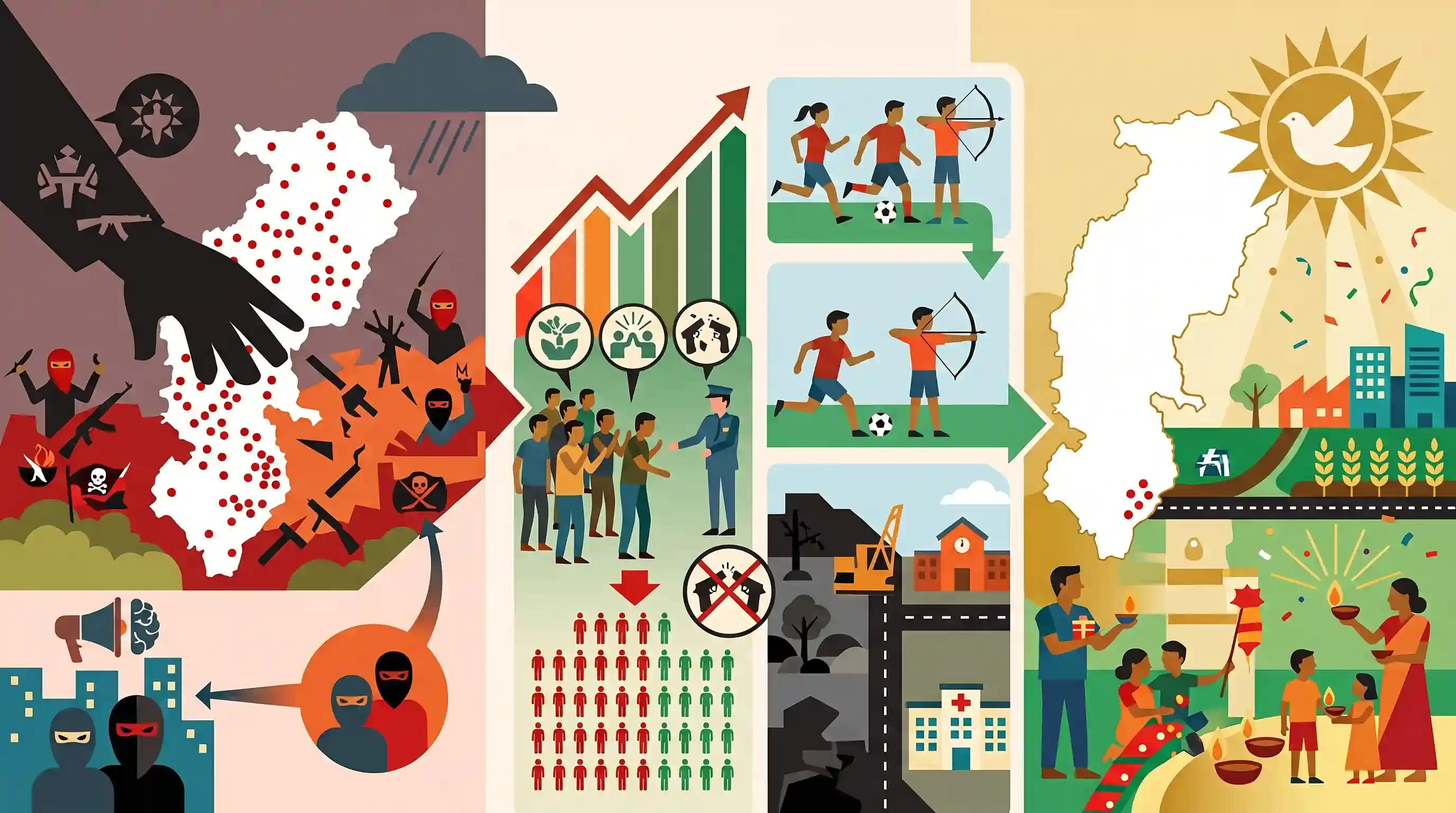
Prime Minister Narendra Modi announced that India is on the verge of eliminating Maoist terrorism, highlighting that Left Wing Extremism (LWE) is now restricted to just three districts. He noted significant operational successes, including the surrender of 303 Maoists within 75 hours. The Prime Minister emphasized that government efforts to mainstream misguided youth are bearing fruit, citing the organization of the \'Bastar Olympics\' as a symbol of positive change. He also criticized past administrations for failing to counter the influence of \'urban naxals\' and stated that areas formerly affected by Naxalism will celebrate Diwali for the first time in decades.
Key Points
- Prime Minister Narendra Modi asserted that India will soon be completely free from Maoist terrorism, with Left Wing Extremism (LWE) now confined to only three districts.
- The government\'s counter-extremism strategy recently yielded the surrender of 303 Maoist operatives within 75 hours, including 210 in Chhattisgarh.
- A key focus of the government is bringing misguided youth back into the mainstream through development and community engagement, exemplified by initiatives like the \'Bastar Olympics\'.
- The Prime Minister criticized previous governments for allowing \'urban naxals\' to dominate the narrative and censor information about Maoist violence.
Important Terms
Left Wing Extremism (LWE)

Armed insurgency by Maoist-inspired groups seeking to overthrow the democratic state through violent revolution, traditionally centered in tribal and forested regions of central and eastern India.
UPSC context
GS Paper III: Internal Security; key topic regarding challenges to internal security and the spread of extremism.
Urban Naxals
A contentious term for city-based intellectuals, activists, or professionals alleged to provide ideological, logistical, or intellectual support to the Maoist movement while operating within urban spaces.
UPSC context
GS Paper III: Role of non-state actors in creating challenges to internal security; tests understanding of evolving security threats.
Bastar Olympics
A multi-sport initiative by the Chhattisgarh government to engage tribal youth and surrendered Maoists, aiming to bridge the gap between affected communities and mainstream development through sports.
UPSC context
GS Paper III: Linkages between development and spread of extremism; tests soft-power strategies for counter-insurgency.
SAMADHAN Strategy
The Ministry of Home Affairs' 2017 operational doctrine for LWE, standing for Smart Leadership, Aggressive Strategy, Motivation, Actionable Intelligence, Dashboard-based KPIs, Harnessing Technology, Action plans, and No access to financing.
UPSC context
GS Paper III: Internal Security; standard government framework for addressing the Maoist challenge.
Red Corridor
A geographical region in central, eastern, and southern India that has historically witnessed high levels of Naxalite-Maoist influence and violence, though it has recently contracted significantly.
UPSC context
GS Paper III: Internal Security; tests knowledge of the geographical spread and decline of domestic insurgencies.
Nua Baat
In the context of Bastar Olympics, this term refers to a specific category for surrendered Maoists who have chosen a 'new path' to rejoin mainstream society.
UPSC context
GS Paper III: Internal Security; relevant for specific regional measures and surrender/rehabilitation terminology.
Prelims Trap
"Left Wing Extremism is now entirely confined to the state of Chhattisgarh."
While the three "most affected" districts are indeed in Chhattisgarh, LWE incidents and Security Related Expenditure (SRE) districts still span across multiple states including Jharkhand, Odisha, and Maharashtra.
Static Concepts Connected
What are the core pillars of the National Policy and Action Plan (2015) against LWE?
- Security interventions: Deployment of Central Armed Police Forces (CAPFs), intelligence sharing, and execution of the SAMADHAN doctrine to neutralize insurgent threats.
- Development initiatives: Infrastructure building via the Road Connectivity Project for LWE areas (RCPLWE), banking access, and mobile tower installations in remote tracts.
- Rights and entitlements: Ensuring tribal land rights and self-governance by effectively implementing the Forest Rights Act (2006) and PESA (1996).
How does the Surrender-cum-Rehabilitation policy mainstream former Left Wing Extremists?
- Financial incentives: Surrendered cadres receive an immediate grant of up to ₹5 lakh, kept in a fixed deposit subject to good behavior.
- Skill development: Offers a monthly stipend (typically ₹6,000) for up to 36 months to support the individual during comprehensive vocational training.
- Weapon surrender bonus: Provides additional specific cash compensation for voluntarily handing over firearms, explosives, and communication devices during the surrender.
Cross-Topic Patterns
PESA, FRA, and Tribal Alienation
The structural decline of Maoism is intrinsically linked to GS2 governance themes—specifically, correcting historical injustices through the Forest Rights Act and PESA, which systematically cuts off local civilian support for extremists.
Civic Action as Counter-Insurgency
The 'Bastar Olympics' mirrors 'Operation Sadbhavana' in J&K. Both highlight how civic action programs and soft power are critical last-mile strategies in counter-radicalization and integrating youth into the mainstream.

LWE's geographical contraction makes a 2026 Mains question on "SAMADHAN doctrine vs. overground 'Urban Naxal' networks" highly probable.
Linked PYQs · 3
Linked PYQs · 3
- 2025MainsGS3
The Government of India recently stated that Left Wing Extremism (LWE) will be eliminated by 2026. What do you understand by LWE and how are the people affected by it? What measures have been taken by the government to eliminate LWE?
- 2022MainsGS3
Naxalism is a social, economic and developmental issue manifesting as a violent internal security threat. In this context, discuss the emerging issues and suggest a multilayered strategy to tackle the menace of Naxalism.
- 2018MainsGS3
Left Wing Extremism (LWE) is showing a downward trend, but still affects many parts of the country. Briefly explain the Government of India's approach to counter the challenges posed by LWE.
