Urban Livelihoods Mission and Women Empowerment Strategies
Source:Indian Express ↗
Why It Matters
Understanding the efficacy, structural challenges, and policy enhancements needed for DAY-NULM is crucial for GS-3 (Inclusive Growth, Poverty, and Government Interventions).
Summary
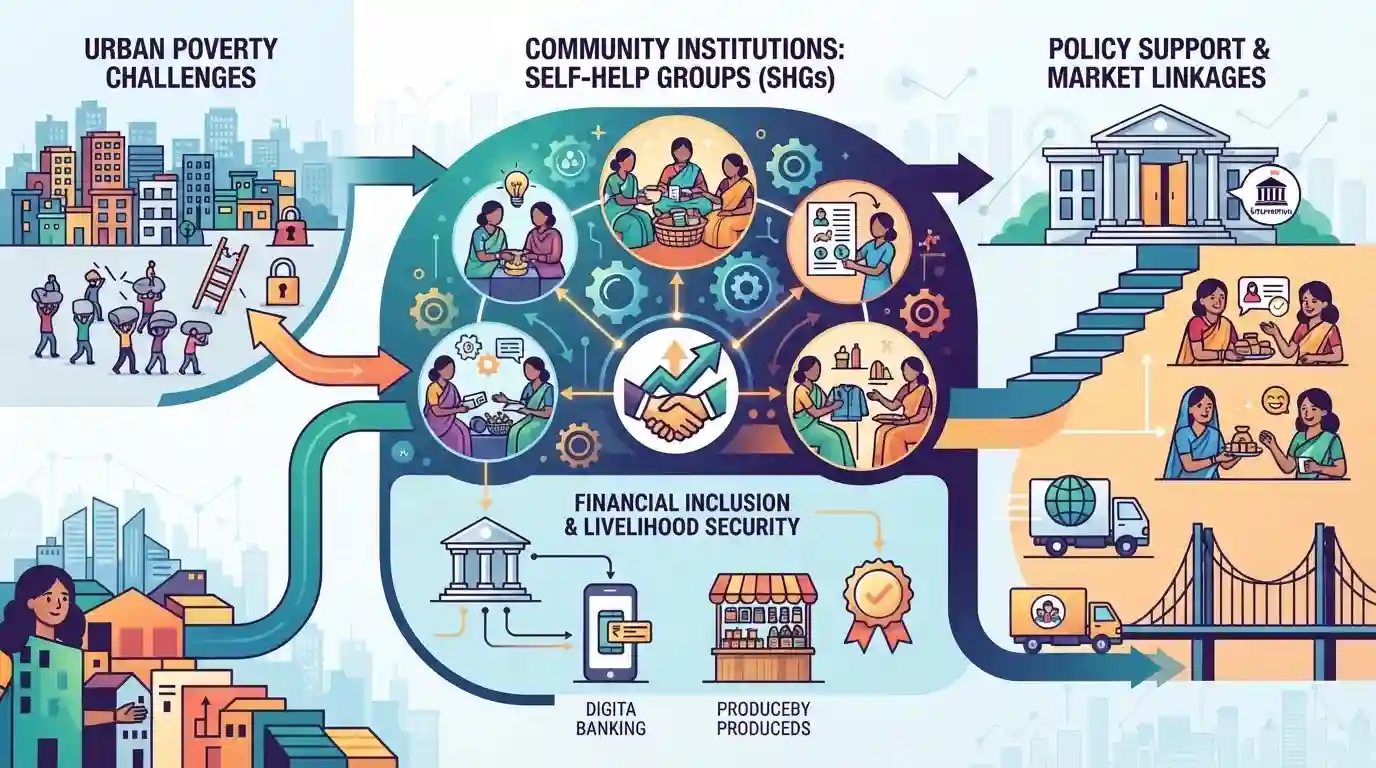
The article examines the significance of the Deendayal Antyodaya Yojana-National Urban Livelihoods Mission (DAY-NULM) in organizing urban poor women into Self-Help Groups (SHGs). It underscores the challenges of urban poverty, the role of community institutions in financial inclusion and livelihood security, and the necessity of robust policy support and market linkages to empower women in urban areas.
Key Points
- DAY-NULM plays a pivotal role in empowering urban women through Self-Help Groups (SHGs).
- Urban poverty alleviation requires targeted interventions for micro-enterprise development and skill training.
- Strengthening community institutions among urban poor women improves financial inclusion and social security.
- Policy focus needs to expand on scaling up market linkages and credit access for urban SHGs compared to rural counterparts.
Important Terms
Deendayal Antyodaya Yojana National Urban Livelihoods Mission

A flagship centrally sponsored scheme of the Ministry of Housing and Urban Affairs aimed at reducing urban poverty through skill training, self-employment ventures, and organizing the urban poor into Self-Help Groups (SHGs).
UPSC context
UPSC GS Paper III (Inclusive Growth, Government Policies & Interventions). Tests understanding of poverty alleviation and urban livelihood strategies.
Ministry of Housing and Urban Affairs
The central nodal ministry responsible for formulating policies, coordinating programs, and overseeing urban development, housing, and urban poverty alleviation schemes like DAY-NULM in India.
UPSC context
UPSC GS Paper II (Governance) and GS Paper III (Urbanization). Evaluates institutional frameworks and administrative machinery for urban welfare.
Prelims Trap
Deendayal Antyodaya Yojana-National Urban Livelihoods Mission is implemented by the Ministry of Rural Development for urban poor.
Aspirants often confuse DAY-NULM with DAY-NRLM; NULM is exclusively managed by the Ministry of Housing and Urban Affairs, whereas NRLM is under the Ministry of Rural Development.
Static Concepts Connected
What are the core components and implementing ministry of DAY-NULM?
- Nodal Ministry: Implementing Ministry: Implemented by the Ministry of Housing and Urban Affairs (MoHUA) to alleviate urban poverty.
- SM&ID Component: Social Mobilization: Organizing urban poor women into Self-Help Groups (SHGs) and federations for financial inclusion.
- Skill & Credit: Wage & Self-Employment: Providing skill training for market demand and interest subvention on micro-enterprise loans.
- Special Groups: Vulnerable Support: Dedicated focus on urban homeless shelters and social security for street vendors.
Cross-Topic Patterns
DAY-NULM vs DAY-NRLM: Rural-Urban Livelihoods Paradigm
While DAY-NULM targets urban poverty, DAY-NRLM focuses on rural areas; both leverage women's SHGs for institutional credit and financial inclusion under twin ministries.
Urban Poverty and Municipal Governance Linkages
Urban SHGs face acute challenges in spatial integration compared to rural counterparts, linking urban poverty schemes directly with urban land use and street vending laws.

DAY-NULM's focus on micro-enterprises and street vendors vs rural NRLM will likely be tested via a comparative statement question.
Linked PYQs · 2
Linked PYQs · 2
- 2023MainsGS3
Distinguish between 'care economy' and 'monetized economy'. How can care economy be brought into monetized economy through women empowerment?
- 2023PrelimsGS1
Consider the following statements: 1. The Self-Help Group (SHG) programme was originally initiated by the State Bank of India by providing microcredit to the financially deprived. 2. In an SHG, all members of a group take responsibility for a loan that an individual member takes. 3. The Regional Rural Banks and Scheduled Commercial Banks support SHGs. How many of the above statements are correct?
