Bihar MLC Resigns to Accommodate Minister Deepak Prakash
Source:new-indian-express ↗
Why It Matters
This incident provides a practical application of Article 164(4) of the Constitution, detailing the limitations on appointing non-legislators as ministers. It emphasizes the Supreme Court's role in upholding the letter and spirit of constitutional provisions against political maneuvering, which is highly relevant for polity questions in the BPSC Prelims.
Summary
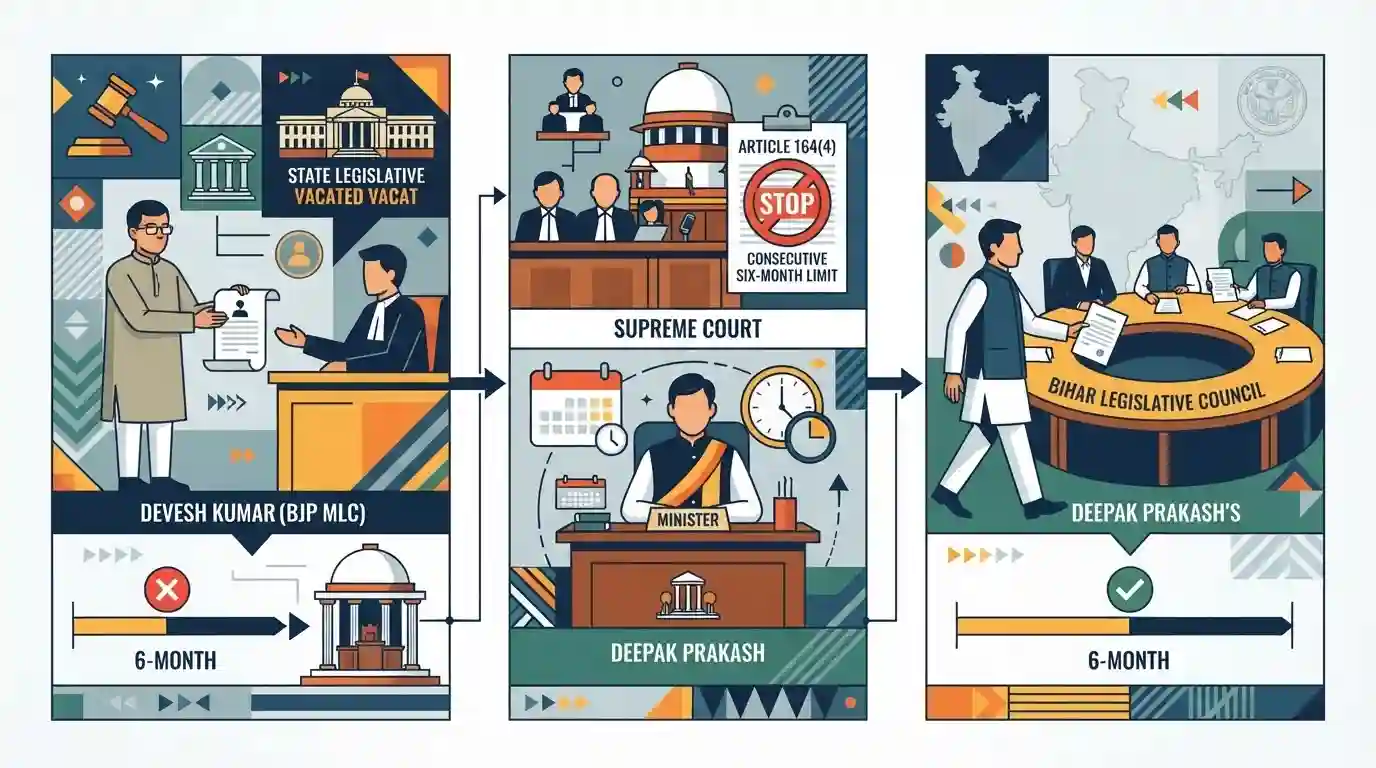
Bihar BJP MLC Devesh Kumar has resigned from the Legislative Council to facilitate the election of Panchayati Raj Minister Deepak Prakash. This move comes immediately after the Supreme Court pulled up the Bihar government over Prakash continuing as a minister for more than six months without being a member of either House of the state legislature. The apex court rejected the state's argument that his tenure could be split due to a change in government formation, affirming the strict consecutive six-month limitation set by Article 164(4) of the Constitution.
Key Points
- BJP MLC Devesh Kumar resigned from the Bihar Legislative Council to create a vacancy for Panchayati Raj Minister Deepak Prakash.
- Deepak Prakash has functioned as a state minister without being a member of the state legislature, exceeding the six-month grace period allowed.
- Article 164(4) of the Constitution stipulates that a minister who is not a member of the state legislature for six consecutive months shall cease to be a minister.
- The Supreme Court sharply criticized the Bihar government for aggregating his tenure across two successive government formations to bypass the six-month constitutional limit.
Important Terms
Article 164(4) of the Constitution

A constitutional provision stating that a state Minister who is not a member of the legislature for six consecutive months ceases to hold office at the expiration of that period.
UPSC context
GS Paper 2 (Polity). Tests the accountability of the state executive to the legislature and constitutional limits on ministerial appointments.
Supreme Court of India
The apex judicial body and highest constitutional court in India. It acts as the final interpreter and guardian of the Constitution, enforcing adherence to constitutional limits through judicial review.
UPSC context
GS Paper 2 (Polity). Essential for questions on judicial review, separation of powers, and the Supreme Court's constitutional role.
State Legislative Council
The upper house in India's bicameral state legislatures, established under Article 169. It has limited legislative powers and serves to review legislation and accommodate expert opinions outside direct elections.
UPSC context
GS Paper 2 (State Legislature). Frequently tested in Prelims and Mains regarding its creation, composition, and comparative powers with the Assembly.
Prelims Trap
"A non-legislator's 6-month grace period as a Minister resets if the government is dissolved and reconstituted."
The Supreme Court (S.R. Chaudhuri, 2001) strictly defined Article 164(4) as a "one-time concession." The consecutive six-month clock cannot be bypassed or reset via reappointment or government reconstitution.
Static Concepts Connected
What are the constitutional limits on appointing non-legislators as Ministers?
- Constitutional Basis: Articles 75(5) and 164(4) allow an unelected individual to serve as a Minister for a maximum of six consecutive months at the Union and State levels, respectively.
- One-time Concession: The Supreme Court ruled in S.R. Chaudhuri (2001) that this grace period is a "one-time constitutional concession" and cannot be repeatedly bypassed through reappointment.
- Includes PM/CM: The Supreme Court clarified in S.P. Anand (1996) that this allowance explicitly extends to the top executive, meaning a non-legislator can be appointed Prime Minister or Chief Minister.
Cross-Topic Patterns
RPA 1951 by-elections + Executive constraints
Article 164(4) limits routinely trigger the invocation of RPA 1951 Section 151A, which mandates filling legislative vacancies within six months, directly linking constitutional executive limits with statutory election laws.
Bicameralism + Backdoor executive appointments
Ministers seeking the Legislative Council route to bypass direct Assembly elections highlight the practical utility of bicameral legislatures in accommodating executive talent without immediate popular mandates.

Expect a multi-statement Prelims question on Art 164(4) limits, specifically testing if a non-legislator's 6-month clock ever resets.
Linked PYQs · 3
Linked PYQs · 3
- 2022BPSC_PRELIMSGS1
The members of a State Legislative Council are not chosen by which of the following categories of persons?
- 2024-IBPSC_PRELIMSGS1
Which of the following Constitutional Amendment in India has decided the maximum strength of the Council of Minister with Chief Minister in a State?
- 2024-EBPSC_PRELIMSGS1
Size of Council of Ministers has been restricted to 15 percent of membership of Lok Sabha by which Constitutional Amendment?
