Maratha Quota Agitation: Jarange Demands Kunbi Certificates for All
Source:The Hindu ↗
Why It Matters
The Maratha quota issue is a pivotal socio-political movement in Maharashtra. This development is crucial for MPSC Combined Prelims as it touches upon administrative committees (Sandeep Shinde Committee), historical regional documents (Hyderabad State/Marathwada), and constitutional frameworks governing backward classes (NCBC).
Summary
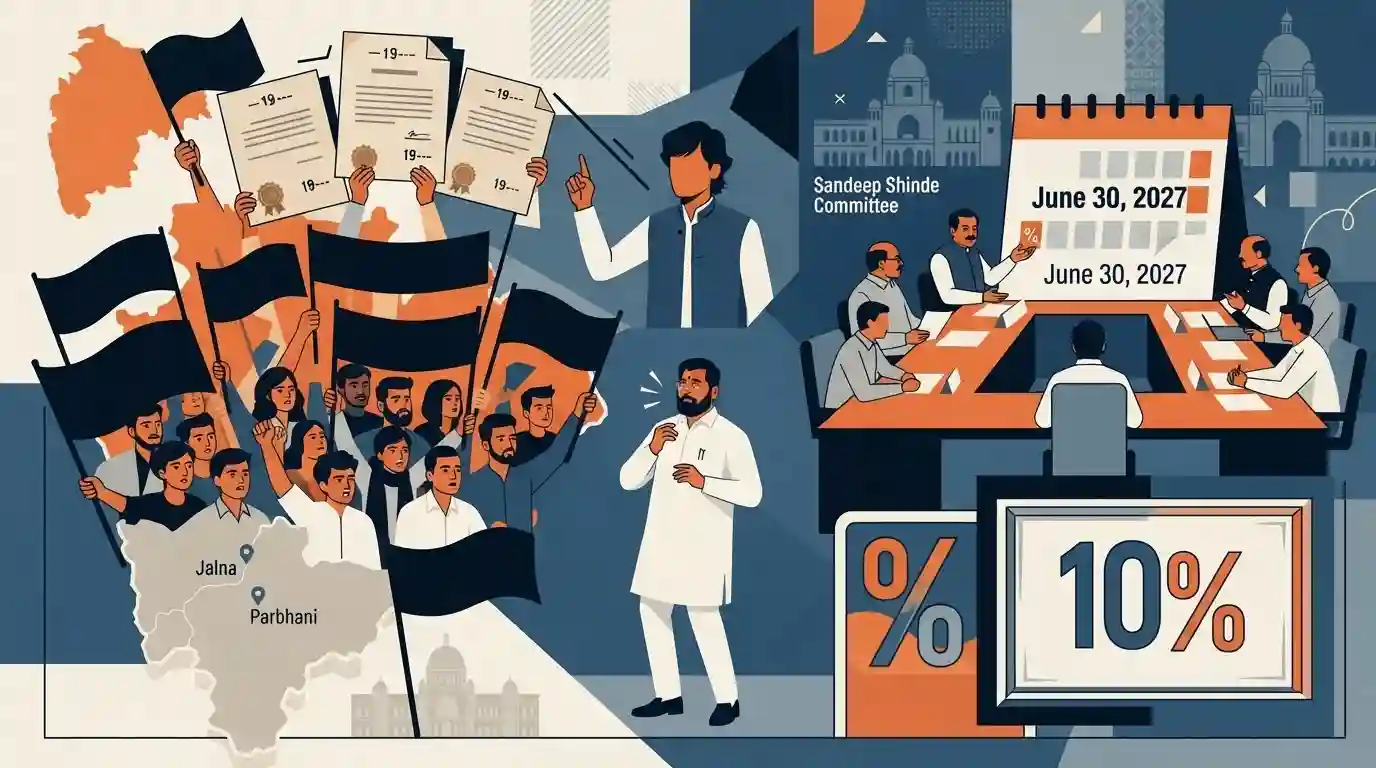
The article covers the intensification of the Maratha quota protests in Maharashtra, led by Manoj Jarange Patil in Jalna and Parbhani (Marathwada). Protesters waved black flags at Chief Minister Eknath Shinde to demand Kunbi (OBC) caste certificates for the Maratha community based on historical British and Hyderabad State-era documents. In response, the state government extended the tenure of the Sandeep Shinde Committee to June 30, 2027, to determine the methodology for issuing Kunbi certificates, while maintaining the separate 10% Maratha reservation.
Key Points
- Maratha quota activist Manoj Jarange Patil launched an indefinite hunger strike from August 28, 2026, in Antarwali Sarati, Jalna, demanding Kunbi caste certificates for all Marathas.
- The core demands include recognizing Marathas as Kunbi (OBC category), accelerating verification, halting any cancellation of existing Kunbi claims, and accepting Nizam-era Hyderabad State and British-era gazettes as valid proof.
- Marathwada region's historical links to the Nizam-ruled Hyderabad State play a vital role in verifying ancestral occupations through legacy documents.
- The Maharashtra Government issued a Government Resolution (GR) on August 25, 2026, extending the tenure of the Sandeep Shinde Committee until June 30, 2027, to standardise the methodology for issuing Kunbi certificates.
- Chief Minister Eknath Shinde defended the administration's policy, highlighting the provision of a separate 10% reservation to Marathas without disturbing existing OBC quotas.
Important Terms
Sandeep Shinde Committee

A committee established by Maharashtra in 2023, headed by retired Judge Sandeep Shinde, to formulate procedures for verifying historical records and issuing Kunbi (OBC) certificates to eligible Marathas.
UPSC context
MPSC GS-2 & GS-3. Tests state-appointed committees, reservation policies, and socio-economic governance issues in Maharashtra.
102nd Constitutional Amendment Act
An Act passed in 2018 that granted constitutional status to the National Commission for Backward Classes (Article 338B) and empowered the President to notify socially and educationally backward classes (Article 342A).
UPSC context
MPSC GS-2 (Polity). Tests constitutional amendments, statutory/constitutional bodies, and division of powers between Center and States.
105th Constitutional Amendment Act
A 2021 constitutional amendment that restored the independent power of Indian state governments and Union Territories to identify and notify their own lists of Socially and Educationally Backward Classes (SEBCs/OBCs).
UPSC context
MPSC GS-2 (Polity). Tests the federal structure, state autonomy in local affirmative action, and social justice legislation.
SEBC Act (Maharashtra)
Legislation enacted by Maharashtra (notably the 2024 Act based on the Shukre Commission) to grant a separate 10% reservation to the Maratha community in educational institutions and government jobs.
UPSC context
MPSC GS-2 & GS-3. Tests state reservation limits, judicial review, and the landmark 50% quota ceiling.
Mahayuti
The ruling political coalition in Maharashtra comprising the Bharatiya Janata Party (BJP), Eknath Shinde's Shiv Sena, and Ajit Pawar's Nationalist Congress Party (NCP).
UPSC context
MPSC GS-2 (Polity/Governance). Tests coalition politics, regional political parties, and state executive decision-making.
Prelims Trap
The 102nd Amendment Act restored the power of state governments to maintain their state list of SEBCs.
The 102nd Amendment actually stripped state powers according to the SC. It was the 105th Amendment in 2021 that explicitly restored state-level listing powers.
Static Concepts Connected
What are the differences between 102nd and 105th Constitutional Amendments?
- NCBC Status: The 102nd Amendment (2018) established Article 338B, granting constitutional status to the National Commission for Backward Classes, and introduced Article 342A.
- State Powers Restored: The 105th Amendment (2021) amended Article 342A to clarify and restore the state governments' power to identify and maintain their own list of SEBCs.
Chronological evolution of Maratha reservation commissions in Maharashtra.
- Bapat & Rane: Bapat Commission (2008) rejected OBC status for Marathas, while Rane Committee (2014) recommended a 16% quota under ESBC category.
- Gaikwad & Shukre: Gaikwad Commission (2018) led to SEBC Act 2018 (struck down by SC), while Shukre Commission (2024) recommended the current separate 10% reservation.
Cross-Topic Patterns
Marathwada Nizam-era records + Land Administration
Links MPSC GS-1 history of Hyderabad State integration (1948) with GS-2 governance, specifically the legal validity of Urdu/Modi script documents for caste determination today.
Indra Sawhney ceiling + Article 16(4)
Connects current SEBC 10% reservation pushing Maharashtra's total past 50% with the 'extraordinary circumstances' clause of the 1992 landmark Supreme Court judgment.

Chronology of Maharashtra reservation commissions paired with 105th Amendment provisions is highly probable for GS-2.
Linked PYQs · 2
Linked PYQs · 2
- 2023MPSC_PRELIMSGS1
Which of the following is/are a duties of National Commission for Backward Classes ?
- 2024MPSC_PRELIMSGS1
Match the following pairs : | List-I | List-II | |---|---| | (a) Dr. Nitin Karmalkar Committee | (i) For implementation of National Education Policy - 2020 in Maharashtra | | (b) Nitin Karir Committee | (ii) To enquire the incident which happened during the distribution of Maharashtra Bhushan Award | | (c) Sunil Pawar Committee | (iii) To study why the rates of onion collapse. | | (d) Dr. K. Kasturirangan Committee | (iv) To make the syllabus for pre-primary to degree according to National Education Policy - 2020 | Code: (a) (b) (c) (d)
