David Attenborough Conservation Legacy and Plastic Pollution
Source:Indian Express ↗
Why It Matters
The article highlights major global conservation milestones and shifting paradigms in environmental advocacy. It is directly relevant to GS3 topics on plastic pollution, species conservation (IUCN), and the role of stakeholders like Indigenous communities and activists in environmental protection.
Summary
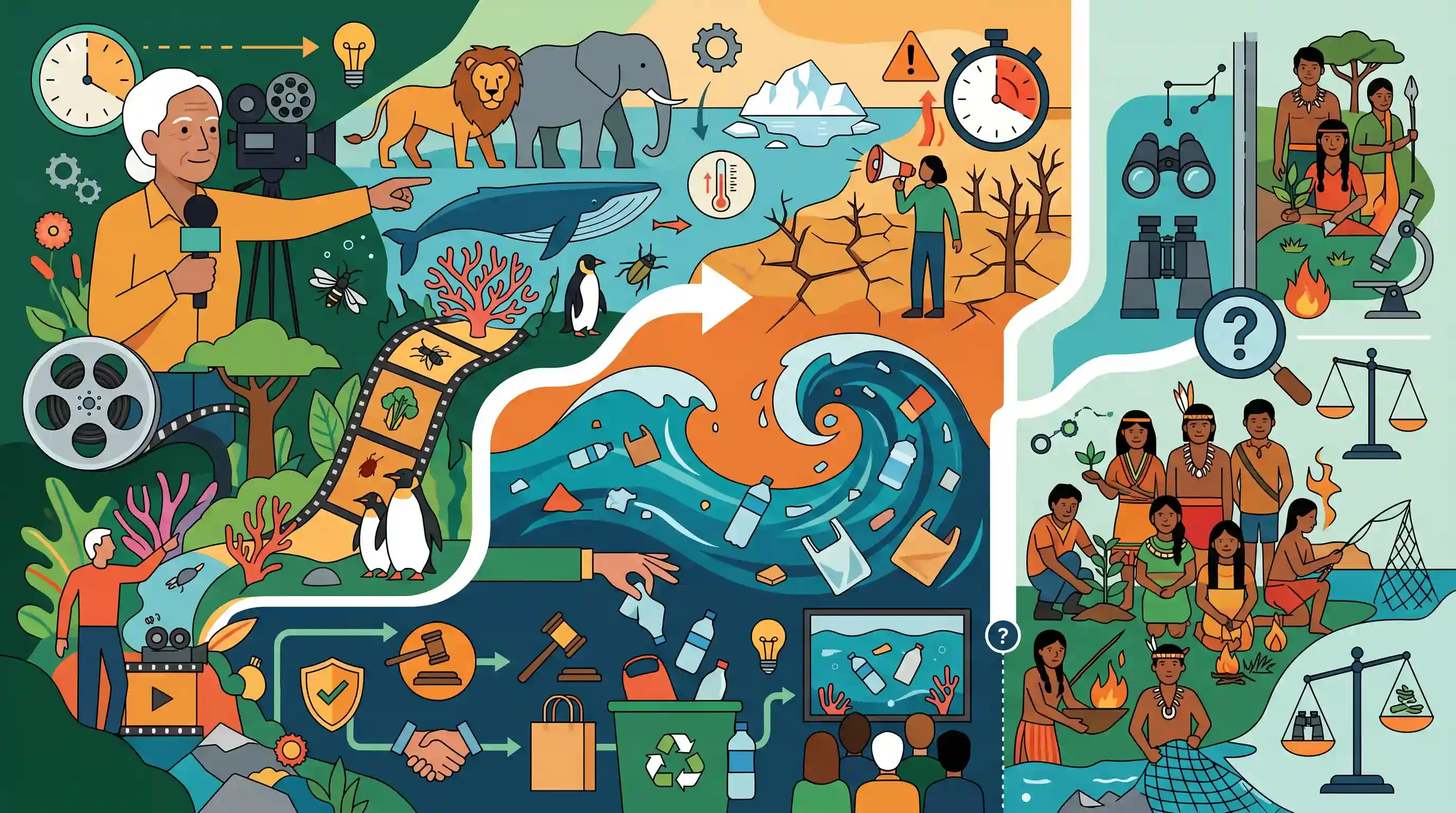
Sir David Attenborough's 100th birthday brings focus to his unparalleled legacy in environmental conservation and nature broadcasting. Over the past 70 years, his documentaries revolutionized global understanding of biodiversity. His later work shifted focus towards urgent environmental crises like climate change and habitat destruction. Most notably, his documentary 'Blue Planet II' served as a major catalyst against oceanic plastic pollution, influencing domestic policies like the UK's single-use plastic ban and international UN plastic treaties. However, his work has recently drawn criticism for historically overlooking the integral role of Indigenous communities and local populations in environmental stewardship and ecosystem maintenance.
Key Points
- Sir David Attenborough's 100th birthday highlights his immense contribution to global conservation awareness through seven decades of nature broadcasting.
- His work evolved from observational natural history to urgent advocacy, bringing global attention to crises like climate change, habitat destruction, and the plight of endangered species like the Mountain Gorilla.
- The documentary 'Blue Planet II' triggered a global movement against ocean plastic pollution, influencing the UK's single-use plastics ban and contributing to the momentum for international UN plastic treaties.
- Recent critiques note that his traditional documentaries often minimized the essential role of Indigenous populations and local communities in preserving biodiversity, reflecting an evolving understanding of inclusive conservation.
Important Terms
Global Plastic Treaty

A proposed legally binding international agreement negotiated under the UN Environment Assembly (UNEA) to end plastic pollution by regulating the entire lifecycle of plastics, from production to disposal.
UPSC context
GS Paper III: Environment. Tests knowledge of international environmental governance, circular economy principles, and global pollution mitigation strategies.
IUCN (International Union for Conservation of Nature)
The world's oldest global environmental union (est. 1948) of government and NGO members; it provides scientific data and assessments, notably the Red List, to guide nature conservation.
UPSC context
GS Paper III: Environment. Essential for understanding species conservation status, international biodiversity frameworks, and protected area management.
Environmental Stewardship
The responsible management and protection of the natural environment through sustainable practices, often highlighting the vital role of Indigenous communities as traditional custodians of ecosystems.
UPSC context
GS Paper III: Conservation. Relevant to community-led conservation models, Traditional Ecological Knowledge (TEK), and debates over "fortress conservation."
Biodiversity
The variety of all life forms on Earth—including genetic, species, and ecosystem diversity—providing essential services like food security, climate regulation, and water purification.
UPSC context
GS Paper III: Environment. A foundational concept for ecology, environmental degradation topics, and global targets like the Kunming-Montreal Framework.
Single-use Plastics (SUPs)
Plastic products intended for one-time use before disposal or recycling, such as straws and cutlery, which are primary targets of bans to mitigate oceanic and terrestrial pollution.
UPSC context
GS Paper III: Pollution and Waste Management. Tests awareness of domestic policies (like India's 2022 ban) and their environmental impact.
Prelims Trap
"The UN Global Plastics Treaty exclusively targets marine plastic pollution and microplastics in international waters."
The UN treaty explicitly mandates addressing the full life cycle of plastics—including raw material production, design, and terrestrial disposal—not just marine pollution.
Static Concepts Connected
What distinguishes Fortress Conservation from Community-Led models?
- Fortress Conservation: Creates strictly protected areas by isolating nature from human presence, often displacing local and indigenous communities without their consent.
- Community-Led Models: Integrates Indigenous Peoples as primary stewards of biodiversity, recognizing traditional land rights and leveraging local ecological knowledge.
What is the difference between primary and secondary microplastics?
- Primary Microplastics: Intentionally manufactured tiny plastics, such as microbeads in cosmetics, facial scrubs, and industrial plastic pellets.
- Secondary Microplastics: Fragments formed when larger plastic debris breaks down under environmental stressors like solar UV radiation and ocean wave action.
Cross-Topic Patterns
Forest Rights Act & Biodiversity Targets
Critiques of exclusionary conservation align with UPSC's focus on India's FRA 2006 and the Kunming-Montreal GBF, both of which emphasize indigenous land rights as a prerequisite for ecological preservation.
UN Plastic Treaty & Circular Economy
The UN treaty's 'full life cycle' approach connects globally with domestic Extended Producer Responsibility (EPR) guidelines under India's Plastic Waste Management Rules, shifting focus from consumption to production.

Expect a 2026 prelims statement linking the UN Global Plastics Treaty's 'full life cycle' approach with India's domestic EPR rules.
Linked PYQs · 5
Linked PYQs · 5
- 2024PrelimsGS1
Consider the following statements : Statement-I: Many chewing gums found in the market are considered a source of environmental pollution. Statement-II : Many chewing gums contain plastic as gum base. Which one of the following is correct in respect of the above statements?
- 2019PrelimsGS1
Why is there a great concern about the 'microbeads' that are released into environment?
- 2023PrelimsGS1
'Invasive Species Specialist Group' (that develops Global Invasive Species Database) belongs to which one of the following organizations?
- 2012PrelimsGS1
Which one of the following groups of animals belongs to the category of endangered species?
- 2024MainsGS3
What role do environmental NGOs and activists play in influencing Environmental Impact Assessment (EIA) outcomes for major projects in India? Cite four examples with all important details.
