DoPT Reports Absence of Data on Government De-Reservation Proposals
Source:The Hindu ↗
हे का महत्त्वाचे आहे
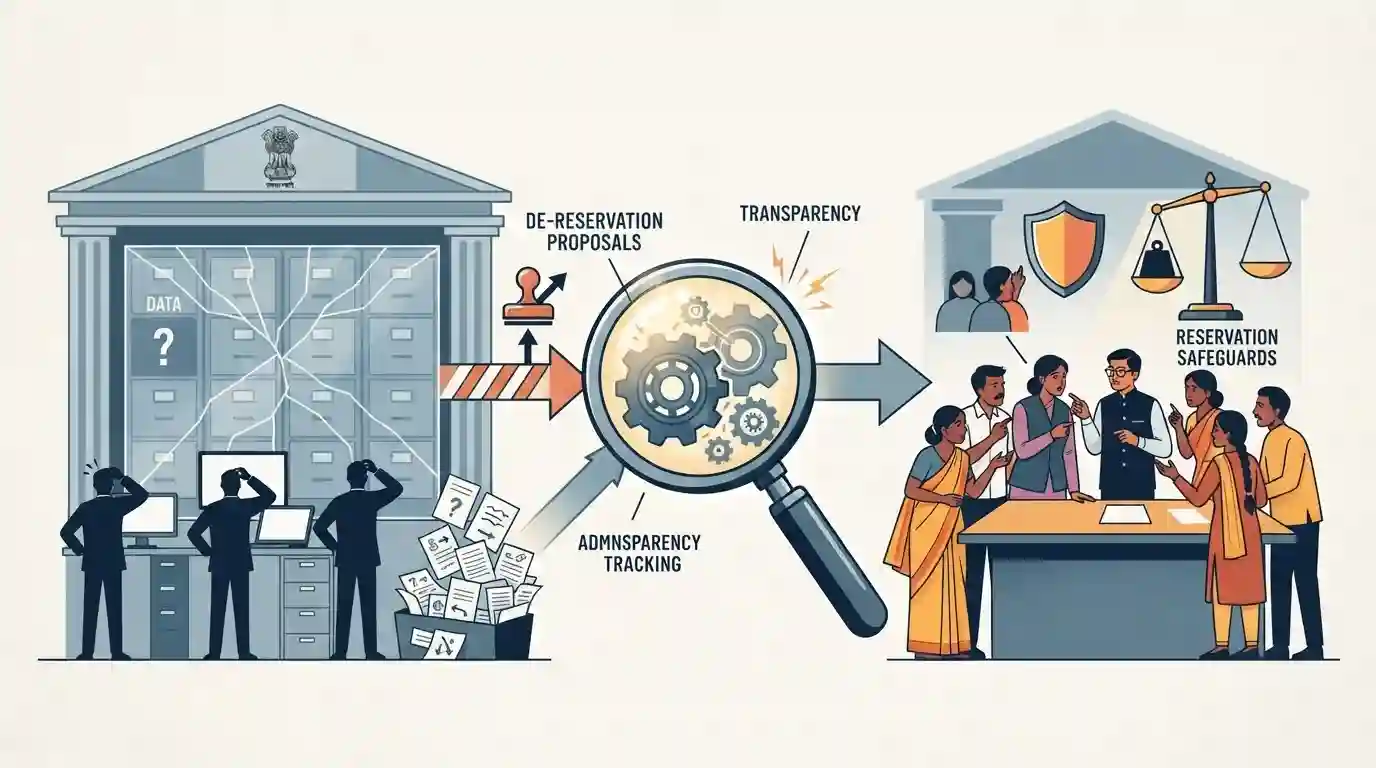
It underscores systemic accountability issues and institutional friction between central bureaucratic departments and statutory/constitutional commissions tasked with safeguarding the rights of Scheduled Castes.
सारांश
The Department of Personnel and Training (DoPT) reported that data concerning de-reservation proposals is not readily available, highlighting a friction point with the National Commission for Scheduled Castes (NCSC) regarding transparency, administrative tracking, and the protection of reservation safeguards for marginalized communities.
मुख्य मुद्दे
- The Department of Personnel and Training (DoPT) stated that data regarding de-reservation proposals in government posts is not readily available.
- This revelation comes amid an ongoing tussle between the DoPT and the National Commission for Scheduled Castes (NCSC) regarding transparency and implementation of reservation safeguards.
- De-reservation involves filling reserved posts with general category candidates when suitable candidates from Scheduled Castes (SC), Scheduled Tribes (ST), or Other Backward Classes (OBC) are not available, a process bound by strict guidelines.
- The lack of readily available data highlights accountability gaps and coordination friction between administrative bodies and constitutional oversight bodies.
महत्त्वाच्या संज्ञा
Department of Personnel and Training (DoPT)

The central nodal agency of the Government of India responsible for personnel management, framing civil service rules, recruitment policies, training, and the implementation of reservation norms in public employment.
UPSC context
GS Paper II (Polity & Governance - Statutory/Executive Bodies & Civil Services). Tests administrative accountability, policy implementation, and reservation governance.
National Commission for Scheduled Castes (NCSC)
A constitutional body established under Article 338 of the Constitution to investigate, monitor, and protect the constitutional and legal safeguards provided for Scheduled Castes.
UPSC context
GS Paper II (Constitutional Bodies & Social Justice). Tests the mandate, powers, and institutional oversight of commissions protecting marginalized groups.
पूर्वपरीक्षा सापळा
The National Commission for Scheduled Castes can independently veto and reverse departmental de-reservation proposals without governmental concurrence.
Aspirants often assume constitutional commissions like the NCSC have absolute executive veto power over departmental decisions, whereas they are primarily investigative and advisory.
संबंधित स्थिर संकल्पना
What are the constitutional powers and functions of the National Commission for Scheduled Castes (NCSC)?
- Article 338: Constitutional basis established under Article 338 of the Indian Constitution to monitor and safeguard protections for SCs.
- Civil Powers: Civil court powers vested under Article 338(8), including summoning witnesses and demanding public records.
- Reporting duty: Annual reporting submits its report to the President, who causes it to be laid before Parliament.
आंतर-विषय नमुने
NCSC oversight versus executive transparency gaps
The friction between executive departments and Article 338 bodies tests the limits of oversight and executive accountability in administrative governance.
Administrative record-keeping and constitutional safeguards
De-reservation protocols link administrative record-keeping directly to the constitutional safeguards mandated for marginalized sections under Part XVI of the Constitution.

NCSC powers under Article 338(8) and de-reservation procedures are prime candidates for a multi-statement polity question.
संबंधित PYQ · 1
संबंधित PYQ · 1
- 2018MainsGS2
Whether National Commission for Scheduled Castes (NCSC) can enforce the implementation of constitutional reservation for the Scheduled Castes in the religious minority institutions? Examine.
