Data-Driven Policy to Curb Human Trafficking
Source:Indian Express ↗
Why It Matters
Human trafficking and bonded labour represent severe violations of fundamental rights. The shift towards data-driven governance is crucial for UPSC aspirants to understand, as it highlights modern public administration's approach to tackling deep-rooted social injustices and organized crime through objective evidence and targeted interventions rather than generalized policies.
Summary
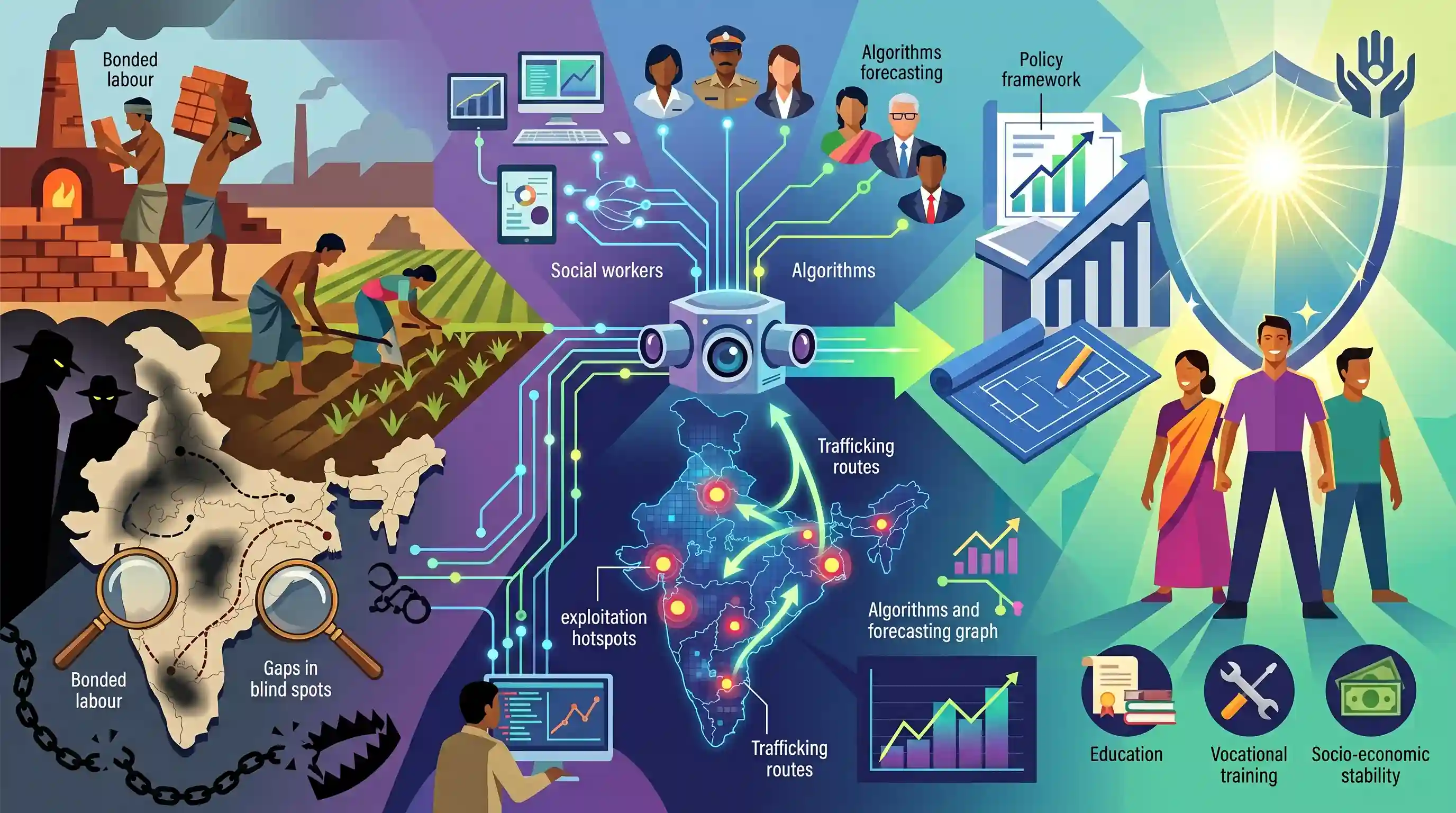
The article advocates for integrating data-driven approaches into policymaking to effectively combat the persistent issues of human trafficking and bonded labour in India. Traditional strategies often fall short due to a lack of granular, actionable data concerning trafficking routes, vulnerable demographics, and high-risk employment sectors (like brick kilns, agriculture, and domestic work). By establishing a robust framework for real-time data collection and inter-agency intelligence sharing, the government can map out exploitation hotspots and predict organized crime trends. Furthermore, evidence-based policymaking ensures that post-rescue rehabilitation programs are precisely tailored to the socio-economic realities of survivors, thereby reducing the risk of re-trafficking and strengthening the enforcement of the constitutional Right against Exploitation (Article 23).
Key Points
- Despite constitutional safeguards (Article 23) and strict legislation, human trafficking and bonded labour remain pervasive, requiring a shift from reactive policing to proactive prevention.
- Evidence-based, data-driven policymaking allows authorities to pinpoint localized trafficking hotspots, vulnerable demographics, and employment sectors with a high risk of forced labour.
- Robust inter-state and inter-agency data sharing is critical to mapping and dismantling organized, multi-state trafficking networks.
- Comprehensive data collection must track post-rescue socio-economic outcomes, enabling targeted rehabilitation interventions that prevent survivors from being re-trafficked.
Important Terms
Article 23 of the Indian Constitution

A Fundamental Right in Part III that prohibits 'traffic in human beings', 'begar' (unpaid work), and other forms of forced labour, making such practices punishable offences.
UPSC context
GS Paper II (Polity); tests knowledge of constitutional safeguards against exploitation and the protection of human dignity.
Bonded Labour System (Abolition) Act, 1976
A statutory law that abolished the bonded labour system in India, extinguished all existing bonded debts, and provided for the identification and rehabilitation of freed labourers.
UPSC context
GS Paper II (Social Justice/Governance); tests understanding of welfare legislation for vulnerable sections and implementation challenges like debt-bondage.
National Crime Records Bureau (NCRB)
The nodal agency under the Ministry of Home Affairs responsible for collecting and analyzing national crime data, including human trafficking statistics through its 'Crime in India' reports.
UPSC context
GS Paper III (Internal Security); tests awareness of data-driven governance and the role of institutional repositories in tracking organized crime.
Anti-Human Trafficking Units (AHTUs)
Specialized district-level law enforcement cells established by the Ministry of Home Affairs to focus specifically on investigating trafficking cases, rescuing victims, and coordinating with NGOs.
UPSC context
GS Paper II (Governance); tests knowledge of administrative mechanisms and field-level enforcement strategies for social justice.
Begar
A form of forced labour historically prevalent in India where individuals were compelled to work for no remuneration; it is specifically prohibited by the Constitution.
UPSC context
GS Paper I & II (Social Issues/Polity); tests historical and legal understanding of traditional exploitative systems in Indian society.
Prelims Trap
"Article 23 protections against human trafficking and forced labour are enforceable only against the State."
False. Article 23 is a unique Fundamental Right enforceable against both the State and private individuals (like contractors or employers), ensuring comprehensive protection against exploitation.
Static Concepts Connected
What are the core provisions of Article 23 regarding forced labour?
- Broad Scope: It explicitly prohibits traffic in human beings, 'begar' (unpaid labour), and other similar forms of forced labour.
- Private Enforcement: It is one of the few Fundamental Rights explicitly enforceable against private citizens, not just the State, to stop exploitation by private employers.
- Minimum Wage Link: The Supreme Court broadly interpreted forced labour to include compelling any person to work for less than the statutory minimum wage (PUDR v. Union of India).
- State Exception: The State is permitted to impose compulsory service for public purposes (like military conscription) without discrimination on grounds of religion, race, caste or class.
What institutional mechanisms tackle bonded labour under the 1976 Act?
- Vigilance Committees: The Act mandates the creation of District and Sub-Divisional Vigilance Committees to identify, release, and rehabilitate bonded labourers.
- Magisterial Powers: District Magistrates are vested with specific statutory powers and administrative duties to ensure the complete eradication of the bonded labour system in their jurisdiction.
- Debt Nullification: The legislation immediately extinguished all liability to repay bonded debts existing prior to the commencement of the Act.
Cross-Topic Patterns
Organised Crime and Money Laundering
Trafficking generates massive illicit wealth, frequently intersecting with PMLA violations and hawala networks. This requires coordinated financial intelligence and inter-agency data sharing under GS-3 internal security frameworks.
Climate-induced distress migration
Agricultural distress due to climate shocks forces vulnerable rural populations into distress migration to unregulated sectors (like brick kilns), sharply increasing their susceptibility to debt bondage.

Expect a GS-2 Mains question linking tech-driven governance (data mapping/AI) with tracking and rehabilitating vulnerable bonded labourers.
Linked PYQs · 3
Linked PYQs · 3
- 2017PrelimsGS1
Which of the following are envisaged by the Right against Exploitation in the Constitution of India? 1. Prohibition of traffic in human beings and forced labour 2. Abolition of untouchability 3. Protection of the interests of minorities 4. Prohibition of employment of children in factories and mines Select the correct answer using the code given below:
- 2025MainsGS2
"In contemporary development models, decision-making and problem-solving responsibilities are not located close to the source of information and execution defeating the objectives of development." Critically evaluate.
- 2022MainsGS3
Discuss the types of organised crimes. Describe the linkages between terrorists and organised crime that exist at the national and transnational levels.
