IMF data deficiencies grading and macroeconomic base year challenges
Source:The Hindu ↗
Why It Matters
Accurate macroeconomic data is foundational for sound policymaking, inflation targeting, and maintaining international investor confidence. Questions on base years, CPI vs. WPI, and GDP calculation methodologies are recurrent themes in both UPSC Prelims and Mains (GS3).
Summary
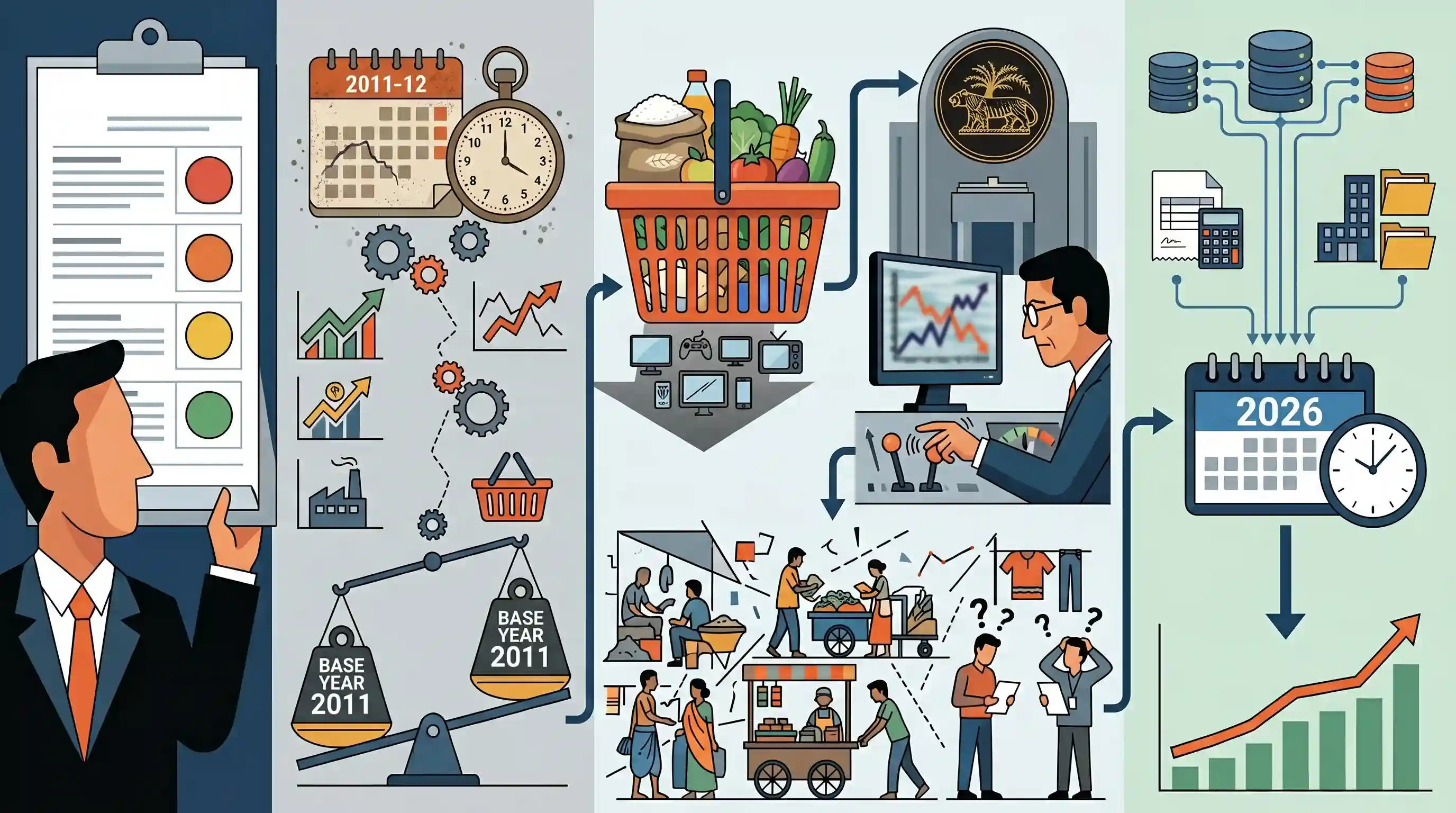
The IMF has given India a 'C' grade for its national accounts statistics and a 'B' for its Consumer Price Index (CPI), citing severe data deficiencies. The core issue lies in India's continued reliance on an outdated 2011-12 base year for critical macroeconomic indicators such as GDP, GVA, IIP, and CPI. This outdated methodology, particularly the outsized weightage of food in the CPI, obscures actual price movements and impedes the Reserve Bank of India's capacity to formulate effective monetary policy. While structural difficulties in surveying the vast informal sector have contributed to delays, the government aims to rectify these statistical anomalies by introducing updated base years and incorporating modern databases like GST and MCA-21 by early 2026.
Key Points
- The IMF has assigned India a 'C' grade for its national accounts statistics and a 'B' grade for its Consumer Price Index (CPI) in its latest Article IV consultation report.
- India's major macroeconomic indicators, including GDP, GVA, IIP, and CPI, still rely on an outdated base year of 2011-12, hindering accurate economic assessment.
- The outdated CPI basket gives an inordinately high weightage to food items, distorting true inflation measurements and complicating the RBI's monetary policy and inflation targeting efforts.
- Capturing data from India's vast, cash-based informal sector remains a significant structural challenge in updating national accounts.
- The government plans to introduce updated base years and revised methodologies—potentially utilizing the MCA-21 and GST databases—by early 2026.
Important Terms
International Monetary Fund (IMF)

International organization that monitors global economic health; its 'Article IV' reports assess the quality and transparency of member countries' macroeconomic data for global surveillance.
UPSC context
GS-2 (International Institutions) and GS-3 (Economic Growth); tests understanding of global oversight on national economic policy.
Base Year
The benchmark year used for calculating 'Real' GDP and inflation to remove price distortions; India currently uses 2011-12, leading to data deficiencies in capturing the modern digital economy.
UPSC context
GS-3 (National Income Accounting); critical for understanding the difference between Nominal vs. Real growth and structural economic shifts.
National Accounts Statistics (NAS)
A comprehensive set of macroeconomic data (including GDP and GVA) produced by MoSPI; it provides the official record of India's production, consumption, and investment activity.
UPSC context
GS-3 (Economic Development); essential for analyzing India's economic performance and the credibility of its statistical institutions.
MCA-21 database
Ministry of Corporate Affairs’ portal for electronic filing; used by the NSO to estimate private corporate sector output in GDP calculations, replacing older survey-based methods.
UPSC context
GS-3 (Growth & Development); involved in major debates regarding the accuracy and overestimation of India's manufacturing sector growth.
Consumer Price Index (CPI)
A retail inflation index measuring price changes from the consumer perspective; it serves as the primary 'nominal anchor' for the RBI’s monetary policy and inflation targeting.
UPSC context
GS-3 (Inflation & Monetary Policy); crucial for understanding how the RBI sets interest rates to maintain price stability.
Reserve Bank of India (RBI)
India's central bank and monetary authority; it relies on accurate NAS and CPI data to manage liquidity and set the repo rate to control inflation.
UPSC context
GS-3 (Indian Economy/Banking); tests knowledge of the institutional link between data quality and effective monetary management.
Goods and Services Tax (GST) Data
Comprehensive transactional data from the tax network; increasingly proposed as a modern, high-frequency alternative to traditional surveys for estimating the output of the formal and informal sectors.
UPSC context
GS-3 (Resource Mobilization/Growth); represents the shift toward using digital footprints for more accurate real-time economic measurement.
Prelims Trap
IMF Article IV consultations are conducted only for member nations seeking financial assistance.
Article IV consultations are regular, mandatory bilateral surveillance exercises for ALL member countries to assess macroeconomic health, regardless of borrowing status.
Static Concepts Connected
What is an IMF Article IV Consultation?
- Mandatory Surveillance: An annual or biennial bilateral review of a member country's economic, financial, and exchange rate policies.
- Universal Applicability: It applies to all 190 IMF member countries, not just those utilizing IMF bailout or lending facilities.
- Output: Results in a report grading economic health, identifying systemic risks, and recommending structural or policy adjustments.
Why does CPI have a higher food weight than WPI?
- Consumption Focus: CPI measures household retail consumption, where the average Indian family spends a significant portion of its income on food.
- Weightage Difference: Food and beverages make up roughly 45.8% of CPI, whereas primary food articles constitute only about 15% of the WPI basket.
- Policy Impact: This high food weight makes the RBI's flexible inflation targeting framework highly vulnerable to agricultural supply shocks.
Cross-Topic Patterns
E-Governance (MCA-21) shaping GDP data
Using the Ministry of Corporate Affairs' MCA-21 database for national accounts marks a transition from traditional enterprise sample surveys to real-time, compliance-based formal sector data.
Climate shocks dictating Monetary Policy
The outdated 2011-12 CPI basket's heavy reliance on food means climate events like El Niño disproportionately skew headline inflation, tying the RBI's hands on rate cuts.

Expect a 2026 Prelims question linking IMF Article IV surveillance, CPI base year revision, and the utility of the MCA-21 database.
Linked PYQs · 4
Linked PYQs · 4
- 2020PrelimsGS1
Consider the following statements: 1. The weightage of food in Consumer Price Index (CPI) is higher than that in Wholesale Price Index (WPI). 2. The WPI does not capture changes in the prices of services, which CPI does. 3. Reserve Bank of India has now adopted WPI as its key measure of inflation and to decide on changing the key policy rates. Which of the statements given above is/are correct?
- 2015PrelimsGS1
Which of the following brings out the 'Consumer Price Index Number for Industrial Workers?
- 2022PrelimsGS1
In India, which one of the following is responsible for maintaining price stability by controlling inflation?
- 2021MainsGS3
Explain the difference between computing methodology of India's Gross Domestic Product (GDP) before the year 2015 and after the year 2015.
