Jeff Bezos Proposes Gigawatt Scale Data Centres in Space
Source:The Hindu ↗
Why It Matters
The exponential growth of AI requires massive energy resources. Shifting data infrastructure to space presents an innovative solution to Earth\'s resource constraints, integrating themes of space technology, AI computing, and sustainable energy which are critical for GS Paper 3.
Summary
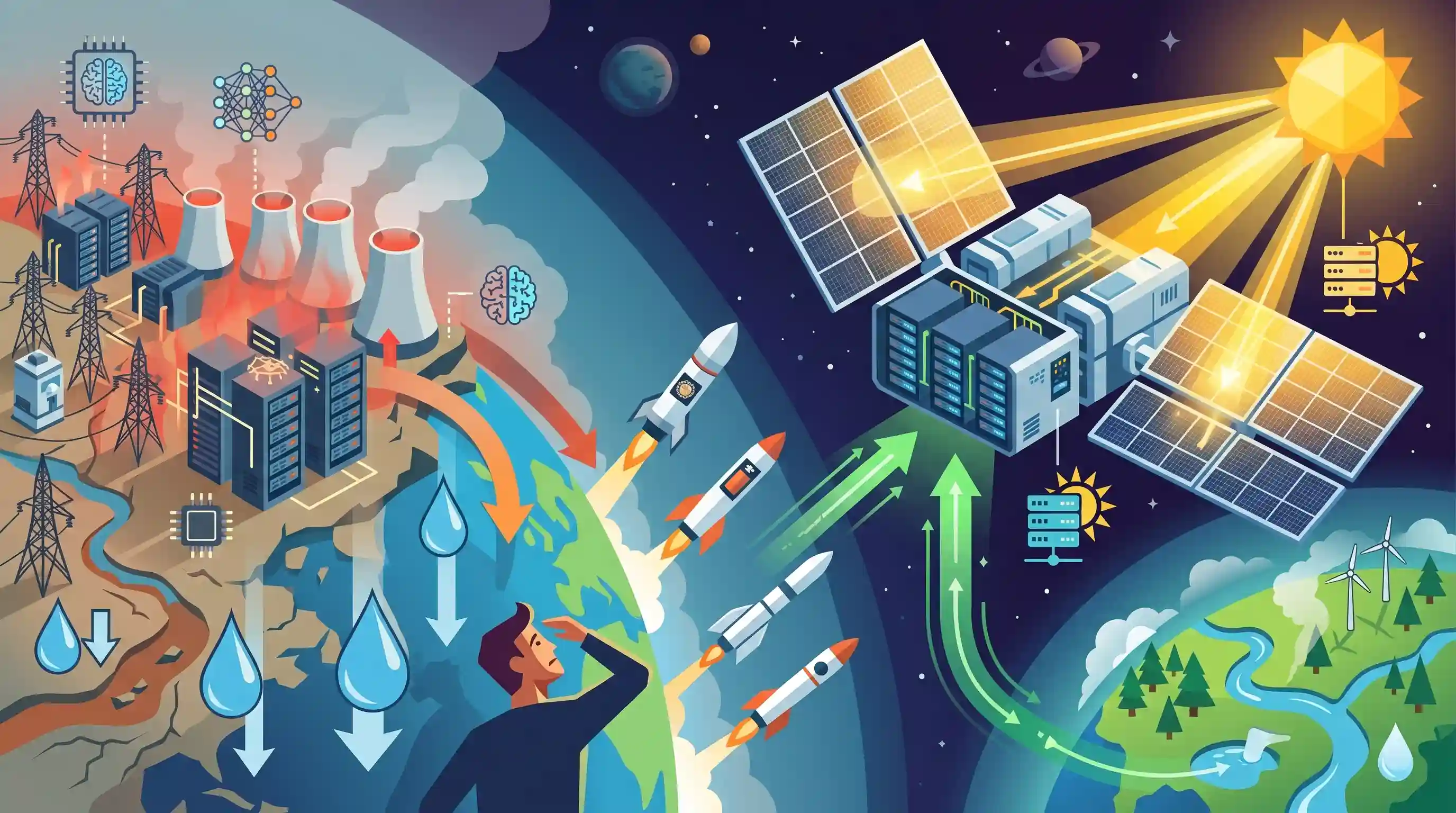
Amazon founder Jeff Bezos has suggested that building gigawatt-scale data centres in space could be a viable solution to the massive energy and water demands of Artificial Intelligence (AI). Orbital data centres would benefit from uninterrupted, continuous solar power and would reduce the strain on Earth\'s resources. While technical and logistical hurdles remain—such as launch costs and maintenance—this concept highlights the growing intersection of space commercialisation, renewable energy, and the infrastructure demands of advanced AI.
Key Points
- Jeff Bezos has proposed building gigawatt-scale data centres in space over the next 10 to 20 years to meet the exponential computational needs of AI.
- The proposal addresses terrestrial resource constraints, as space offers continuous, 24/7 solar power unaffected by weather or day/night cycles, avoiding the depletion of Earth\'s electricity and water resources.
- Moving heavy, energy-intensive computing infrastructure off-Earth aligns with broader visions of shifting heavy industry into space to preserve Earth\'s environment.
- Key challenges to this vision include the high costs of rocket launches, in-orbit maintenance and upgrades, data transmission latency, and heat dissipation in a vacuum.
Important Terms
Space Commercialisation

The increasing involvement of private entities in space-related economic activities, such as satellite services, tourism, and manufacturing, shifting space exploration from government-led missions to profit-driven industries.
UPSC context
GS Paper III (Science & Tech/Economy). Tests understanding of the global space economy and private sector roles.
Orbital Data Centres
Space-based computing facilities designed to process massive AI workloads using continuous solar energy and the natural cold of space for cooling, reducing the environmental footprint on Earth.
UPSC context
GS Paper III (Science & Tech). Relevant for emerging technologies addressing energy-intensive AI infrastructure needs.
Blue Origin
An American private aerospace manufacturer founded by Jeff Bezos that develops reusable launch vehicles to reduce space access costs and enable large-scale space infrastructure.
UPSC context
GS Paper III (Science & Tech). Significant for studying global private space industry leaders and technological innovation.
Space-Based Solar Power (SBSP)
The technology of collecting solar energy in space (where it is constant and unfiltered by weather) and transmitting it to Earth or orbital facilities via microwaves or lasers.
UPSC context
GS Paper III (Energy/Environment). Important for discussing sustainable energy alternatives and space-based scientific applications.
Data Centre Fatigue
A phenomenon where cities and grids face extreme pressure on land, water, and electricity due to high-energy data centers, leading to moratoriums or regulatory restrictions.
UPSC context
GS Paper III (Infrastructure/Environment). Relevant for trade-offs between digital growth and environmental sustainability.
NewSpace India Limited (NSIL)
The commercial arm of ISRO, a public sector undertaking established to promote private sector participation in the Indian space industry and commercialize space products.
UPSC context
GS Paper III (Science & Tech). Key for India’s space reforms and private sector synergy.
Prelims Trap
Data centres in space naturally benefit from the cold vacuum, easily dissipating immense heat without water cooling.
Space is a vacuum, making convection and conduction impossible. Waste heat must be expelled solely through radiative cooling, which is a massive thermodynamic challenge, not an inherent advantage.
Static Concepts Connected
How does heat dissipation work in the vacuum of space?
- No Convection/Conduction: Conduction and convection require a physical medium (like air or water), which is absent in the vacuum of space.
- Radiative Cooling Only: Spacecraft and orbital structures must expel waste heat entirely as infrared energy using large radiators, a complex thermodynamic process.
What are the advantages of Space-Based Solar Power (SBSP)?
- Uninterrupted Generation: Unlike terrestrial solar, SBSP harvests energy 24/7 without interruptions from atmospheric scattering, weather conditions, or day-night cycles.
- Wireless Transmission: Can be used in-situ for orbital infrastructure or beamed back to Earth as microwaves or lasers for clean terrestrial electricity.
Cross-Topic Patterns
The hidden "Water Footprint" of AI
Terrestrial AI data centres consume immense freshwater for evaporative cooling. Proposing space-based servers links AI expansion directly to global water security, localized thermal pollution, and terrestrial resource constraints.
100% FDI and Space Commercialisation
As orbital data infrastructure becomes viable, India's recent policy allowing up to 100% FDI for satellite manufacturing positions the country as a key hub for commercial space mega-projects.

Expect a 2026 multi-statement question linking AI's ecological footprint with Space-Based Solar Power and vacuum thermodynamics.
Linked PYQs · 3
Linked PYQs · 3
- 2023MainsGS3
Introduce the concept of Artificial Intelligence (AI). How does Al help clinical diagnosis? Do you perceive any threat to privacy of the individual in the use of Al in healthcare?
- 2016MainsGS3
Discuss India's achievements in the field of Space Science and Technology. How the application of this technology has helped India in its socio-economic development?
- 2020MainsGS3
Describe the benefits of deriving electric energy from sunlight in contrast to the conventional energy generation. What are the initiatives offered by our Government for this purpose?
