Data Centre Electricity Surge and Grid Energy Security Challenges
Source:The Hindu ↗
Why It Matters
The exponential rise in energy consumption by data centres due to AI highlights a critical intersection between rapid technological advancement (GS3 Tech) and infrastructure capacity/environmental sustainability (GS3 Energy/Environment). It is a vital current affair for understanding the hidden ecological costs of digitalization and the need for energy security in the AI era.
Summary
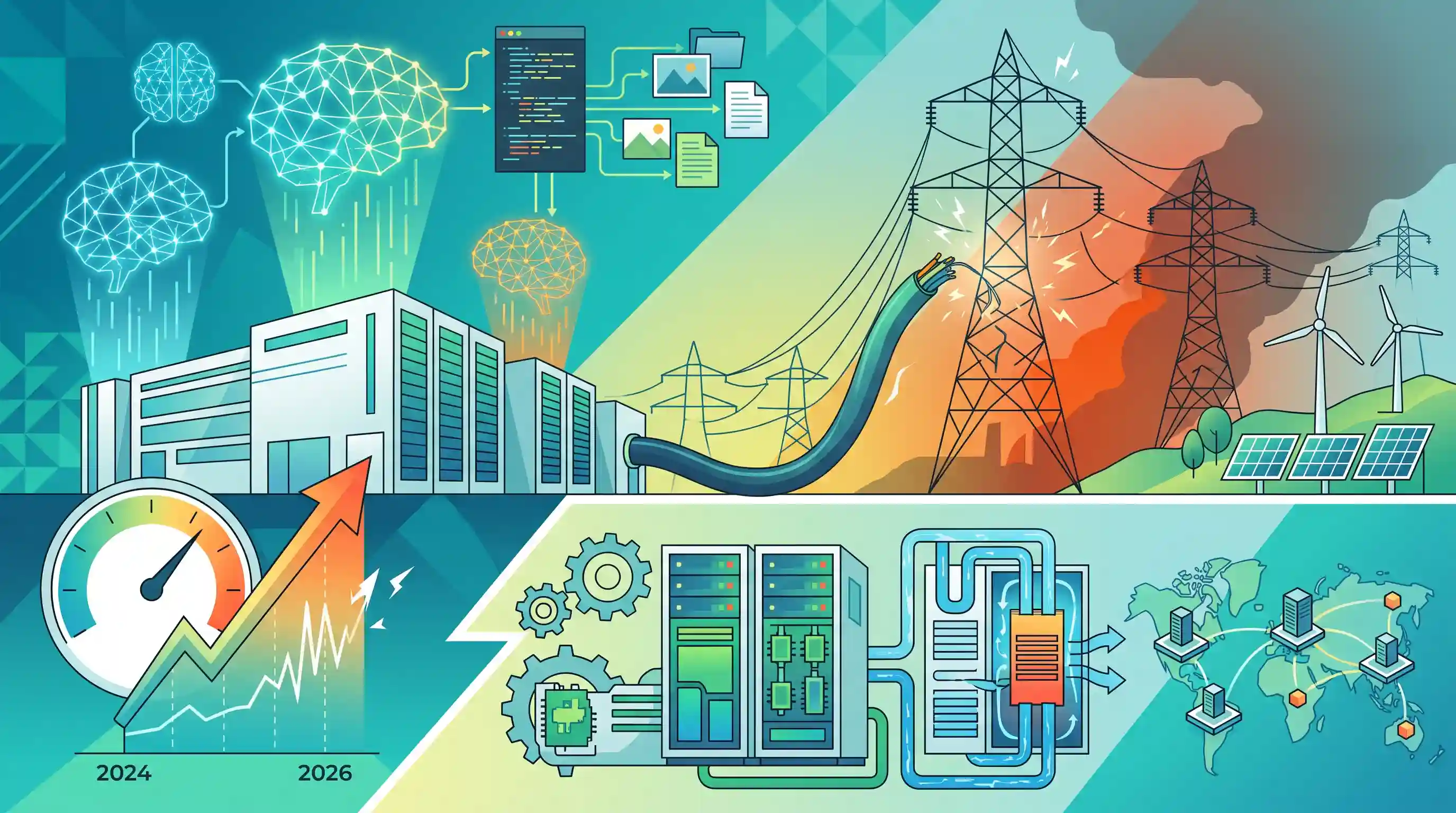
Global data centre electricity consumption is projected to surge by 26% to reach 565 terawatt-hours (TWh) in 2026, according to a forecast by Gartner. This dramatic increase is largely driven by the power-intensive requirements of generative AI and AI-optimised servers, which are expected to account for nearly a third of total data centre electricity usage. The power capacity demand is forecast to double to 290 gigawatts (GW) by 2030. Such unprecedented growth threatens to outpace the expansion of electrical grids, raising critical concerns over energy security and the environmental impact of digital infrastructure. To mitigate these challenges, there is an urgent need to adopt energy-efficient technologies, advanced cooling mechanisms, and edge computing architectures to reduce centralized processing loads.
Key Points
- Gartner forecasts global data centre electricity consumption will reach 565 terawatt-hours (TWh) in 2026, marking a 26% increase from 2025.
- The power demand to operate data centres will hit 132 gigawatts (GW) in 2026, driven primarily by generative AI and AI-optimised servers (projected to use 31% of data centre energy).
- Global data centre power demand could more than double to 290 GW by 2030, putting immense pressure on grid infrastructure.
- Due to the lack of scalable energy sources to match this rapid growth, data centre power demand may outstrip grid supply capabilities, raising energy security concerns.
- Solutions suggested include prioritising efficiency upgrades, securing reliable grid access, investing in advanced cooling systems, and adopting edge computing.
Important Terms
Data Centre

A centralized facility housing networked computers, storage systems, and computing infrastructure used for processing, managing, and distributing digital data.
UPSC context
GS3 (Infrastructure/Economy); critical for India's digital sovereignty, data localization mandates, and supporting the trillion-dollar digital economy.
Generative AI
AI capable of creating new content (text, images, code); its training and deployment are uniquely energy-intensive, requiring high-density, continuous computing power.
UPSC context
GS3 (Science & Tech); represents a paradigm shift in computing demand that impacts national energy planning and environmental sustainability.
Edge Computing
A distributed computing architecture that processes data near its source (at the network's 'edge') rather than in a distant, centralized cloud.
UPSC context
GS3 (Science & Tech); essential for reducing latency in 5G and IoT applications while mitigating centralized grid loads.
Energy Security
The uninterrupted availability of energy sources at an affordable price, crucial for maintaining digital infrastructure without disrupting domestic or industrial supply.
UPSC context
GS3 (Infrastructure/Energy); high data center demand risks grid stability and complicates the transition to renewable energy sources.
Liquid Cooling
Advanced thermal management using fluids (immersion or cold-plate) to dissipate heat from high-density AI servers more effectively than traditional air cooling.
UPSC context
GS3 (Science & Tech); a critical green technology for improving data center efficiency and achieving India's Net Zero targets.
Data Centre Policy 2020
The draft framework by MeitY that provides 'infrastructure status' to data centers, simplifying clearances and incentivizing the sector to attract global investment.
UPSC context
GS3 (Economy/Governance); aims to transform India into a global digital hub through regulatory ease and infrastructure development.
Gartner
A prominent global technological research and consulting firm whose market forecasts and 'Hype Cycles' often guide government and industrial policy planning.
UPSC context
GS3 (Economy); its data is frequently cited in NITI Aayog and MeitY reports to project digital infrastructure requirements.
Prelims Trap
The initial training phase of Large Language Models consumes the vast majority of AI's total lifecycle energy footprint.
False. While training is highly intensive, day-to-day "inference" (running models to answer user queries) consumes 80-90% of the total energy over an AI's lifecycle.
Static Concepts Connected
What is Edge Computing and how does it mitigate data centre loads?
- Decentralized Processing: Data is processed locally near the source (e.g., IoT sensors) rather than traveling back to a centralized cloud server.
- Low Latency: It significantly cuts transmission delays and bandwidth usage, which is crucial for real-time applications like autonomous vehicles.
- Grid Relief: By distributing processing requirements to the 'edge' of the network, it reduces the massive centralized power demand on mega data centres.
What are the key provisions of India's Draft Data Centre Policy 2020?
- Essential Service: Classifies data centres as an "Essential Service" under ESMA (1968) to legally ensure uninterrupted power supply and continuity.
- Infrastructure Status: Proposes granting official 'Infrastructure' status to the sector to enable access to long-term credit at lower interest rates.
- Renewable Integration: Encourages data centre parks to establish captive self-generation units relying heavily on solar and wind energy to offset grid reliance.
Cross-Topic Patterns
AI's Carbon Paradox and Net Zero
While AI is hailed for optimizing smart grids and aiding climate modeling, its own massive energy footprint (GenAI servers) creates a contradictory challenge for nations chasing Net Zero emissions targets.
The 5G, IoT, and Edge Computing triad
The rollout of 5G accelerates IoT deployment, making Edge computing increasingly mandatory to process data locally and avoid choking the bandwidth of centralized data centres.

Expect a Prelims statement comparing the energy intensity of AI 'inference' vs 'training', paired with Edge computing as a mitigation tool.
Linked PYQs · 4
Linked PYQs · 4
- 2023MainsGS3
Introduce the concept of Artificial Intelligence (AI). How does Al help clinical diagnosis? Do you perceive any threat to privacy of the individual in the use of Al in healthcare?
- 2023MainsGS3
What is the status of digitalization in the Indian economy? Examine the problems faced in this regard and suggest improvements.
- 2020PrelimsGS1
With the present state of development, Artificial Intelligence can effectively do which of the following? 1. Bring down electricity consumption in industrial units 2. Create meaningful short stories and songs 3. Disease diagnosis 4. Text-to-Speech Conversion 5. Wireless transmission of electrical energy Select the correct answer using the code given below:
- 2024PrelimsGS1
Consider the following: 1. Battery storage 2. Biomass generators 3. Fuel cells 4. Rooftop solar photovoltaic units How many of the above are considered "Distributed Energy Resources"?
