Data Breach at ICAR Disrupts Agricultural Research Projects
Source:Indian Express ↗
Why It Matters
Demonstrates the tangible consequences of cyber threats on critical sectors like agriculture and research administration. It provides a concrete case study for Mains GS3 questions on cybersecurity, vulnerability of digital infrastructure, and the necessity of robust data protection frameworks for government institutions.
Summary
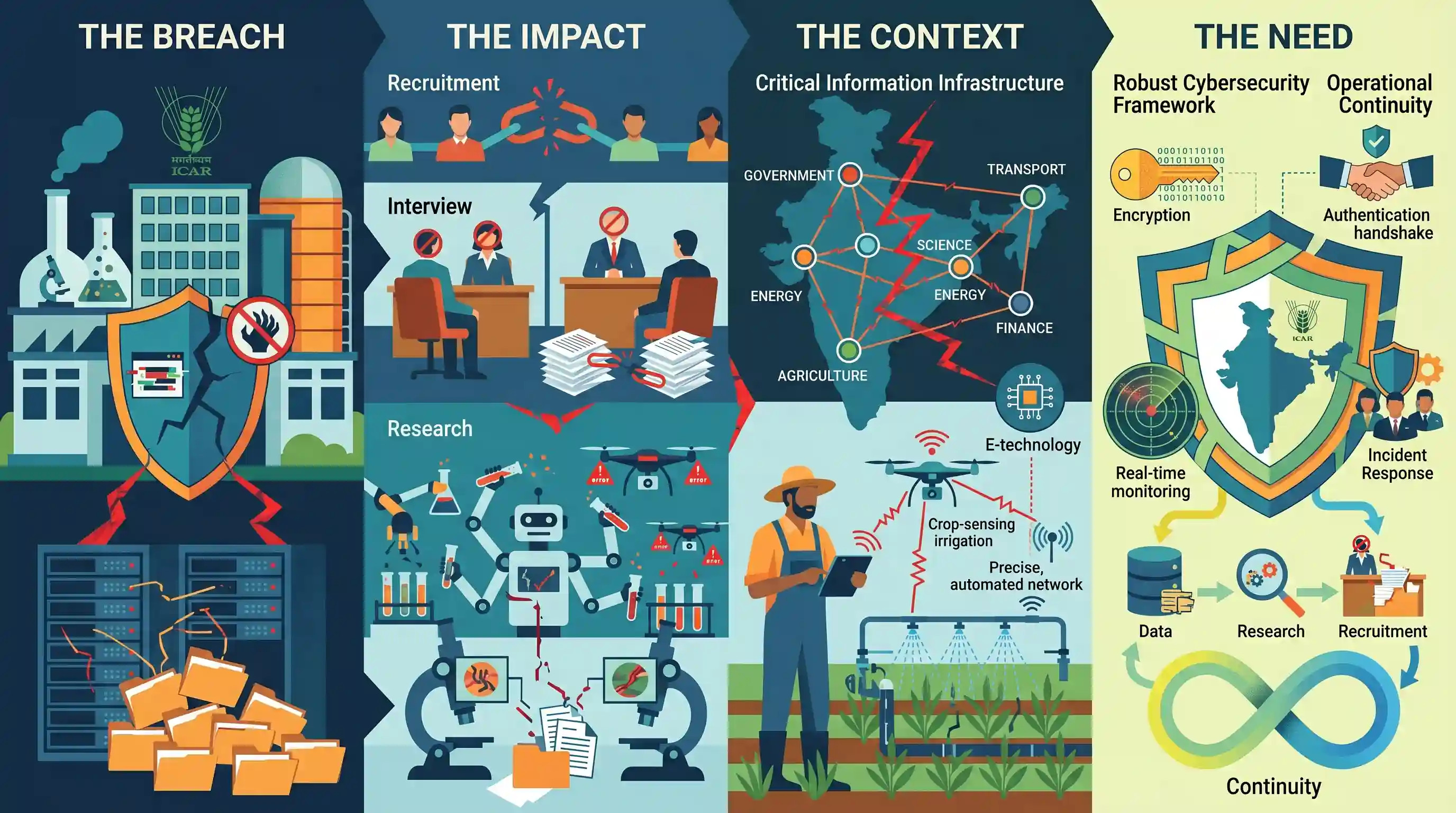
The Indian Council of Agricultural Research (ICAR) suffered a major data breach, which severely impacted its key recruitment processes and disrupted crucial agricultural research projects. This cyber incident highlights the growing vulnerabilities within the digital infrastructure of essential government and scientific organizations in India, stressing the need for robust cybersecurity frameworks to protect critical data and ensure operational continuity.
Key Points
- A significant cyberattack and data breach targeted the Indian Council of Agricultural Research (ICAR).
- The breach disrupted crucial ongoing agricultural research projects and compromised related data.
- Key recruitment processes managed by ICAR have been delayed or hindered due to the compromised systems.
- The incident underscores the vulnerability of vital Indian scientific and governmental institutions to cyber threats, necessitating stronger critical information infrastructure protection.
Important Terms
Indian Council of Agricultural Research (ICAR)

An autonomous apex body under the Ministry of Agriculture responsible for coordinating and managing agricultural research and education across India.
UPSC context
GS Paper 3: Agriculture and S&T; essential for food security and agritech research.
Critical Information Infrastructure (CII)
Computer resources whose destruction or incapacitation would have a debilitating impact on national security, economy, or public safety.
UPSC context
GS Paper 3: Internal Security; tests knowledge of protected digital assets under the IT Act.
CERT-In (Indian Computer Emergency Response Team)
India's national nodal agency for cyber incident response, operating under the Ministry of Electronics and Information Technology (MeitY).
UPSC context
GS Paper 3: Cyber Security; focus on emergency measures and threat reporting mandates.
National Critical Information Infrastructure Protection Centre (NCIIPC)
The nodal agency specifically mandated to protect the nation's Critical Information Infrastructure from unauthorized access or disruption.
UPSC context
GS Paper 3: Internal Security; tests specialized institutional frameworks for safeguarding sensitive sectors.
Information Technology Act, 2000
The primary legal framework in India governing electronic commerce, digital signatures, and penalties for cybercrimes and data breaches.
UPSC context
GS Paper 2 & 3: Polity and Security; tests legal foundations of India's digital ecosystem.
Agricultural Scientists Recruitment Board (ASRB)
An independent recruitment body within ICAR that selects scientists and technical personnel for the national agricultural research system.
UPSC context
GS Paper 2: Governance; relevant to institutional integrity and recruitment transparency in scientific bodies.
Prelims Trap
CERT-In is the designated national nodal agency for protecting Critical Information Infrastructure (CII) in India.
While CERT-In is the national nodal agency for responding to cyber incidents, protecting Critical Information Infrastructure (CII) is exclusively the mandate of NCIIPC under Section 70A of the IT Act.
Static Concepts Connected
What are the distinct mandates of CERT-In and NCIIPC under the IT Act, 2000?
- CERT-In: Functions under Sec 70B as the nodal agency for incident response, vulnerability forecasting, and issuing emergency cybersecurity guidelines.
- NCIIPC: Established under Sec 70A specifically to protect Critical Information Infrastructure (CII) from unauthorized access, modification, or destruction.
- CII Definition: Defined as computer resources whose incapacitation would have a debilitating impact on national security, economy, public health, or safety.
What is the organizational status and mandate of ICAR?
- Organizational Status: It is not a statutory body; it is an autonomous organization registered as a society under the Societies Registration Act, 1860.
- Nodal Ministry: Functions under the Department of Agricultural Research and Education (DARE), Ministry of Agriculture and Farmers Welfare.
- Key Mandate: Acts as the apex body for coordinating agricultural research, education, and managing the vast network of Krishi Vigyan Kendras (KVKs).
Cross-Topic Patterns
Cyber risks to e-agriculture initiatives
Agritech platforms (like e-NAM and AgriStack) digitize vast farmer datasets, making agriculture a vulnerable critical infrastructure sector that requires targeted cyber-resilience protocols to prevent economic disruptions.
Data breaches compromising agricultural IPR
Breaches at apex research bodies like ICAR risk the theft of critical genetic data, climate-resilient crop research, and patented seed technologies, bridging cyber threats with IPR and food security.

Expect a 2026 prelims question contrasting the statutory mandates of CERT-In and NCIIPC, potentially using Agristack as context.
Linked PYQs · 5
Linked PYQs · 5
- 2020MainsGS3
Discuss different types of cyber crimes and measures required to be taken to fight the menace.
- 2017MainsGS3
Discuss the potential threats of Cyber attack and the security framework to prevent it.
- 2021MainsGS3
Keeping in view India's internal security, analyse the impact of cross-border cyber attacks. Also discuss defensive measures against these sophisticated attacks.
- 2018PrelimsGS1
The terms 'WannaCry, Petya and EternalBlue' sometimes mentioned in the news recently are related to
- 2020PrelimsGS1
In India, under cyber insurance for individuals, which of the following benefits are generally covered, in addition to payment for the loss of funds and other benefits? 1. Cost of restoration of the computer system in case of malware disrupting access to one's computer 2. Cost of a new computer if some miscreant wilfully damages it, if proved so 3. Cost of hiring a specialized consultant to minimize the loss in case of cyber extortion 4. Cost of defence in the Court of Law if any third party files a suit Select the correct answer using the code given below:
