Maharashtra Special Public Security Bill and Civil Liberties
Source:The Hindu ↗
Why It Matters
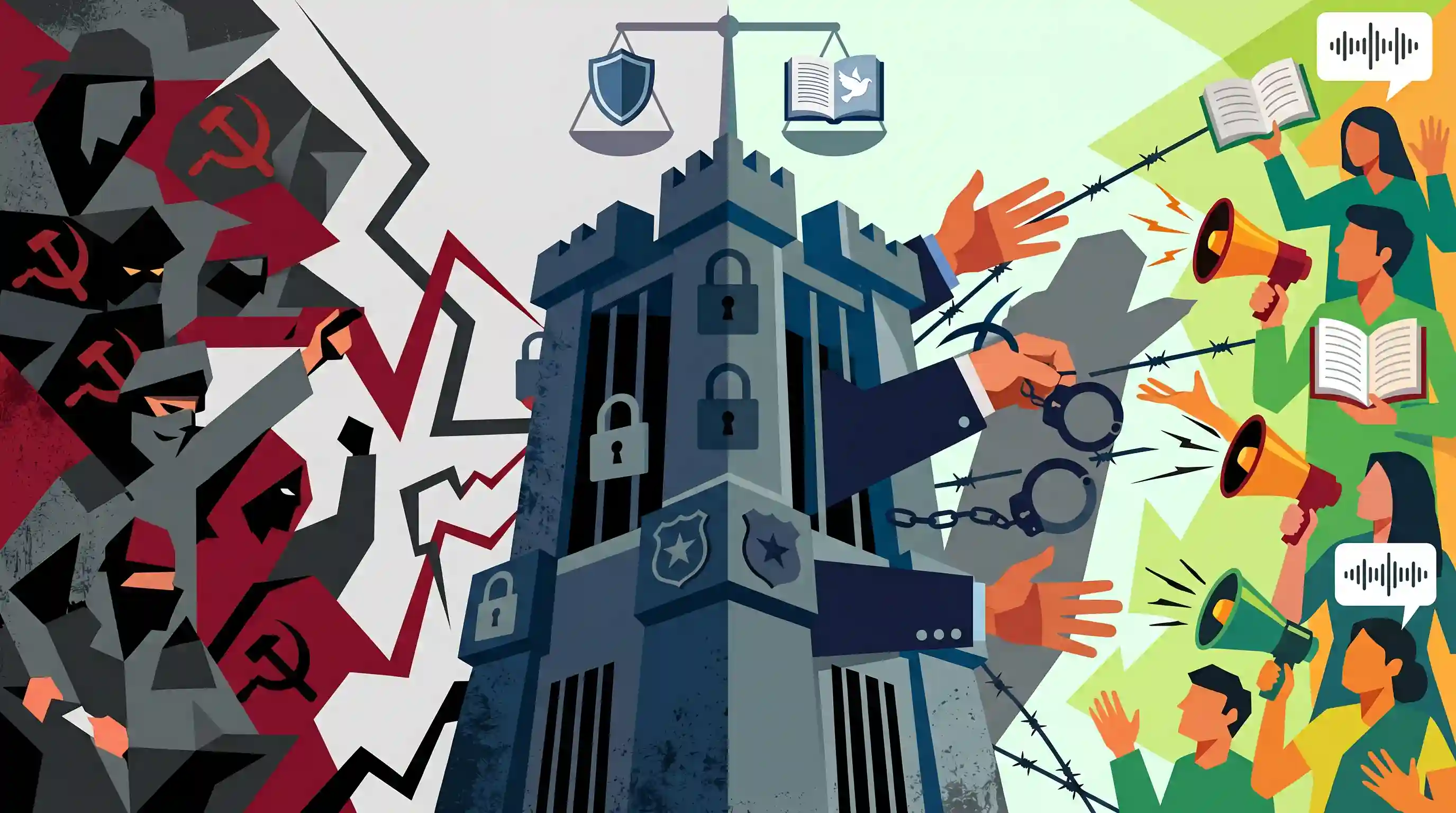
Highlights the recurring dilemma of balancing robust internal security measures (like combating Naxal front organizations) with the preservation of democratic civil liberties, fundamental rights (Article 19), and protection against executive overreach.
Summary
The Maharashtra Special Public Security Bill, 2024, introduced to combat the influence of Maoist front organisations, has sparked severe criticism for its potential threat to civil liberties. By criminalising thoughts, words, and representations through an overbroad definition of "unlawful activity," the legislation risks being weaponized against political opponents, civil rights activists, and dissenting voices. It grants the police sweeping powers to arrest without warrants and outlaws groups arbitrarily, carrying harsh penalties. The editorial underscores the need for a delicate balance between countering internal security threats like Left-Wing Extremism and upholding constitutional rights to freedom of speech and expression.
Key Points
- The Maharashtra Legislative Assembly has passed the Maharashtra Special Public Security (MSPS) Bill, 2024, aimed at curbing Maoist front organisations from indoctrinating youth and professionals.
- Critics argue the Bill's definition of "unlawful activity" is excessively broad, encompassing thoughts, spoken words, and written representations, posing a severe risk to freedom of expression.
- The legislation grants sweeping powers to law enforcement, allowing for arrests without a warrant and the arbitrary declaration of groups as "unlawful organisations".
- Penalties under the Bill are stringent, featuring imprisonment ranging from two to seven years and fines between ₹2 lakh and ₹5 lakh.
- While tackling internal security threats like Left-Wing Extremism is crucial, the editorial emphasizes that it must not come at the expense of civil liberties, drawing parallels with similar controversial laws in states like Chhattisgarh and Telangana.
Important Terms
Maharashtra Special Public Security Bill, 2024

Proposed state legislation aiming to curb Naxalism by empowering the government to ban organizations and penalize individuals for 'unlawful activities' through broad police powers and limited judicial oversight.
UPSC context
GS Paper II (Governance/Polity) & III (Internal Security). Tests understanding of state security laws versus fundamental rights.
Left-Wing Extremism (LWE)
An armed insurgency against the Indian state motivated by Maoist ideology; it seeks to overthrow the government through a 'Protracted People’s War' and is considered a major internal security threat.
UPSC context
GS Paper III (Internal Security). Core topic regarding challenges to domestic peace and developmental linkages to extremism.
Front Organisations
Sub-groups or NGOs linked to Maoist parties that operate legally to spread propaganda, recruit members, and provide legal or logistical support while maintaining a separate identity to avoid bans.
UPSC context
GS Paper III (Internal Security). Important for understanding how extremist groups maintain influence in non-conflict zones or urban areas.
Urban Naxalism
A controversial term referring to Maoist infiltration in urban centers to radicalize students and intellectuals; it is often cited as the primary target of the 2024 Maharashtra Bill.
UPSC context
GS Paper III (Internal Security). Tests ability to analyze evolving security narratives and their impact on democratic dissent.
Unlawful Activity
Under the Maharashtra Bill, this includes any action, speech, or representation that endangers public order, incites violence, or encourages disobedience to established law.
UPSC context
GS Paper II (Governance). Relates to the legal threshold for state intervention and potential overreach of executive power.
Civil Liberties
Fundamental rights like freedom of speech, association, and personal liberty (Articles 19 and 21) that critics argue are threatened by the Bill’s sweeping arrest and banning powers.
UPSC context
GS Paper II (Polity). Essential for discussing the constitutional 'reasonable restrictions' on fundamental rights in the interest of security.
Prelims Trap
Only the Union Government has the legislative competence to declare an organisation 'unlawful' or ban it under anti-terror and security laws.
States have the power to enact their own public security laws (e.g., under 'Public Order' in the State List) and can unilaterally proscribe organizations, independent of the UAPA.
Static Concepts Connected
What are the constitutional grounds for restricting the Freedom of Association?
- Constitutional Guarantee: Article 19(1)(c) guarantees all citizens the fundamental right to form associations, unions, or co-operative societies.
- Reasonable Restrictions: Under Article 19(4), the State can impose 'reasonable restrictions' solely in the interests of sovereignty and integrity of India, public order, or morality.
- Judicial Scrutiny: Laws granting arbitrary executive power to ban groups without a judicial tribunal often face strict constitutional scrutiny for violating the 'reasonableness' test.
How do 'Front Organisations' function in the Left-Wing Extremism (LWE) ecosystem?
- Legal Facade: They operate as over-ground, seemingly democratic NGOs or civil rights groups, shielding themselves from direct anti-terror or police action.
- Mass Mobilisation: They systematically recruit educated youth, professionals, and marginalized groups in urban centres to build ideological support for the Maoist cause.
- Logistical Support: They provide crucial legal aid, fundraising, intellectual defense, and safe houses to underground armed cadres.
Cross-Topic Patterns
Federalism and internal security laws
State security laws like MSPS or MCOCA parallel central acts like UAPA, raising Mains GS2 themes of federal overlap, Presidential assent (Article 254), and uniformity in India's internal security architecture.
Broad definitions and the chilling effect
The expansion of 'unlawful activity' to penalize written/spoken words mirrors debates on sedition and preventive detention, illustrating the 'Rule of Law vs Rule by Law' paradox.

GS3 Mains 2026 will likely feature a 15-marker balancing state measures against 'Urban Naxalism' with constitutional civil liberties.
Linked PYQs · 3
Linked PYQs · 3
- 2022MainsGS3
Naxalism is a social, economic and developmental issue manifesting as a violent internal security threat. In this context, discuss the emerging issues and suggest a multilayered strategy to tackle the menace of Naxalism.
- 2018MainsGS3
Left Wing Extremism (LWE) is showing a downward trend, but still affects many parts of the country. Briefly explain the Government of India's approach to counter the challenges posed by LWE.
- 2014MainsGS2
What do you understand by the concept "freedom of speech and expression"? Does it cover hate speech also ? Why do the films in India stand on a slightly different plane from other forms of expression ? Discuss.
