Manual Sewer Cleaning Deaths and Policy Failures in India
Source:The Hindu ↗
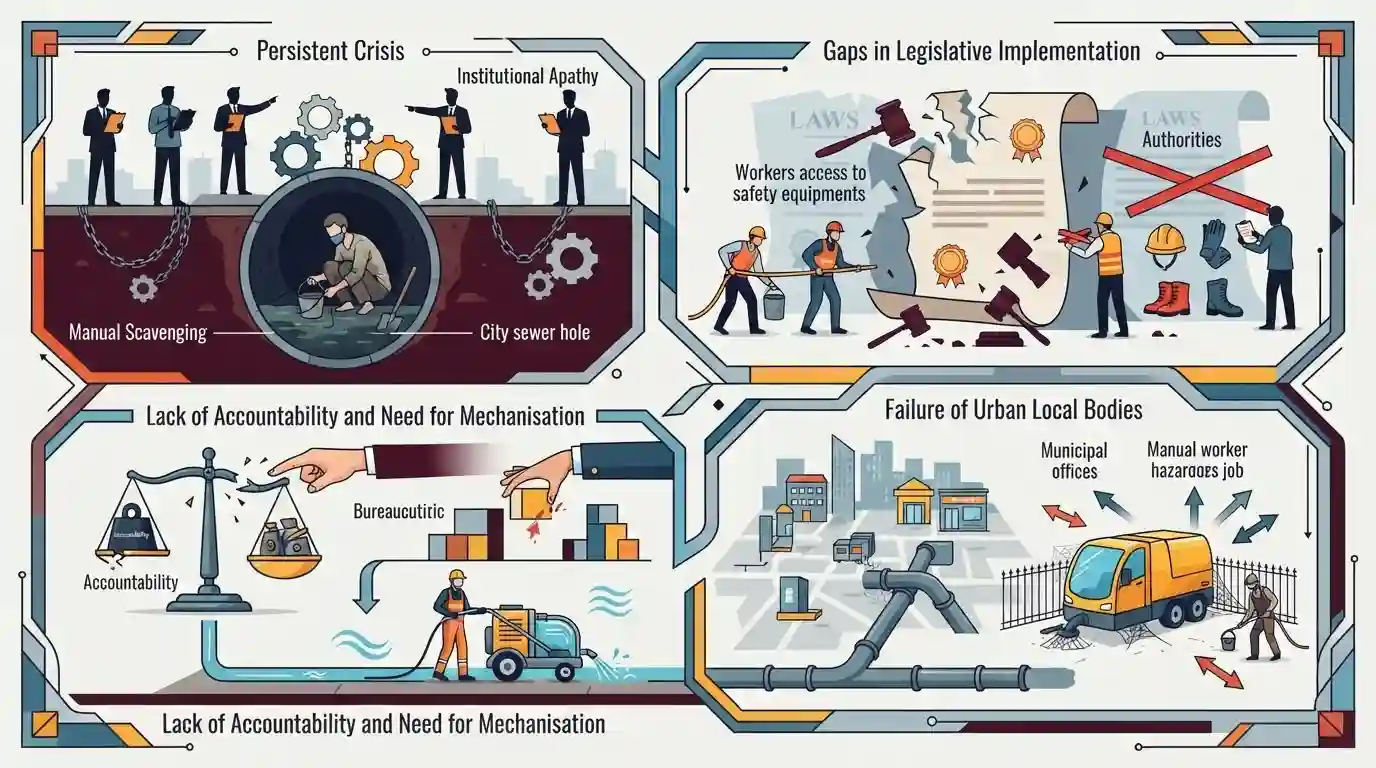
Why It Matters
This topic is critically relevant for GS Paper II under issues relating to vulnerable sections, statutory protections, and the efficacy of welfare and sanitation policies.
Summary
The article addresses the persistent crisis of sewer cleaning deaths in India, examining the gaps in legislative implementation, institutional apathy, and the failure of urban local bodies to eradicate hazardous manual scavenging through mechanisation and accountability.
Key Points
- Persistent deaths during manual sewer cleaning highlight severe systemic failure and non-compliance with statutory bans and safety protocols.
- Despite explicit legal prohibitions under the Prohibition of Employment as Manual Scavengers and their Rehabilitation Act, informal and hazardous sanitation work continues.
- Urban local bodies frequently outsource sanitation work to contractors, bypassing accountability and denying workers basic protective gear.
- Addressing this crisis requires stringent enforcement of laws, mandatory mechanisation of urban sanitation, and robust socio-economic rehabilitation for vulnerable communities.
Important Terms
Prohibition of Employment as Manual Scavengers and their Rehabilitation Act

A landmark 2013 Indian legislation that legally bans manual scavenging in all forms, prohibits hazardous manual sewer cleaning without safety gear, and mandates identification, rehabilitation, and financial compensation for affected individuals.
UPSC context
UPSC GS Paper II: Social Justice, Vulnerable Sections (Scheduled Castes/Safai Karamcharis), legislative safeguards, and welfare laws.
NAMASTE Scheme
A joint central sector scheme by the Ministry of Social Justice and Empowerment and MoHUA aimed at achieving zero fatalities in sanitation work by promoting mechanisation and capacity building.
UPSC context
UPSC GS Paper II: Government policies, welfare interventions for marginalized communities, and urban sanitation governance.
National Commission for Safai Karamcharis
A non-statutory body under the Ministry of Social Justice and Empowerment tasked with studying, evaluating, and recommending programs for the socio-economic rehabilitation and welfare of sanitation workers.
UPSC context
UPSC GS Paper II: Statutory/Constitutional bodies, institutional mechanisms for the protection of vulnerable sections.
Prelims Trap
The Prohibition of Employment as Manual Scavengers and their Rehabilitation Act, 2013 permits manual sewer cleaning under strict governmental supervision.
The 2013 Act does not merely regulate manual scavenging; it completely prohibits hazardous manual cleaning of sewers and septic tanks without protective gear and mandates total eradication of manual scavenging.
Static Concepts Connected
What are the key statutory provisions and constitutional mandates against manual scavenging in India?
- Constitutional Mandate: Constitutional Safeguards: Article 17 abolishes untouchability, while Articles 21 and 42 guarantee human dignity, life, and just and humane conditions of work.
- Statutory Ban: 2013 Act Provisions: The Prohibition of Employment as Manual Scavengers and their Rehabilitation Act, 2013 outlaws manual scavenging and prohibits hazardous cleaning of sewers and septic tanks without protective gear.
- Supreme Court Rulings: Judicial Directives: In Dr. Balram Singh vs Union of India (2023), the Supreme Court ordered complete mechanisation of sewer cleaning and mandated strict compensation for sewer deaths.
Cross-Topic Patterns
Urban Governance & Labour Exploitation
Urban local bodies outsourcing hazardous sanitation to contractors creates accountability gaps that intersect directly with labour rights violations and constitutional guarantees under Article 21.
Judicial Activism & Technology in Governance
The Supreme Court's mandate on sewer cleaning links Article 21 (Right to Life) with technological interventions like robotic scavengers and mechanised sanitation.

Expect a statement-based question combining the 2013 Act, NAMASTE scheme objectives, and Supreme Court rulings on sewer cleaning liability.
Linked PYQs · 2
Linked PYQs · 2
- 2019MainsGS2
Performance of welfare schemes that are implemented for vulnerable sections is not so effective due to absence of their awareness and active involvement at all stages of policy process. Discuss.
- 2017MainsGS2
To ensure effective implementation of policies addressing water, sanitation and hygiene needs the identification of the beneficiary segments is to be synchronized with the anticipated outcomes." Examine the statement in the context of the WASH scheme.
