Railways Approves Danapur Fatuha Multi Tracking Rail Project
Source:indian-infrastructure ↗
Why It Matters
Enhancing railway infrastructure in Bihar addresses vital logistical bottlenecks, facilitating smoother passenger transit and efficient freight movement. Questions about the East Central Railway and rail networks in Bihar have appeared in past BPSC exams.
Summary
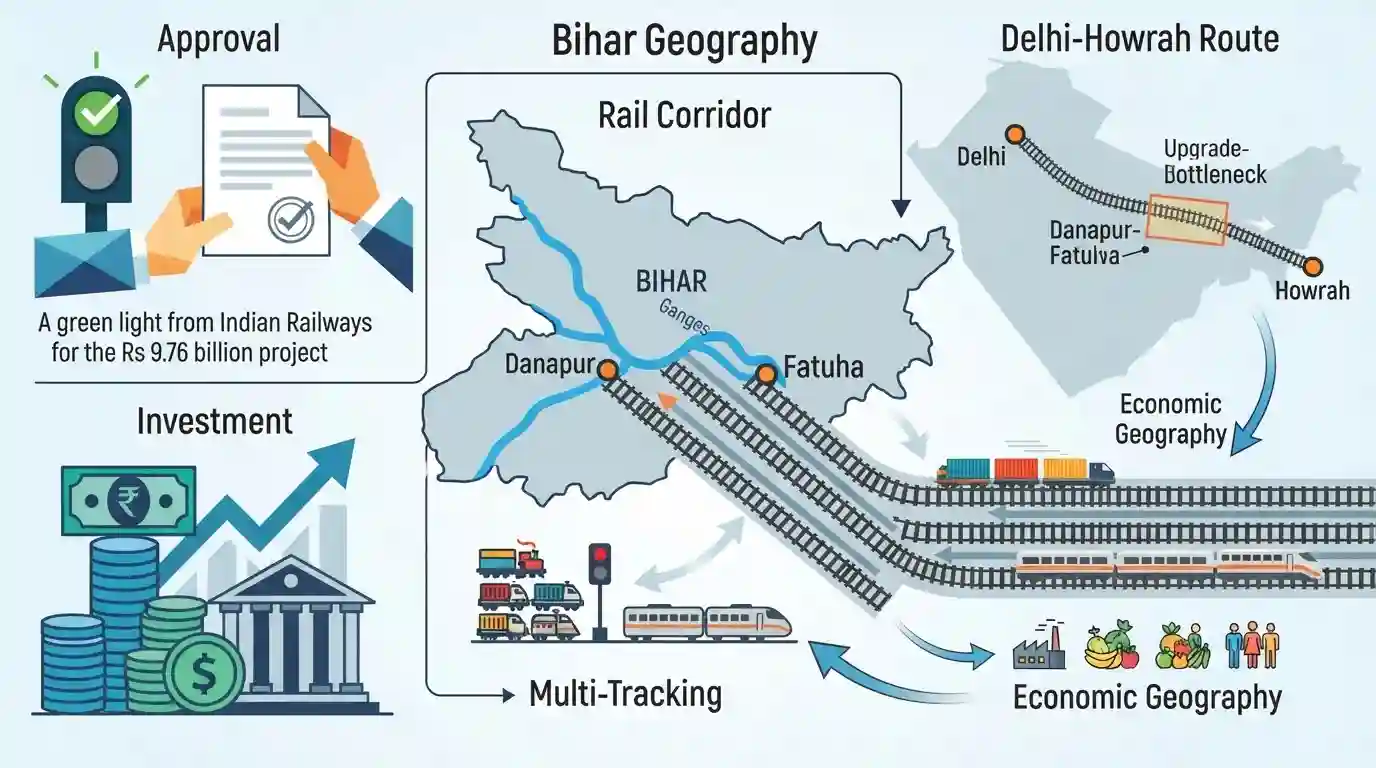
Indian Railways has given the green light to the Rs 9.76 billion Danapur-Fatuha Multi-Tracking Rail Section Project in Bihar, aiming to relieve congestion and boost freight and passenger capacity on the busy Delhi-Howrah route.
Key Points
- Indian Railways approved the Rs 9.76 billion Danapur-Fatuha Multi-Tracking Rail Section Project in Bihar on August 1, 2026.
- The project is under the jurisdiction of the East Central Railway (ECR) zone.
- It involves multitracking a 29 km stretch, including laying a 3rd and 4th line between Danapur-Patna and Patna Saheb-Fatuha, and a 3rd line between Rajendra Nagar-Patna Saheb.
- The project will augment capacity by accommodating 22 additional passenger trains and 18 additional freight trains daily.
- It is part of the quadrupling initiative on the Delhi-Howrah route under the Indian Railways' Energy, Mineral and Cement Corridor.
Prelims Trap
The Energy, Mineral, and Cement corridor is a dedicated freight track managed by the DFCCIL separate from Indian Railways.
It is one of three economic corridors executed by Indian Railways on its normal high-density network under PM Gati Shakti, not a separate Dedicated Freight Corridor.
Static Concepts Connected
What are the three Economic Railway Corridors under PM Gati Shakti?
- Energy, Mineral, Cement: Connects key extraction and manufacturing hubs to reduce transit times for bulk industrial inputs.
- Port Connectivity: Focuses on linking hinterland production centers directly to ports to boost export-import (EXIM) efficiency.
- High Traffic Density: Targets multi-tracking and technology upgrades along saturated high-density passenger and freight routes.
What is the High-Density Network (HDN) of Indian Railways?
- Traffic disproportion: Represents only about 16% of the total network but bears more than 40% of all traffic.
- Shared track bottleneck: Mixing slow freight and fast passenger trains on the same tracks limits freight speeds to under 30 kmph.
- Capacity remedies: Relies on 3rd/4th line multi-tracking and automatic signaling to expand capacity without complete route duplication.
Cross-Topic Patterns
Logistics efficiency vs GDP competitiveness
Multi-tracking under the Gati Shakti framework directly targets lowering India's logistics costs from ~13% of GDP to global benchmarks, boosting manufacturing export competitiveness.
Railway safety tech and track capacity
Physical line-doubling is coupled with Kavach 4.0 rollout to optimize train headways and safety, showcasing technology-driven capacity expansion.

GS-3 Mains 2026 may analyze how PM Gati Shakti's three rail corridors address high logistics costs and safety bottlenecks.
Linked PYQs · 3
Linked PYQs · 3
- 2011BPSC_PRELIMSGS1
The East Central Railway zone headquarters is located at:
- 2008BPSC_PRELIMSGS1
The railway zone headquarters Hajipur is located in:
- 2023BPSC_PRELIMSGS1
Which of the following is the last railway station of Bihar in the train route from Bhagalpur towards Mirza Cheuki?
