Dam Safety Expert Committee Inspection of Somasila Reservoir
Source:deccan-chronicle ↗
Why It Matters
Reservoirs like Somasila and Kandaleru play a vital role in AP's agricultural economy, drinking water supply (including Chennai's water supply via Telugu Ganga), and regional flood control. Evaluating their structural safety under standardized safety regimes is critical for avoiding infrastructural disasters and managing water resources sustainably.
Summary
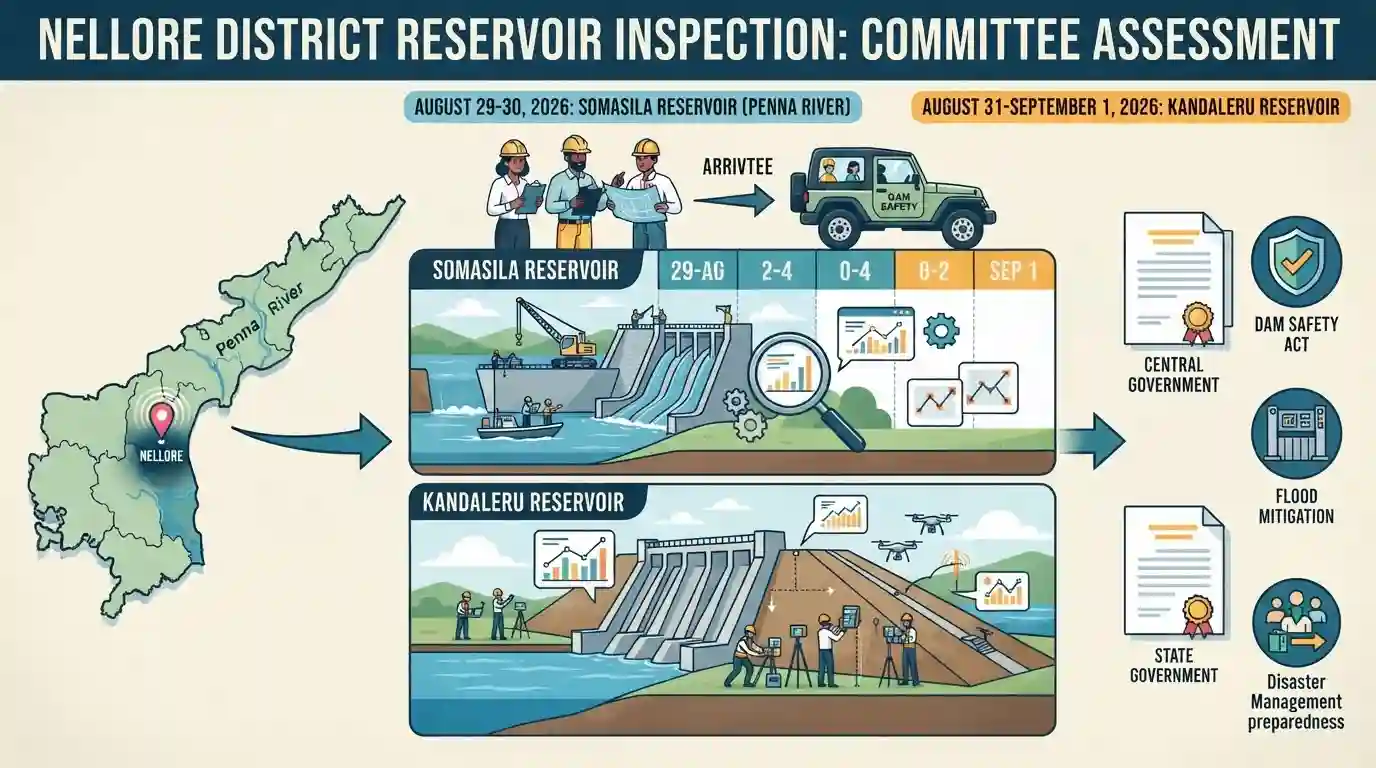
A committee of dam safety experts, chaired by Gopal Reddy, has arrived in Nellore district to inspect and assess the structural integrity of the Somasila and Kandaleru reservoirs. The Somasila Reservoir on the Penna River will be inspected on August 29-30, 2026, followed by the Kandaleru Reservoir on August 31 and September 1, 2026. The committee's evaluations will be presented in a report to the Central and State governments, highlighting the institutional focus on infrastructure safety, disaster mitigation, and compliance with national safety frameworks like the Dam Safety Act, 2021.
Key Points
- A specialized dam safety expert committee, led by Chairman Gopal Reddy and members Venkateswarlu and Srikanth, is conducting a comprehensive structural assessment of key reservoirs in Andhra Pradesh's Nellore district.
- The Somasila Reservoir, a major water storage structure built across the Penna River, is slated for evaluation on August 29 and 30, 2026.
- Following the Somasila inspection, the experts will assess the Kandaleru Reservoir (an earth dam built across the Kandaleru River) on August 31 and September 1, 2026.
- The findings and structural safety recommendations of the committee will be compiled into a report and submitted to both the Central and State governments.
- These inspections are crucial for ensuring the integrity of water-supply systems, flood mitigation, and compliance with national dam safety standards (Dam Safety Act, 2021).
Important Terms
Somasila Reservoir

A major reservoir constructed across the Penna River in Nellore, Andhra Pradesh, with a capacity of ~75 TMC, serving key irrigation and drinking water needs.
UPSC context
GS Paper-I (Geography of AP) & Paper-III (AP Economy); tests knowledge of key river basins and irrigation projects.
Kandaleru Reservoir
An earth dam balancing reservoir on the Kandaleru River in Nellore, AP, acting as a crucial conduit in the Telugu Ganga water supply scheme.
UPSC context
GS Paper-I (AP Geography) & Paper-III (Infrastructure); tests key reservoirs, inter-basin transfers, and inter-state agreements.
Telugu Ganga Project
An inter-state project built in the 1980s by Andhra Pradesh and Tamil Nadu to supply drinking water to Chennai and irrigate Rayalaseema.
UPSC context
GS Paper-I & Paper-III (AP Economy/Geography); tests inter-state water sharing, river linking, and drought-prone area development.
Dam Safety Act, 2021
A landmark central law establishing a uniform national regulatory framework for the surveillance, periodic inspection, and safe maintenance of specified large dams in India.
UPSC context
GS Paper-III (Disaster Management & Laws); tests safety frameworks, legislative relationships, and mitigation of infrastructure disasters.
Penna River
A major east-flowing river in southern India that rises in Karnataka, flows through the Rayalaseema region of Andhra Pradesh, and enters the Bay of Bengal.
UPSC context
GS Paper-I (Geography of India & AP); tests regional drainage systems, river basins, and physical geography.
Prelims Trap
The Penna River, which feeds the Somasila reservoir, originates in the Eastern Ghats of Andhra Pradesh.
APPSC frequently tests river origins. Penna does not originate in AP, but in Karnataka. Additionally, Kandaleru is a separate coastal river, not a direct tributary of the Penna.
Static Concepts Connected
What is the Telugu Ganga Project and its water-sharing framework?
- Project Objective: Supplies drinking water to Chennai and irrigates drought-prone areas of Rayalaseema and Nellore districts.
- Water Source: Taps Krishna River water from Srisailam reservoir, channeling it via canals to Somasila and Kandaleru.
- Inter-State Share: AP, Karnataka, and Maharashtra each contribute 5 TMC of Krishna water annually for Chennai's supply.
What is the institutional framework under the Dam Safety Act, 2021?
- Four-Tier Structure: Creates policy and regulatory bodies at both Central (NCDS, NDSA) and State (SCDS, SDSO) levels.
- Constitutional Basis: Enacted under Article 252, where states voluntarily passed resolutions enabling Parliament to legislate on State List subjects.
- Dam Criteria: Applies to specified dams over 15 meters in height, or 10-15 meters with specific technical conditions.
Cross-Topic Patterns
Federal water friction vs central regulation
The Dam Safety Act 2021 showcases federal friction where Union guidelines oversee state-controlled water resources (Entry 17), testing cooperative federalism under Article 252.
Rayalaseema drought vs Chennai drinking water
The Somasila-Kandaleru network links Rayalaseema’s agricultural survival to Chennai’s drinking water security, demonstrating inter-state economic reliance under the Telugu Ganga Project.

APPSC likely to link Somasila/Kandaleru with the Telugu Ganga Project, river origins, and the four-tier Dam Safety Act framework.
Linked PYQs · 2
Linked PYQs · 2
- 2019APPSC_PRELIMSGS1
Which one of the following pairs is not correctly matched ? Dam/Lake / River
- 2024APPSC_PRELIMSGS1
In Andhra Pradesh, Dharwar types of rocks are found in:
