Caste Discrimination and Temple Entry Issues in Barabanki
Source:The Hindu ↗
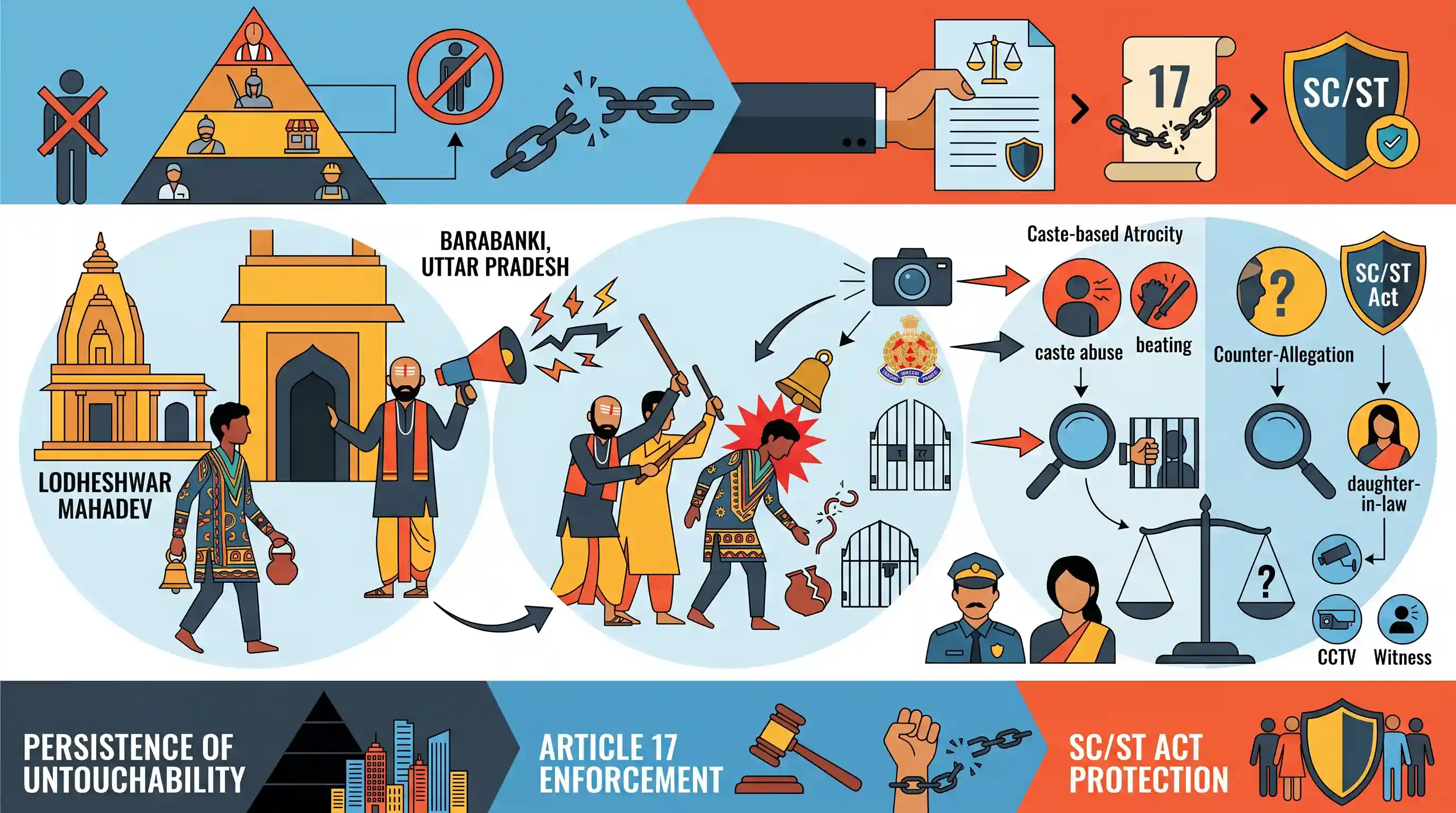
Why It Matters
The incident serves as a case study for the persistence of caste-based discrimination and untouchability (a core GS1 Social Issues topic and GS2 Constitutional Rights topic), despite protections under Article 17 and the SC/ST Act. It also touches on GS4 (Ethics) regarding social prejudices and truth in allegations, and GS1 (Culture) regarding the significance of regional temples.
Summary
A Dalit youth in Barabanki, Uttar Pradesh, has alleged that a priest at the historic Lodheshwar Mahadev temple prevented him from offering prayers, beat him, and used casteist slurs. In response, the priest accused the youth of molesting his daughter-in-law. The police are investigating both claims. This incident highlights the persistence of caste-based discrimination and untouchability in modern India, raising critical questions about the enforcement of Article 17 and the SC/ST (Prevention of Atrocities) Act, as well as the ethical dimensions of social prejudice and the filing of counter-allegations.
Key Points
- A Dalit youth in Uttar Pradesh's Barabanki district alleged he was prevented from praying at the Lodheshwar Mahadev temple.
- The youth claimed the temple priest subjected him to casteist slurs and physical assault.
- In a counter-claim, the priest alleged the youth molested his daughter-in-law.
- The Lodheshwar Mahadev temple is culturally significant, being described as one of the rarest of 52 Shivlings found on Shakti Pithas across India.
- The incident underscores the continuing challenge of caste-based discrimination (untouchability) despite constitutional and legal safeguards.
Important Terms
Article 17 of the Indian Constitution

A fundamental right that abolishes 'untouchability' and forbids its practice. It makes the enforcement of any disability arising out of it a punishable offense, ensuring social equality and human dignity.
UPSC context
GS II - Polity; essential for understanding Fundamental Rights and state-led social reforms.
Scheduled Castes and the Scheduled Tribes (Prevention of Atrocities) Act, 1989
A stringent law enacted to prevent crimes and indignities against Scheduled Castes and Tribes. It mandates special courts for speedy trials and provides for the relief and rehabilitation of victims.
UPSC context
GS II - Social Justice; tests knowledge of legal protections for vulnerable sections and institutional mechanisms.
Untouchability
A discriminatory social practice rooted in the caste system that ostracizes specific groups, restricting their access to temples, water sources, and public spaces based on perceived ritual impurity.
UPSC context
GS I - Indian Society; relates to the history of caste-based discrimination and social empowerment.
Protection of Civil Rights Act, 1955
Legislation enacted to provide penalties for practicing untouchability and enforcing disabilities. It serves as the primary statutory tool for enforcing the mandate of Article 17.
UPSC context
GS II - Polity/Social Justice; tests the evolution of laws protecting civil liberties in India.
Lodheshwar Mahadev Temple
An ancient Shiva temple in Barabanki, Uttar Pradesh, historically linked to the Pandavas. It is recognized for its unique lingam and its spiritual significance within the Shakti Pitha tradition.
UPSC context
GS I - Art and Culture; significant for regional temple history and cultural heritage.
Social Justice
The principle of creating a fair society by addressing historical inequalities, ensuring equitable resource distribution, and protecting the rights of marginalized communities through constitutional safeguards.
UPSC context
GS II/IV - Governance and Ethics; fundamental for welfare state analysis and ethical decision-making.
Prelims Trap
"Article 17 explicitly empowers the State to throw open Hindu religious institutions to all classes."
This is a trap. Article 17 abolishes untouchability generally. It is Article 25(2)(b) that specifically empowers the State to throw open Hindu public religious institutions to all classes.
Static Concepts Connected
Which Constitutional articles and laws secure temple entry rights for marginalized castes?
- Article 17: Abolishes untouchability in all forms; its enforcement is a punishable offence, making private and public discrimination actionable.
- Article 25(2)(b): Specifically empowers the State to make laws throwing open Hindu religious institutions of a public character to all classes of Hindus.
- PCR Act 1955: The Protection of Civil Rights Act explicitly penalises preventing any person from entering a place of public worship on untouchability grounds.
What is the cultural and mythological significance of Shakti Pithas?
- Mythological origin: These are revered shrines marking the locations where body parts or ornaments of Goddess Sati fell during Lord Shiva's cosmic dance (Tandava).
- Sectarian importance: They form the core pilgrimage circuit for Shaktism, a major Hindu denomination focusing on Goddess worship, with 51 or 52 traditionally recognized sites.
- Dual deities: Each Shakti Pitha traditionally houses a shrine for the Goddess (Shakti) alongside a corresponding manifestation of Lord Shiva (Bhairava).
Cross-Topic Patterns
Temple Entry & Historical Reform
Connects modern Article 17 enforcement directly to historical social justice struggles like the Vaikom (1924) and Guruvayur (1931) Satyagrahas, frequently tested in Modern History.
SC/ST Act & Counter-Litigation
Highlights GS2 governance challenges where enforcing the SC/ST Act is complicated by immediate counter-FIRs, a theme often scrutinized by the Supreme Court regarding anticipatory bail provisions.

Expect a tricky Prelims polity question distinguishing the specific scopes of Article 15(2), Article 17, and Article 25(2)(b) on public access.
Linked PYQs · 3
Linked PYQs · 3
- 2015MainsGS1
Debate the issue of whether and how contemporary movements for assertion of Dalit identity work towards annihilation of caste.
- 2024MainsGS1
Despite comprehensive policies for equity and social justice, underprivileged sections are not yet getting the full benefits of affirmative action envisaged by the Constitution. Comment.
- 2016PrelimsGS1
Satya Shodhak Samaj organized
